

450
S. Das et al.
For Metal oxides (MO)
λμ ≥ Band gap of
Semiconductors
h
+
e
-
O 2
O 2
.,
H 2 O 2
H 2 O (OH - )
OH
.
Organic
Pollutants
and bacteria
Less toxic
degradation
By-products
+ CO 2 + H 2 O
CB
VB
Reduction
Oxidation
e
-
h
+
MO-TiO 2 , ZnO
etc
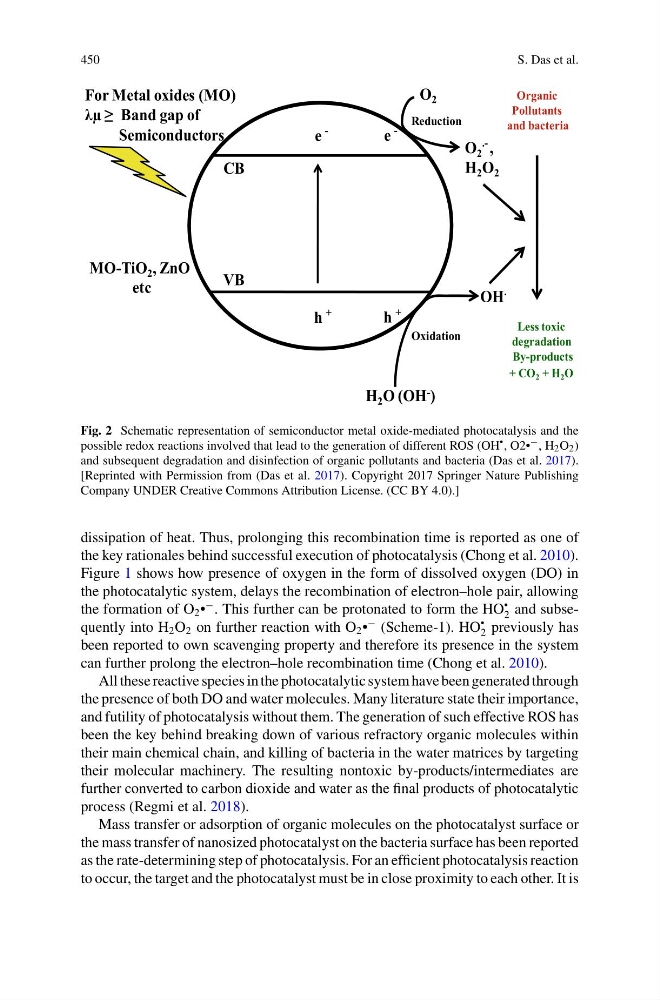
Fig. 2 Schematic representation of semiconductor metal oxide-mediated photocatalysis and the
possible redox reactions involved that lead to the generation of different ROS (OH • , O2• − , H 2 O 2 )
and subsequent degradation and disinfection of organic pollutants and bacteria (Das et al. 2017).
[Reprinted with Permission from (Das et al. 2017). Copyright 2017 Springer Nature Publishing
Company UNDER Creative Commons Attribution License. (CC BY 4.0).]
dissipation of heat. Thus, prolonging this recombination time is reported as one of
the key rationales behind successful execution of photocatalysis (Chong et al. 2010).
Figure 1 shows how presence of oxygen in the form of dissolved oxygen (DO) in
the photocatalytic system, delays the recombination of electron–hole pair, allowing
the formation of O 2 •
− . This further can be protonated to form the HO
•
2 and subsequently into H 2 O 2 on further reaction with O 2 •
− (Scheme-1). HO
•
2 previously has
been reported to own scavenging property and therefore its presence in the system
can further prolong the electron–hole recombination time (Chong et al. 2010).
All these reactive species in the photocatalytic system have been generated through
the presence of both DO and water molecules. Many literature state their importance,
and futility of photocatalysis without them. The generation of such effective ROS has
been the key behind breaking down of various refractory organic molecules within
their main chemical chain, and killing of bacteria in the water matrices by targeting
their molecular machinery. The resulting nontoxic by-products/intermediates are
further converted to carbon dioxide and water as the final products of photocatalytic
process (Regmi et al. 2018).
Mass transfer or adsorption of organic molecules on the photocatalyst surface or
the mass transfer of nanosized photocatalyst on the bacteria surface has been reported
as the rate-determining step of photocatalysis. For an efficient photocatalysis reaction
to occur, the target and the photocatalyst must be in close proximity to each other. It is
S. Das et al.
For Metal oxides (MO)
λμ ≥ Band gap of
Semiconductors
h
+
e
-
O 2
O 2
.,
H 2 O 2
H 2 O (OH - )
OH
.
Organic
Pollutants
and bacteria
Less toxic
degradation
By-products
+ CO 2 + H 2 O
CB
VB
Reduction
Oxidation
e
-
h
+
MO-TiO 2 , ZnO
etc
Fig. 2 Schematic representation of semiconductor metal oxide-mediated photocatalysis and the
possible redox reactions involved that lead to the generation of different ROS (OH • , O2• − , H 2 O 2 )
and subsequent degradation and disinfection of organic pollutants and bacteria (Das et al. 2017).
[Reprinted with Permission from (Das et al. 2017). Copyright 2017 Springer Nature Publishing
Company UNDER Creative Commons Attribution License. (CC BY 4.0).]
dissipation of heat. Thus, prolonging this recombination time is reported as one of
the key rationales behind successful execution of photocatalysis (Chong et al. 2010).
Figure 1 shows how presence of oxygen in the form of dissolved oxygen (DO) in
the photocatalytic system, delays the recombination of electron–hole pair, allowing
the formation of O 2 •
− . This further can be protonated to form the HO
•
2 and subsequently into H 2 O 2 on further reaction with O 2 •
− (Scheme-1). HO
•
2 previously has
been reported to own scavenging property and therefore its presence in the system
can further prolong the electron–hole recombination time (Chong et al. 2010).
All these reactive species in the photocatalytic system have been generated through
the presence of both DO and water molecules. Many literature state their importance,
and futility of photocatalysis without them. The generation of such effective ROS has
been the key behind breaking down of various refractory organic molecules within
their main chemical chain, and killing of bacteria in the water matrices by targeting
their molecular machinery. The resulting nontoxic by-products/intermediates are
further converted to carbon dioxide and water as the final products of photocatalytic
process (Regmi et al. 2018).
Mass transfer or adsorption of organic molecules on the photocatalyst surface or
the mass transfer of nanosized photocatalyst on the bacteria surface has been reported
as the rate-determining step of photocatalysis. For an efficient photocatalysis reaction
to occur, the target and the photocatalyst must be in close proximity to each other. It is