

Designing Novel Photocatalysts for Disinfection of Multidrug-Resistant …
449
2010). Moreover, understanding the technical rationale behind the common reactor geometry, design, kinetics, and operational parameters is necessary for process
optimization.
1.4.1 Mechanism of Heterogenous Photocatalysis
Mechanism of heterogenous photocatalysis depends on the chemistry of photophysics and photochemistry employing metal oxide semiconductors as catalytic
agents which has been long reported in literature (Matsunaga et al. 1985). Semiconductors like TiO 2 and ZnO are generally used as photocatalysts owing to their
potential to induce reduction and oxidation-based reactions on their surface, which is
exclusively due to the discrete lone electron property in its outermost orbital. When
photonic energy, i.e., λμ of greater than or equal to the bandgap energy of metal oxide
semiconductor is illumined onto its surface, the lone electron (e
− ) from the valence
band (VB) of semiconductor will be photoexcited to the empty conduction band (CB)
within femtoseconds leaving behind hole (h
+ ) in the VB of the semiconductor. This
e
− /h
+ pair (charge carriers) gets transferred to the photocatalyst surface and participates in the reduction and oxidation reactions. High amount of ROS is produced in
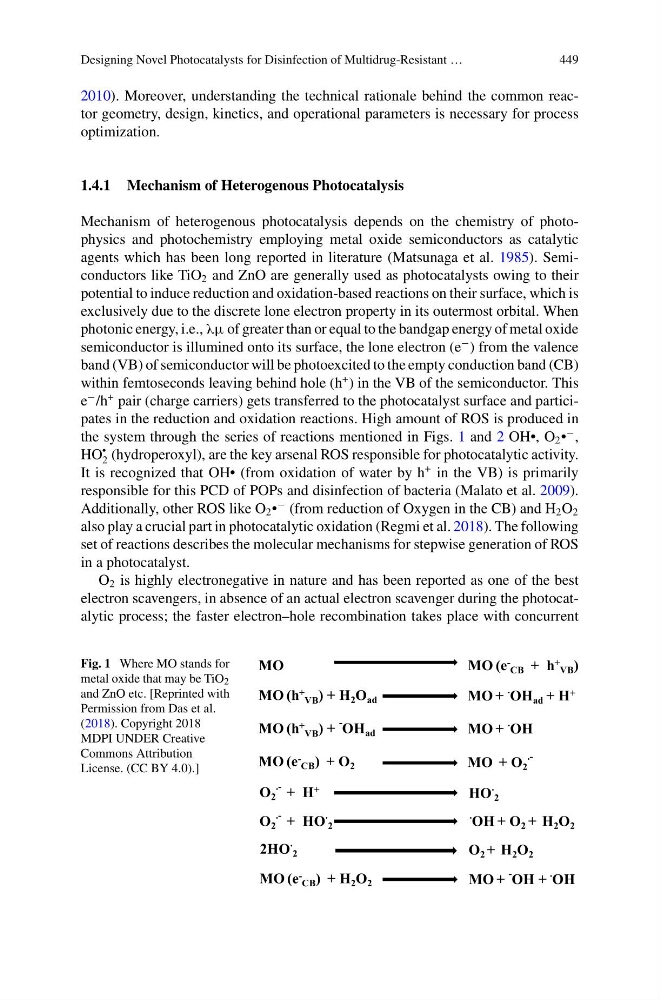
the system through the series of reactions mentioned in Figs. 1 and 2 OH•, O 2 •
− ,
HO
•
2 (hydroperoxyl), are the key arsenal ROS responsible for photocatalytic activity.
It is recognized that OH• (from oxidation of water by h
+ in the VB) is primarily
responsible for this PCD of POPs and disinfection of bacteria (Malato et al. 2009).
Additionally, other ROS like O 2 •
− (from reduction of Oxygen in the CB) and H 2 O 2
also play a crucial part in photocatalytic oxidation (Regmi et al. 2018). The following
set of reactions describes the molecular mechanisms for stepwise generation of ROS
in a photocatalyst.
O 2 is highly electronegative in nature and has been reported as one of the best
electron scavengers, in absence of an actual electron scavenger during the photocatalytic process; the faster electron–hole recombination takes place with concurrent
Fig. 1 Where MO stands for
metal oxide that may be TiO 2
and ZnO etc. [Reprinted with
Permission from Das et al.
(2018). Copyright 2018
MDPI UNDER Creative
Commons Attribution
License. (CC BY 4.0).]
449
2010). Moreover, understanding the technical rationale behind the common reactor geometry, design, kinetics, and operational parameters is necessary for process
optimization.
1.4.1 Mechanism of Heterogenous Photocatalysis
Mechanism of heterogenous photocatalysis depends on the chemistry of photophysics and photochemistry employing metal oxide semiconductors as catalytic
agents which has been long reported in literature (Matsunaga et al. 1985). Semiconductors like TiO 2 and ZnO are generally used as photocatalysts owing to their
potential to induce reduction and oxidation-based reactions on their surface, which is
exclusively due to the discrete lone electron property in its outermost orbital. When
photonic energy, i.e., λμ of greater than or equal to the bandgap energy of metal oxide
semiconductor is illumined onto its surface, the lone electron (e
− ) from the valence
band (VB) of semiconductor will be photoexcited to the empty conduction band (CB)
within femtoseconds leaving behind hole (h
+ ) in the VB of the semiconductor. This
e
− /h
+ pair (charge carriers) gets transferred to the photocatalyst surface and participates in the reduction and oxidation reactions. High amount of ROS is produced in
the system through the series of reactions mentioned in Figs. 1 and 2 OH•, O 2 •
− ,
HO
•
2 (hydroperoxyl), are the key arsenal ROS responsible for photocatalytic activity.
It is recognized that OH• (from oxidation of water by h
+ in the VB) is primarily
responsible for this PCD of POPs and disinfection of bacteria (Malato et al. 2009).
Additionally, other ROS like O 2 •
− (from reduction of Oxygen in the CB) and H 2 O 2
also play a crucial part in photocatalytic oxidation (Regmi et al. 2018). The following
set of reactions describes the molecular mechanisms for stepwise generation of ROS
in a photocatalyst.
O 2 is highly electronegative in nature and has been reported as one of the best
electron scavengers, in absence of an actual electron scavenger during the photocatalytic process; the faster electron–hole recombination takes place with concurrent
Fig. 1 Where MO stands for
metal oxide that may be TiO 2
and ZnO etc. [Reprinted with
Permission from Das et al.
(2018). Copyright 2018
MDPI UNDER Creative
Commons Attribution
License. (CC BY 4.0).]