

Designing Novel Photocatalysts for Disinfection of Multidrug-Resistant …
451
mainly because the ROS generating on the photocatalyst surface lose their affectivity
on diffusing away from the catalyst surface. Similarly, desorption of the degraded
molecules from the catalyst surface are also rate determining if the concentration
of the organics in the system is high, and the photocatalytic reaction has to run for
longer intervals for complete degradation of organic targets (Chong et al. 2010).
In case of microorganisms, their surface interaction with the photocatalyst (TiO 2
and ZnO) in PCD is crucial for enhancing the rate of inactivation. When the ROS
generated during photocatalysis comes in close proximity with the microorganisms,
bacterial membrane will be the primary target for ROS attack (Maness et al. 1999).
ROS could break open even the strongest of covalent bonds (C–C, C–H, C–N, C–O,
and H–O) present in biomolecules such as lipids, carbohydrates, nucleic acid, and
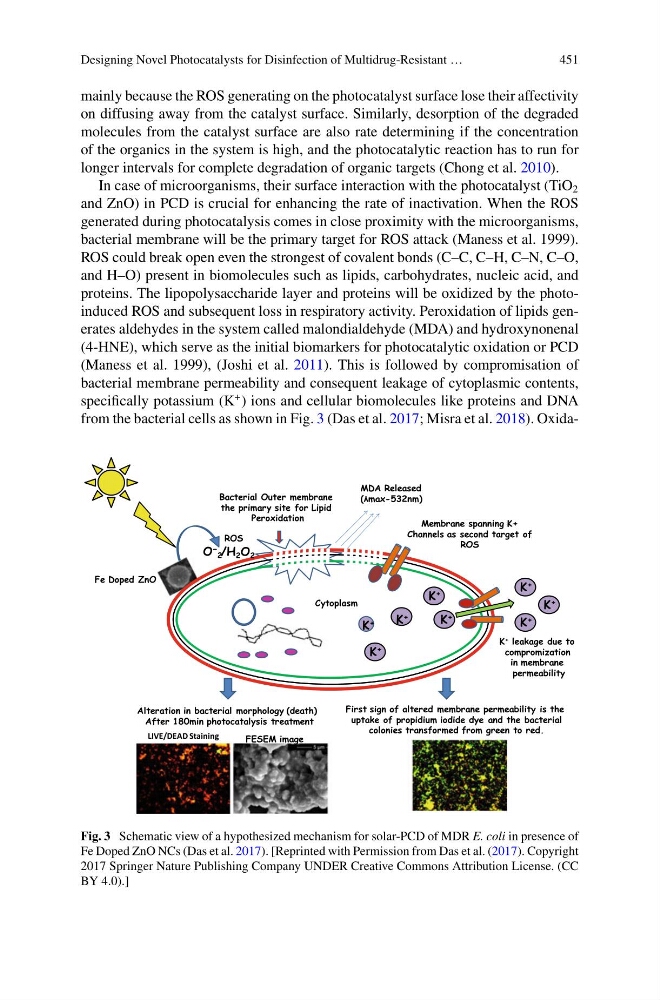
proteins. The lipopolysaccharide layer and proteins will be oxidized by the photoinduced ROS and subsequent loss in respiratory activity. Peroxidation of lipids generates aldehydes in the system called malondialdehyde (MDA) and hydroxynonenal
(4-HNE), which serve as the initial biomarkers for photocatalytic oxidation or PCD
(Maness et al. 1999), (Joshi et al. 2011). This is followed by compromisation of
bacterial membrane permeability and consequent leakage of cytoplasmic contents,
specifically potassium (K
+ ) ions and cellular biomolecules like proteins and DNA
from the bacterial cells as shown in Fig. 3 (Das et al. 2017; Misra et al. 2018). OxidaFig. 3 Schematic view of a hypothesized mechanism for solar-PCD of MDR E. coli in presence of
Fe Doped ZnO NCs (Das et al. 2017). [Reprinted with Permission from Das et al. (2017). Copyright
2017 Springer Nature Publishing Company UNDER Creative Commons Attribution License. (CC
BY 4.0).]
451
mainly because the ROS generating on the photocatalyst surface lose their affectivity
on diffusing away from the catalyst surface. Similarly, desorption of the degraded
molecules from the catalyst surface are also rate determining if the concentration
of the organics in the system is high, and the photocatalytic reaction has to run for
longer intervals for complete degradation of organic targets (Chong et al. 2010).
In case of microorganisms, their surface interaction with the photocatalyst (TiO 2
and ZnO) in PCD is crucial for enhancing the rate of inactivation. When the ROS
generated during photocatalysis comes in close proximity with the microorganisms,
bacterial membrane will be the primary target for ROS attack (Maness et al. 1999).
ROS could break open even the strongest of covalent bonds (C–C, C–H, C–N, C–O,
and H–O) present in biomolecules such as lipids, carbohydrates, nucleic acid, and
proteins. The lipopolysaccharide layer and proteins will be oxidized by the photoinduced ROS and subsequent loss in respiratory activity. Peroxidation of lipids generates aldehydes in the system called malondialdehyde (MDA) and hydroxynonenal
(4-HNE), which serve as the initial biomarkers for photocatalytic oxidation or PCD
(Maness et al. 1999), (Joshi et al. 2011). This is followed by compromisation of
bacterial membrane permeability and consequent leakage of cytoplasmic contents,
specifically potassium (K
+ ) ions and cellular biomolecules like proteins and DNA
from the bacterial cells as shown in Fig. 3 (Das et al. 2017; Misra et al. 2018). OxidaFig. 3 Schematic view of a hypothesized mechanism for solar-PCD of MDR E. coli in presence of
Fe Doped ZnO NCs (Das et al. 2017). [Reprinted with Permission from Das et al. (2017). Copyright
2017 Springer Nature Publishing Company UNDER Creative Commons Attribution License. (CC
BY 4.0).]