

Optimization of MAPbI 3 Film Using Response …
399
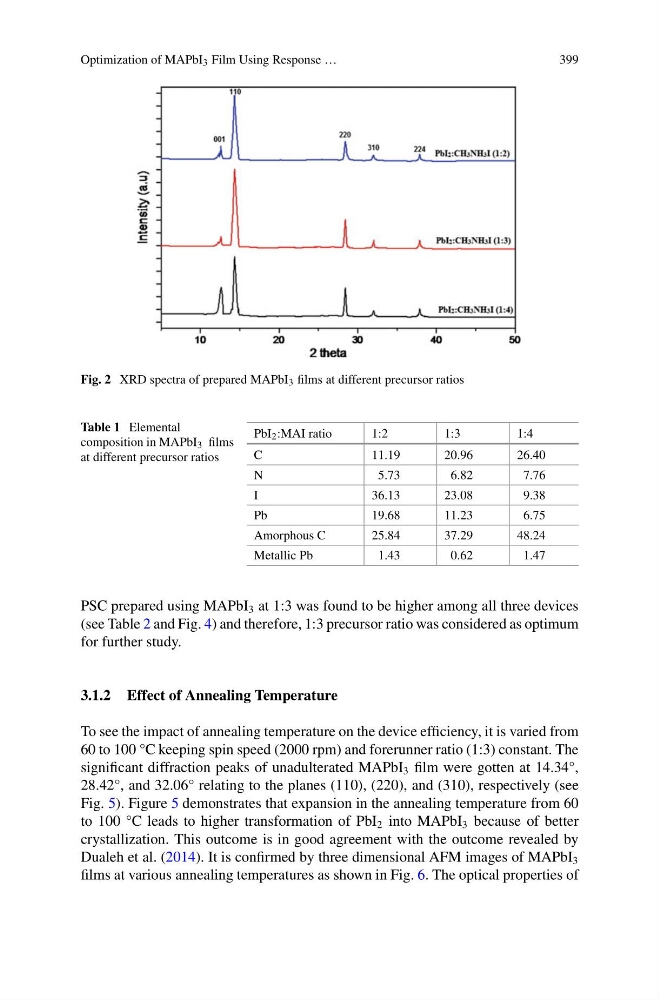
Fig. 2 XRD spectra of prepared MAPbI 3 films at different precursor ratios
Table 1 Elemental
composition in MAPbI 3 films
at different precursor ratios
PbI 2 :MAI ratio
1:2
1:3
1:4
C
11.19
20.96
26.40
N
5.73
6.82
7.76
I
36.13
23.08
9.38
Pb
19.68
11.23
6.75
Amorphous C
25.84
37.29
48.24
Metallic Pb
1.43
0.62
1.47
PSC prepared using MAPbI 3 at 1:3 was found to be higher among all three devices
(see Table 2 and Fig. 4) and therefore, 1:3 precursor ratio was considered as optimum
for further study.
3.1.2 Effect of Annealing Temperature
To see the impact of annealing temperature on the device efficiency, it is varied from
60 to 100 °C keeping spin speed (2000 rpm) and forerunner ratio (1:3) constant. The
significant diffraction peaks of unadulterated MAPbI 3 film were gotten at 14.34°,
28.42°, and 32.06° relating to the planes (110), (220), and (310), respectively (see
Fig. 5). Figure 5 demonstrates that expansion in the annealing temperature from 60
to 100 °C leads to higher transformation of PbI 2 into MAPbI 3 because of better
crystallization. This outcome is in good agreement with the outcome revealed by
Dualeh et al. (2014). It is confirmed by three dimensional AFM images of MAPbI 3
films at various annealing temperatures as shown in Fig. 6. The optical properties of
399
Fig. 2 XRD spectra of prepared MAPbI 3 films at different precursor ratios
Table 1 Elemental
composition in MAPbI 3 films
at different precursor ratios
PbI 2 :MAI ratio
1:2
1:3
1:4
C
11.19
20.96
26.40
N
5.73
6.82
7.76
I
36.13
23.08
9.38
Pb
19.68
11.23
6.75
Amorphous C
25.84
37.29
48.24
Metallic Pb
1.43
0.62
1.47
PSC prepared using MAPbI 3 at 1:3 was found to be higher among all three devices
(see Table 2 and Fig. 4) and therefore, 1:3 precursor ratio was considered as optimum
for further study.
3.1.2 Effect of Annealing Temperature
To see the impact of annealing temperature on the device efficiency, it is varied from
60 to 100 °C keeping spin speed (2000 rpm) and forerunner ratio (1:3) constant. The
significant diffraction peaks of unadulterated MAPbI 3 film were gotten at 14.34°,
28.42°, and 32.06° relating to the planes (110), (220), and (310), respectively (see
Fig. 5). Figure 5 demonstrates that expansion in the annealing temperature from 60
to 100 °C leads to higher transformation of PbI 2 into MAPbI 3 because of better
crystallization. This outcome is in good agreement with the outcome revealed by
Dualeh et al. (2014). It is confirmed by three dimensional AFM images of MAPbI 3
films at various annealing temperatures as shown in Fig. 6. The optical properties of