

400
N. Kumari et al.
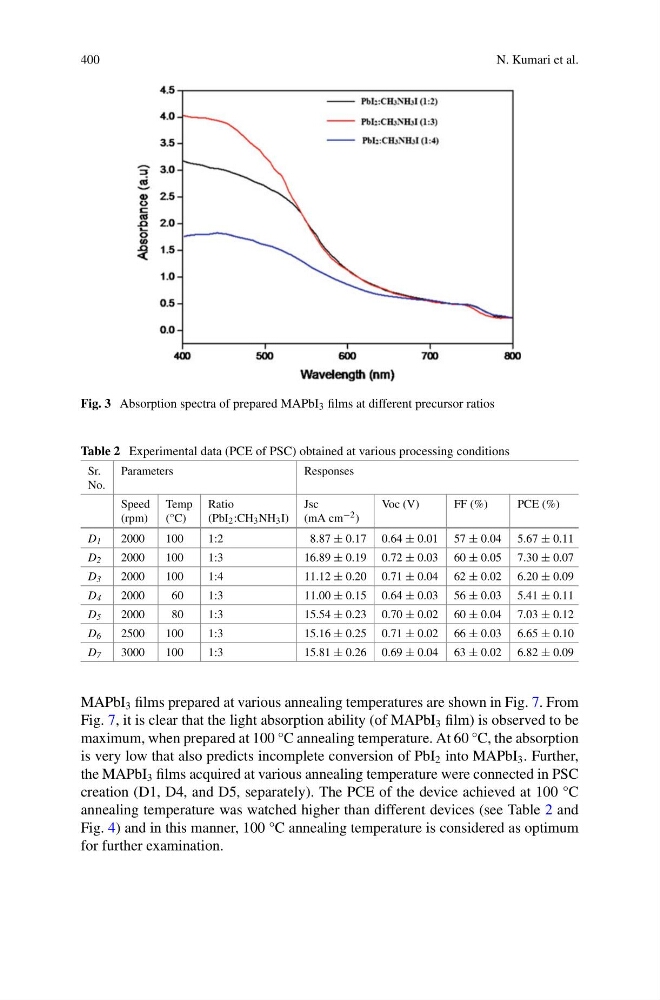
Fig. 3 Absorption spectra of prepared MAPbI 3 films at different precursor ratios
Table 2 Experimental data (PCE of PSC) obtained at various processing conditions
Sr.
No.
Parameters
Responses
Speed
(rpm)
Temp
(°C)
Ratio
(PbI 2 :CH 3 NH 3 I)
Jsc
(mA cm −2 )
Voc (V)
FF (%)
PCE (%)
D 1
2000
100
1:2
8.87 ± 0.17 0.64 ± 0.01 57 ± 0.04 5.67 ± 0.11
D 2
2000
100
1:3
16.89 ± 0.19 0.72 ± 0.03 60 ± 0.05 7.30 ± 0.07
D 3
2000
100
1:4
11.12 ± 0.20 0.71 ± 0.04 62 ± 0.02 6.20 ± 0.09
D 4
2000
60
1:3
11.00 ± 0.15 0.64 ± 0.03 56 ± 0.03 5.41 ± 0.11
D 5
2000
80
1:3
15.54 ± 0.23 0.70 ± 0.02 60 ± 0.04 7.03 ± 0.12
D 6
2500
100
1:3
15.16 ± 0.25 0.71 ± 0.02 66 ± 0.03 6.65 ± 0.10
D 7
3000
100
1:3
15.81 ± 0.26 0.69 ± 0.04 63 ± 0.02 6.82 ± 0.09
MAPbI 3 films prepared at various annealing temperatures are shown in Fig. 7. From
Fig. 7, it is clear that the light absorption ability (of MAPbI 3 film) is observed to be
maximum, when prepared at 100 °C annealing temperature. At 60 °C, the absorption
is very low that also predicts incomplete conversion of PbI 2 into MAPbI 3 . Further,
the MAPbI 3 films acquired at various annealing temperature were connected in PSC
creation (D1, D4, and D5, separately). The PCE of the device achieved at 100 °C
annealing temperature was watched higher than different devices (see Table 2 and
Fig. 4) and in this manner, 100 °C annealing temperature is considered as optimum
for further examination.
N. Kumari et al.
Fig. 3 Absorption spectra of prepared MAPbI 3 films at different precursor ratios
Table 2 Experimental data (PCE of PSC) obtained at various processing conditions
Sr.
No.
Parameters
Responses
Speed
(rpm)
Temp
(°C)
Ratio
(PbI 2 :CH 3 NH 3 I)
Jsc
(mA cm −2 )
Voc (V)
FF (%)
PCE (%)
D 1
2000
100
1:2
8.87 ± 0.17 0.64 ± 0.01 57 ± 0.04 5.67 ± 0.11
D 2
2000
100
1:3
16.89 ± 0.19 0.72 ± 0.03 60 ± 0.05 7.30 ± 0.07
D 3
2000
100
1:4
11.12 ± 0.20 0.71 ± 0.04 62 ± 0.02 6.20 ± 0.09
D 4
2000
60
1:3
11.00 ± 0.15 0.64 ± 0.03 56 ± 0.03 5.41 ± 0.11
D 5
2000
80
1:3
15.54 ± 0.23 0.70 ± 0.02 60 ± 0.04 7.03 ± 0.12
D 6
2500
100
1:3
15.16 ± 0.25 0.71 ± 0.02 66 ± 0.03 6.65 ± 0.10
D 7
3000
100
1:3
15.81 ± 0.26 0.69 ± 0.04 63 ± 0.02 6.82 ± 0.09
MAPbI 3 films prepared at various annealing temperatures are shown in Fig. 7. From
Fig. 7, it is clear that the light absorption ability (of MAPbI 3 film) is observed to be
maximum, when prepared at 100 °C annealing temperature. At 60 °C, the absorption
is very low that also predicts incomplete conversion of PbI 2 into MAPbI 3 . Further,
the MAPbI 3 films acquired at various annealing temperature were connected in PSC
creation (D1, D4, and D5, separately). The PCE of the device achieved at 100 °C
annealing temperature was watched higher than different devices (see Table 2 and
Fig. 4) and in this manner, 100 °C annealing temperature is considered as optimum
for further examination.