

Nanoporous Polymeric Membranes for Hydrogen Separation
361
D i K =
d p
3
8RT
π M i
(8)
where, M i showing the molecular weights for gas species and d p is the average
pore size of the porous membrane. Generally, Knudsen diffusion is useful during
low pressure, because due to the bigger pore diameter the permeation rate in such
membrane is high at low pressure. This mechanism is ruled in the zeolites membranes
(Zito et al. 2018), CNT-polymer composite membranes (Damle et al. 1994), swift
heavy ion irradiated membranes, fiber membranes and the membranes have porous
structure across the thickness, etc.
5 Types of Membranes
Commercially, various types of membranes are used for application on hydrogen
separation like metal membranes, track-etched membranes, polymer membranes,
ceramic membranes, etc. (Jose et al. 2018; Ng et al. 2013).
Because the material of a membrane is the most essential fragment for the better
selectivity and permeability of the gas, the selection of the membrane material is
very important for the required application.
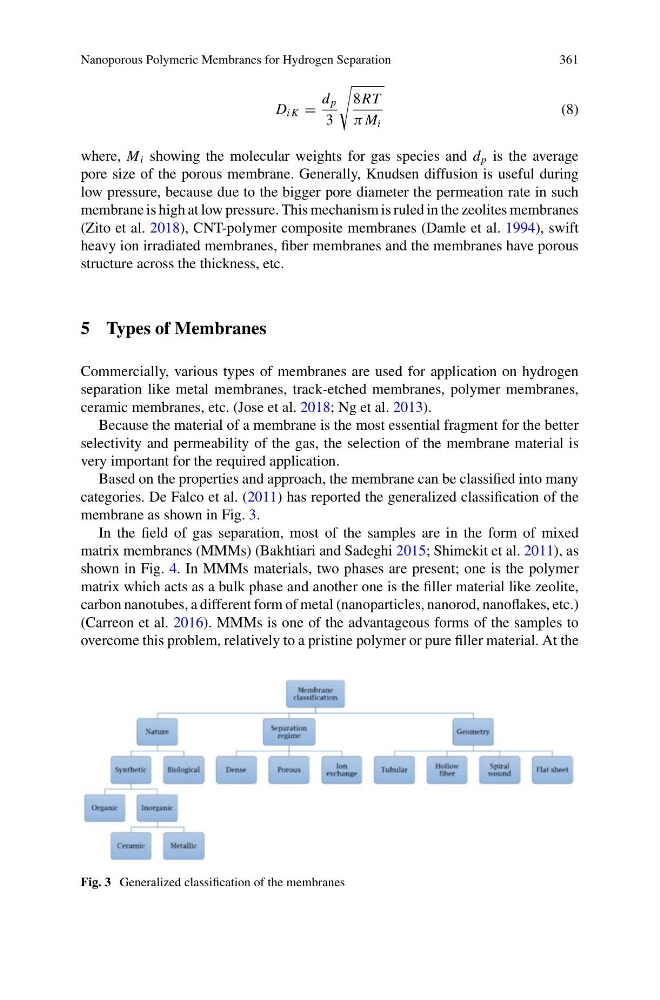
Based on the properties and approach, the membrane can be classified into many
categories. De Falco et al. (2011) has reported the generalized classification of the
membrane as shown in Fig. 3.
In the field of gas separation, most of the samples are in the form of mixed
matrix membranes (MMMs) (Bakhtiari and Sadeghi 2015; Shimekit et al. 2011), as
shown in Fig. 4. In MMMs materials, two phases are present; one is the polymer
matrix which acts as a bulk phase and another one is the filler material like zeolite,
carbon nanotubes, a different form of metal (nanoparticles, nanorod, nanoflakes, etc.)
(Carreon et al. 2016). MMMs is one of the advantageous forms of the samples to
overcome this problem, relatively to a pristine polymer or pure filler material. At the
Fig. 3 Generalized classification of the membranes
361
D i K =
d p
3
8RT
π M i
(8)
where, M i showing the molecular weights for gas species and d p is the average
pore size of the porous membrane. Generally, Knudsen diffusion is useful during
low pressure, because due to the bigger pore diameter the permeation rate in such
membrane is high at low pressure. This mechanism is ruled in the zeolites membranes
(Zito et al. 2018), CNT-polymer composite membranes (Damle et al. 1994), swift
heavy ion irradiated membranes, fiber membranes and the membranes have porous
structure across the thickness, etc.
5 Types of Membranes
Commercially, various types of membranes are used for application on hydrogen
separation like metal membranes, track-etched membranes, polymer membranes,
ceramic membranes, etc. (Jose et al. 2018; Ng et al. 2013).
Because the material of a membrane is the most essential fragment for the better
selectivity and permeability of the gas, the selection of the membrane material is
very important for the required application.
Based on the properties and approach, the membrane can be classified into many
categories. De Falco et al. (2011) has reported the generalized classification of the
membrane as shown in Fig. 3.
In the field of gas separation, most of the samples are in the form of mixed
matrix membranes (MMMs) (Bakhtiari and Sadeghi 2015; Shimekit et al. 2011), as
shown in Fig. 4. In MMMs materials, two phases are present; one is the polymer
matrix which acts as a bulk phase and another one is the filler material like zeolite,
carbon nanotubes, a different form of metal (nanoparticles, nanorod, nanoflakes, etc.)
(Carreon et al. 2016). MMMs is one of the advantageous forms of the samples to
overcome this problem, relatively to a pristine polymer or pure filler material. At the
Fig. 3 Generalized classification of the membranes