

362
R. Kumar et al.
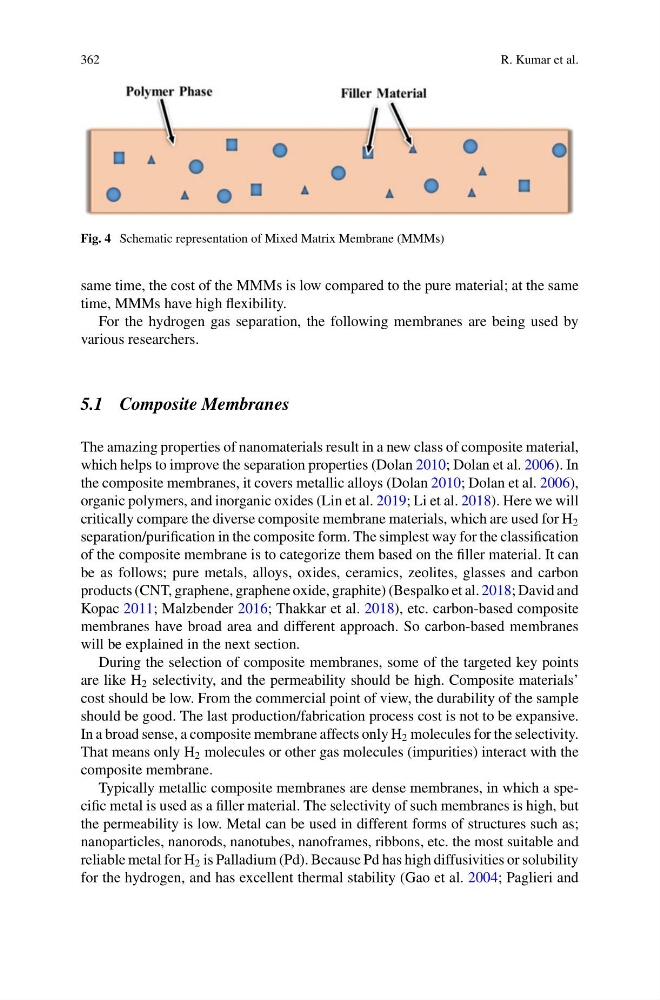
Fig. 4 Schematic representation of Mixed Matrix Membrane (MMMs)
same time, the cost of the MMMs is low compared to the pure material; at the same
time, MMMs have high flexibility.
For the hydrogen gas separation, the following membranes are being used by
various researchers.
5.1 Composite Membranes
The amazing properties of nanomaterials result in a new class of composite material,
which helps to improve the separation properties (Dolan 2010; Dolan et al. 2006). In
the composite membranes, it covers metallic alloys (Dolan 2010; Dolan et al. 2006),
organic polymers, and inorganic oxides (Lin et al. 2019; Li et al. 2018). Here we will
critically compare the diverse composite membrane materials, which are used for H 2
separation/purification in the composite form. The simplest way for the classification
of the composite membrane is to categorize them based on the filler material. It can
be as follows; pure metals, alloys, oxides, ceramics, zeolites, glasses and carbon
products (CNT, graphene, graphene oxide, graphite) (Bespalko et al. 2018; David and
Kopac 2011; Malzbender 2016; Thakkar et al. 2018), etc. carbon-based composite
membranes have broad area and different approach. So carbon-based membranes
will be explained in the next section.
During the selection of composite membranes, some of the targeted key points
are like H 2 selectivity, and the permeability should be high. Composite materials’
cost should be low. From the commercial point of view, the durability of the sample
should be good. The last production/fabrication process cost is not to be expansive.
In a broad sense, a composite membrane affects only H 2 molecules for the selectivity.
That means only H 2 molecules or other gas molecules (impurities) interact with the
composite membrane.
Typically metallic composite membranes are dense membranes, in which a specific metal is used as a filler material. The selectivity of such membranes is high, but
the permeability is low. Metal can be used in different forms of structures such as;
nanoparticles, nanorods, nanotubes, nanoframes, ribbons, etc. the most suitable and
reliable metal for H 2 is Palladium (Pd). Because Pd has high diffusivities or solubility
for the hydrogen, and has excellent thermal stability (Gao et al. 2004; Paglieri and
R. Kumar et al.
Fig. 4 Schematic representation of Mixed Matrix Membrane (MMMs)
same time, the cost of the MMMs is low compared to the pure material; at the same
time, MMMs have high flexibility.
For the hydrogen gas separation, the following membranes are being used by
various researchers.
5.1 Composite Membranes
The amazing properties of nanomaterials result in a new class of composite material,
which helps to improve the separation properties (Dolan 2010; Dolan et al. 2006). In
the composite membranes, it covers metallic alloys (Dolan 2010; Dolan et al. 2006),
organic polymers, and inorganic oxides (Lin et al. 2019; Li et al. 2018). Here we will
critically compare the diverse composite membrane materials, which are used for H 2
separation/purification in the composite form. The simplest way for the classification
of the composite membrane is to categorize them based on the filler material. It can
be as follows; pure metals, alloys, oxides, ceramics, zeolites, glasses and carbon
products (CNT, graphene, graphene oxide, graphite) (Bespalko et al. 2018; David and
Kopac 2011; Malzbender 2016; Thakkar et al. 2018), etc. carbon-based composite
membranes have broad area and different approach. So carbon-based membranes
will be explained in the next section.
During the selection of composite membranes, some of the targeted key points
are like H 2 selectivity, and the permeability should be high. Composite materials’
cost should be low. From the commercial point of view, the durability of the sample
should be good. The last production/fabrication process cost is not to be expansive.
In a broad sense, a composite membrane affects only H 2 molecules for the selectivity.
That means only H 2 molecules or other gas molecules (impurities) interact with the
composite membrane.
Typically metallic composite membranes are dense membranes, in which a specific metal is used as a filler material. The selectivity of such membranes is high, but
the permeability is low. Metal can be used in different forms of structures such as;
nanoparticles, nanorods, nanotubes, nanoframes, ribbons, etc. the most suitable and
reliable metal for H 2 is Palladium (Pd). Because Pd has high diffusivities or solubility
for the hydrogen, and has excellent thermal stability (Gao et al. 2004; Paglieri and