

360
R. Kumar et al.
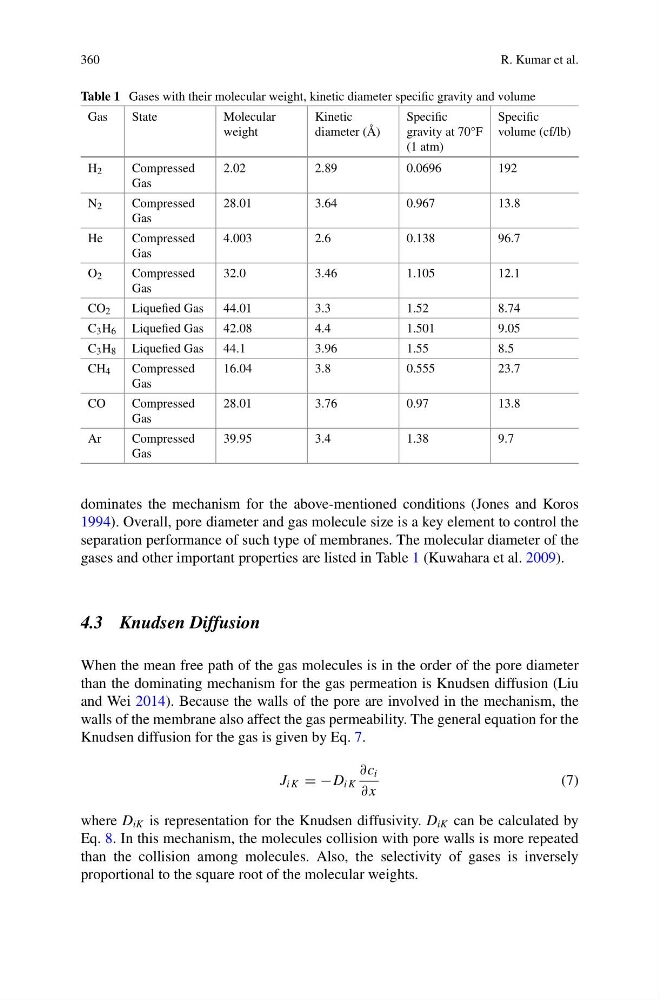
Table 1 Gases with their molecular weight, kinetic diameter specific gravity and volume
Gas
State
Molecular
weight
Kinetic
diameter (Å)
Specific
gravity at 70°F
(1 atm)
Specific
volume (cf/lb)
H 2
Compressed
Gas
2.02
2.89
0.0696
192
N 2
Compressed
Gas
28.01
3.64
0.967
13.8
He
Compressed
Gas
4.003
2.6
0.138
96.7
O 2
Compressed
Gas
32.0
3.46
1.105
12.1
CO 2
Liquefied Gas
44.01
3.3
1.52
8.74
C 3 H 6 Liquefied Gas
42.08
4.4
1.501
9.05
C 3 H 8 Liquefied Gas
44.1
3.96
1.55
8.5
CH 4
Compressed
Gas
16.04
3.8
0.555
23.7
CO
Compressed
Gas
28.01
3.76
0.97
13.8
Ar
Compressed
Gas
39.95
3.4
1.38
9.7
dominates the mechanism for the above-mentioned conditions (Jones and Koros
1994). Overall, pore diameter and gas molecule size is a key element to control the
separation performance of such type of membranes. The molecular diameter of the
gases and other important properties are listed in Table 1 (Kuwahara et al. 2009).
4.3 Knudsen Diffusion
When the mean free path of the gas molecules is in the order of the pore diameter
than the dominating mechanism for the gas permeation is Knudsen diffusion (Liu
and Wei 2014). Because the walls of the pore are involved in the mechanism, the
walls of the membrane also affect the gas permeability. The general equation for the
Knudsen diffusion for the gas is given by Eq. 7.
J i K = −D i K
∂c i
∂ x
(7)
where D iK is representation for the Knudsen diffusivity. D iK can be calculated by
Eq. 8. In this mechanism, the molecules collision with pore walls is more repeated
than the collision among molecules. Also, the selectivity of gases is inversely
proportional to the square root of the molecular weights.
R. Kumar et al.
Table 1 Gases with their molecular weight, kinetic diameter specific gravity and volume
Gas
State
Molecular
weight
Kinetic
diameter (Å)
Specific
gravity at 70°F
(1 atm)
Specific
volume (cf/lb)
H 2
Compressed
Gas
2.02
2.89
0.0696
192
N 2
Compressed
Gas
28.01
3.64
0.967
13.8
He
Compressed
Gas
4.003
2.6
0.138
96.7
O 2
Compressed
Gas
32.0
3.46
1.105
12.1
CO 2
Liquefied Gas
44.01
3.3
1.52
8.74
C 3 H 6 Liquefied Gas
42.08
4.4
1.501
9.05
C 3 H 8 Liquefied Gas
44.1
3.96
1.55
8.5
CH 4
Compressed
Gas
16.04
3.8
0.555
23.7
CO
Compressed
Gas
28.01
3.76
0.97
13.8
Ar
Compressed
Gas
39.95
3.4
1.38
9.7
dominates the mechanism for the above-mentioned conditions (Jones and Koros
1994). Overall, pore diameter and gas molecule size is a key element to control the
separation performance of such type of membranes. The molecular diameter of the
gases and other important properties are listed in Table 1 (Kuwahara et al. 2009).
4.3 Knudsen Diffusion
When the mean free path of the gas molecules is in the order of the pore diameter
than the dominating mechanism for the gas permeation is Knudsen diffusion (Liu
and Wei 2014). Because the walls of the pore are involved in the mechanism, the
walls of the membrane also affect the gas permeability. The general equation for the
Knudsen diffusion for the gas is given by Eq. 7.
J i K = −D i K
∂c i
∂ x
(7)
where D iK is representation for the Knudsen diffusivity. D iK can be calculated by
Eq. 8. In this mechanism, the molecules collision with pore walls is more repeated
than the collision among molecules. Also, the selectivity of gases is inversely
proportional to the square root of the molecular weights.