

Nanoporous Polymeric Membranes for Hydrogen Separation
359
Both the coefficient D and S depends on the membrane material and the type of gas
chosen for permeation. Every material has a different value of diffusion coefficient
and solubility coefficient according to the gas type. Also, both the coefficients change
with temperature, as the temperature changes the polymer structure and mobility of
gas molecules. As mentioned above temperature depends on P, D, and S which can
be represented by the Arrhenius type equation.
P = P 0 exp
−E p
RT
(4)
S = S 0 exp
−H s
RT
(5)
D = D 0 exp
−E d
RT
(6)
where P 0 , S 0, and D 0 are represented as pre-exponential values for the corresponding
equation. R is used for universal gas constant and T for the temperature. E d , H s, and
E p are the activation energy for diffusion, heat of solution/sorption, and activation
energy for permeation, respectively.
4.2 Molecular Sieving
In terms of gas separation, molecular sieve membranes have been recognized as
a very promising applicant for gas separation (Ma et al. 2013; Liu et al. 2019).
These molecular sieves are porous solids that contain constrictions of apertures that
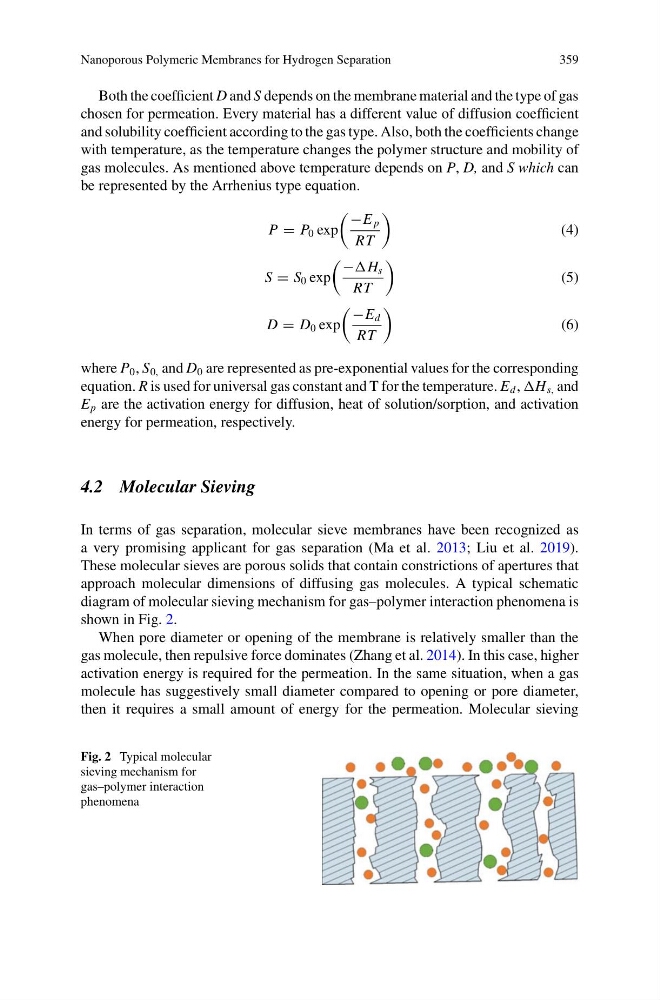
approach molecular dimensions of diffusing gas molecules. A typical schematic
diagram of molecular sieving mechanism for gas–polymer interaction phenomena is
shown in Fig. 2.
When pore diameter or opening of the membrane is relatively smaller than the
gas molecule, then repulsive force dominates (Zhang et al. 2014). In this case, higher
activation energy is required for the permeation. In the same situation, when a gas
molecule has suggestively small diameter compared to opening or pore diameter,
then it requires a small amount of energy for the permeation. Molecular sieving
Fig. 2 Typical molecular
sieving mechanism for
gas–polymer interaction
phenomena
359
Both the coefficient D and S depends on the membrane material and the type of gas
chosen for permeation. Every material has a different value of diffusion coefficient
and solubility coefficient according to the gas type. Also, both the coefficients change
with temperature, as the temperature changes the polymer structure and mobility of
gas molecules. As mentioned above temperature depends on P, D, and S which can
be represented by the Arrhenius type equation.
P = P 0 exp
−E p
RT
(4)
S = S 0 exp
−H s
RT
(5)
D = D 0 exp
−E d
RT
(6)
where P 0 , S 0, and D 0 are represented as pre-exponential values for the corresponding
equation. R is used for universal gas constant and T for the temperature. E d , H s, and
E p are the activation energy for diffusion, heat of solution/sorption, and activation
energy for permeation, respectively.
4.2 Molecular Sieving
In terms of gas separation, molecular sieve membranes have been recognized as
a very promising applicant for gas separation (Ma et al. 2013; Liu et al. 2019).
These molecular sieves are porous solids that contain constrictions of apertures that
approach molecular dimensions of diffusing gas molecules. A typical schematic
diagram of molecular sieving mechanism for gas–polymer interaction phenomena is
shown in Fig. 2.
When pore diameter or opening of the membrane is relatively smaller than the
gas molecule, then repulsive force dominates (Zhang et al. 2014). In this case, higher
activation energy is required for the permeation. In the same situation, when a gas
molecule has suggestively small diameter compared to opening or pore diameter,
then it requires a small amount of energy for the permeation. Molecular sieving
Fig. 2 Typical molecular
sieving mechanism for
gas–polymer interaction
phenomena