

358
R. Kumar et al.
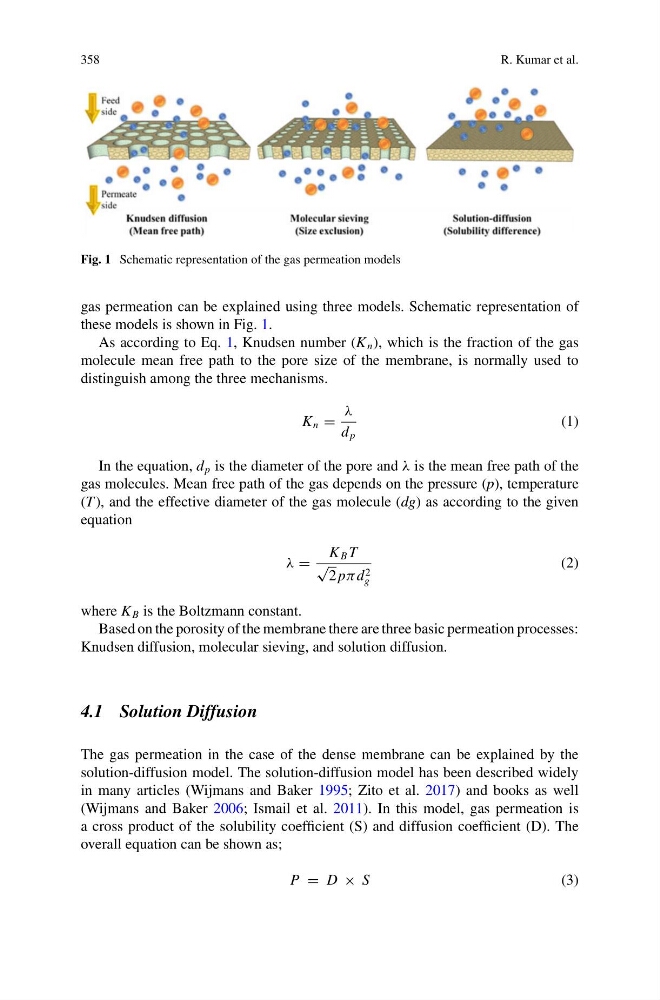
Fig. 1 Schematic representation of the gas permeation models
gas permeation can be explained using three models. Schematic representation of
these models is shown in Fig. 1.
As according to Eq. 1, Knudsen number (K n ), which is the fraction of the gas
molecule mean free path to the pore size of the membrane, is normally used to
distinguish among the three mechanisms.
K n =
λ
d p
(1)
In the equation, d p is the diameter of the pore and λ is the mean free path of the
gas molecules. Mean free path of the gas depends on the pressure (p), temperature
(T ), and the effective diameter of the gas molecule (dg) as according to the given
equation
λ =
K B T
√
2 pπ d 2
g
(2)
where K B is the Boltzmann constant.
Based on the porosity of the membrane there are three basic permeation processes:
Knudsen diffusion, molecular sieving, and solution diffusion.
4.1 Solution Diffusion
The gas permeation in the case of the dense membrane can be explained by the
solution-diffusion model. The solution-diffusion model has been described widely
in many articles (Wijmans and Baker 1995; Zito et al. 2017) and books as well
(Wijmans and Baker 2006; Ismail et al. 2011). In this model, gas permeation is
a cross product of the solubility coefficient (S) and diffusion coefficient (D). The
overall equation can be shown as;
P = D × S
(3)
R. Kumar et al.
Fig. 1 Schematic representation of the gas permeation models
gas permeation can be explained using three models. Schematic representation of
these models is shown in Fig. 1.
As according to Eq. 1, Knudsen number (K n ), which is the fraction of the gas
molecule mean free path to the pore size of the membrane, is normally used to
distinguish among the three mechanisms.
K n =
λ
d p
(1)
In the equation, d p is the diameter of the pore and λ is the mean free path of the
gas molecules. Mean free path of the gas depends on the pressure (p), temperature
(T ), and the effective diameter of the gas molecule (dg) as according to the given
equation
λ =
K B T
√
2 pπ d 2
g
(2)
where K B is the Boltzmann constant.
Based on the porosity of the membrane there are three basic permeation processes:
Knudsen diffusion, molecular sieving, and solution diffusion.
4.1 Solution Diffusion
The gas permeation in the case of the dense membrane can be explained by the
solution-diffusion model. The solution-diffusion model has been described widely
in many articles (Wijmans and Baker 1995; Zito et al. 2017) and books as well
(Wijmans and Baker 2006; Ismail et al. 2011). In this model, gas permeation is
a cross product of the solubility coefficient (S) and diffusion coefficient (D). The
overall equation can be shown as;
P = D × S
(3)