

Effect of Nanoparticles on the Performance of Drilling Fluids
293
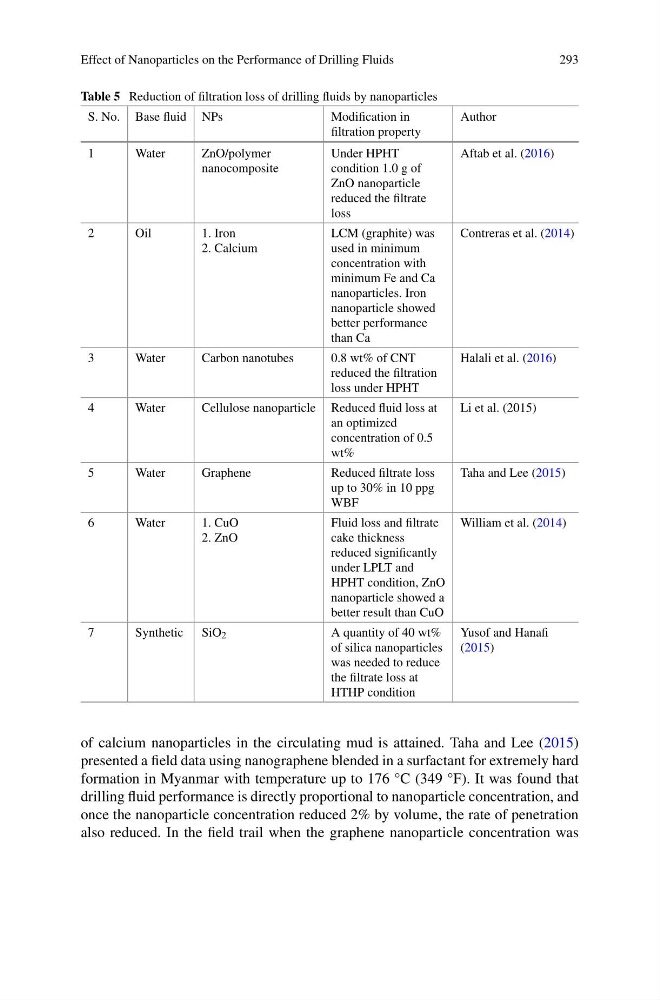
Table 5 Reduction of filtration loss of drilling fluids by nanoparticles
S. No. Base fluid NPs
Modification in
filtration property
Author
1
Water
ZnO/polymer
nanocomposite
Under HPHT
condition 1.0 g of
ZnO nanoparticle
reduced the filtrate
loss
Aftab et al. (2016)
2
Oil
1. Iron
2. Calcium
LCM (graphite) was
used in minimum
concentration with
minimum Fe and Ca
nanoparticles. Iron
nanoparticle showed
better performance
than Ca
Contreras et al. (2014)
3
Water
Carbon nanotubes
0.8 wt% of CNT
reduced the filtration
loss under HPHT
Halali et al. (2016)
4
Water
Cellulose nanoparticle Reduced fluid loss at
an optimized
concentration of 0.5
wt%
Li et al. (2015)
5
Water
Graphene
Reduced filtrate loss
up to 30% in 10 ppg
WBF
Taha and Lee (2015)
6
Water
1. CuO
2. ZnO
Fluid loss and filtrate
cake thickness
reduced significantly
under LPLT and
HPHT condition, ZnO
nanoparticle showed a
better result than CuO
William et al. (2014)
7
Synthetic SiO 2
A quantity of 40 wt%
of silica nanoparticles
was needed to reduce
the filtrate loss at
HTHP condition
Yusof and Hanafi
(2015)
of calcium nanoparticles in the circulating mud is attained. Taha and Lee (2015)
presented a field data using nanographene blended in a surfactant for extremely hard
formation in Myanmar with temperature up to 176 °C (349 °F). It was found that
drilling fluid performance is directly proportional to nanoparticle concentration, and
once the nanoparticle concentration reduced 2% by volume, the rate of penetration
also reduced. In the field trail when the graphene nanoparticle concentration was
293
Table 5 Reduction of filtration loss of drilling fluids by nanoparticles
S. No. Base fluid NPs
Modification in
filtration property
Author
1
Water
ZnO/polymer
nanocomposite
Under HPHT
condition 1.0 g of
ZnO nanoparticle
reduced the filtrate
loss
Aftab et al. (2016)
2
Oil
1. Iron
2. Calcium
LCM (graphite) was
used in minimum
concentration with
minimum Fe and Ca
nanoparticles. Iron
nanoparticle showed
better performance
than Ca
Contreras et al. (2014)
3
Water
Carbon nanotubes
0.8 wt% of CNT
reduced the filtration
loss under HPHT
Halali et al. (2016)
4
Water
Cellulose nanoparticle Reduced fluid loss at
an optimized
concentration of 0.5
wt%
Li et al. (2015)
5
Water
Graphene
Reduced filtrate loss
up to 30% in 10 ppg
WBF
Taha and Lee (2015)
6
Water
1. CuO
2. ZnO
Fluid loss and filtrate
cake thickness
reduced significantly
under LPLT and
HPHT condition, ZnO
nanoparticle showed a
better result than CuO
William et al. (2014)
7
Synthetic SiO 2
A quantity of 40 wt%
of silica nanoparticles
was needed to reduce
the filtrate loss at
HTHP condition
Yusof and Hanafi
(2015)
of calcium nanoparticles in the circulating mud is attained. Taha and Lee (2015)
presented a field data using nanographene blended in a surfactant for extremely hard
formation in Myanmar with temperature up to 176 °C (349 °F). It was found that
drilling fluid performance is directly proportional to nanoparticle concentration, and
once the nanoparticle concentration reduced 2% by volume, the rate of penetration
also reduced. In the field trail when the graphene nanoparticle concentration was