

294
G. R. Seetharaman and J. S. Sangwai
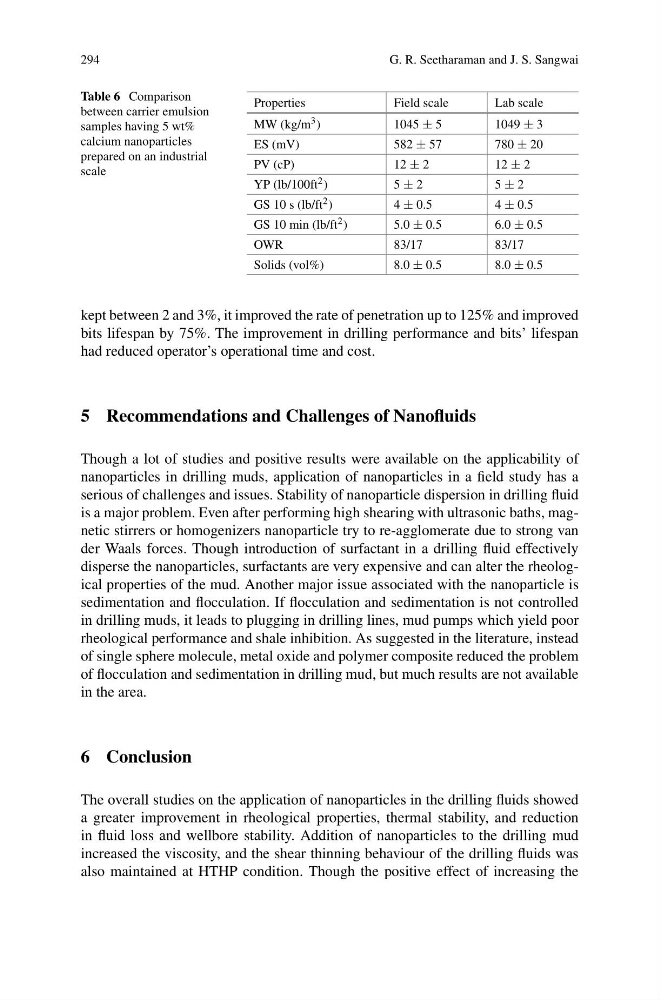
Table 6 Comparison
between carrier emulsion
samples having 5 wt%
calcium nanoparticles
prepared on an industrial
scale
Properties
Field scale
Lab scale
MW (kg/m 3 )
1045 ± 5
1049 ± 3
ES (mV)
582 ± 57
780 ± 20
PV (cP)
12 ± 2
12 ± 2
YP (lb/100ft 2 )
5 ± 2
5 ± 2
GS 10 s (lb/ft 2 )
4 ± 0.5
4 ± 0.5
GS 10 min (lb/ft 2 )
5.0 ± 0.5
6.0 ± 0.5
OWR
83/17
83/17
Solids (vol%)
8.0 ± 0.5
8.0 ± 0.5
kept between 2 and 3%, it improved the rate of penetration up to 125% and improved
bits lifespan by 75%. The improvement in drilling performance and bits’ lifespan
had reduced operator’s operational time and cost.
5 Recommendations and Challenges of Nanofluids
Though a lot of studies and positive results were available on the applicability of
nanoparticles in drilling muds, application of nanoparticles in a field study has a
serious of challenges and issues. Stability of nanoparticle dispersion in drilling fluid
is a major problem. Even after performing high shearing with ultrasonic baths, magnetic stirrers or homogenizers nanoparticle try to re-agglomerate due to strong van
der Waals forces. Though introduction of surfactant in a drilling fluid effectively
disperse the nanoparticles, surfactants are very expensive and can alter the rheological properties of the mud. Another major issue associated with the nanoparticle is
sedimentation and flocculation. If flocculation and sedimentation is not controlled
in drilling muds, it leads to plugging in drilling lines, mud pumps which yield poor
rheological performance and shale inhibition. As suggested in the literature, instead
of single sphere molecule, metal oxide and polymer composite reduced the problem
of flocculation and sedimentation in drilling mud, but much results are not available
in the area.
6 Conclusion
The overall studies on the application of nanoparticles in the drilling fluids showed
a greater improvement in rheological properties, thermal stability, and reduction
in fluid loss and wellbore stability. Addition of nanoparticles to the drilling mud
increased the viscosity, and the shear thinning behaviour of the drilling fluids was
also maintained at HTHP condition. Though the positive effect of increasing the
G. R. Seetharaman and J. S. Sangwai
Table 6 Comparison
between carrier emulsion
samples having 5 wt%
calcium nanoparticles
prepared on an industrial
scale
Properties
Field scale
Lab scale
MW (kg/m 3 )
1045 ± 5
1049 ± 3
ES (mV)
582 ± 57
780 ± 20
PV (cP)
12 ± 2
12 ± 2
YP (lb/100ft 2 )
5 ± 2
5 ± 2
GS 10 s (lb/ft 2 )
4 ± 0.5
4 ± 0.5
GS 10 min (lb/ft 2 )
5.0 ± 0.5
6.0 ± 0.5
OWR
83/17
83/17
Solids (vol%)
8.0 ± 0.5
8.0 ± 0.5
kept between 2 and 3%, it improved the rate of penetration up to 125% and improved
bits lifespan by 75%. The improvement in drilling performance and bits’ lifespan
had reduced operator’s operational time and cost.
5 Recommendations and Challenges of Nanofluids
Though a lot of studies and positive results were available on the applicability of
nanoparticles in drilling muds, application of nanoparticles in a field study has a
serious of challenges and issues. Stability of nanoparticle dispersion in drilling fluid
is a major problem. Even after performing high shearing with ultrasonic baths, magnetic stirrers or homogenizers nanoparticle try to re-agglomerate due to strong van
der Waals forces. Though introduction of surfactant in a drilling fluid effectively
disperse the nanoparticles, surfactants are very expensive and can alter the rheological properties of the mud. Another major issue associated with the nanoparticle is
sedimentation and flocculation. If flocculation and sedimentation is not controlled
in drilling muds, it leads to plugging in drilling lines, mud pumps which yield poor
rheological performance and shale inhibition. As suggested in the literature, instead
of single sphere molecule, metal oxide and polymer composite reduced the problem
of flocculation and sedimentation in drilling mud, but much results are not available
in the area.
6 Conclusion
The overall studies on the application of nanoparticles in the drilling fluids showed
a greater improvement in rheological properties, thermal stability, and reduction
in fluid loss and wellbore stability. Addition of nanoparticles to the drilling mud
increased the viscosity, and the shear thinning behaviour of the drilling fluids was
also maintained at HTHP condition. Though the positive effect of increasing the