

292
G. R. Seetharaman and J. S. Sangwai
Table 4 Thickness of mud
cake produced by nano
clay–silica (CS) composite
with increase in temperature
Sample*
Thickness of mud cake
(in.)
25 °C
90 °C
Base mud (WBM)
0.137
0.149
WBM + 0.1 wt% nano CS
0.066
0.068
WBM + 0.5 wt% nano CS
0.059
0.058
WBM + 1 wt% nano CS
0.052
0.053
WBM + 1.5 wt% nano CS
0.054
0.051
WBM + 0.1 wt% nano SiO 2
0.071
0.077
WBM + 0.5 wt% nano SiO 2
0.067
0.079
WBM + 1.0 wt% nano SiO 2
0.066
0.076
WBM + 1.5 wt% nano SiO 2
0.066
0.074
* WBM+nano CS or WBM+SiO 2
result shows that the action of ZnTiO 3 in drilling fluid produced mud cake of ~1 mm
thickness.
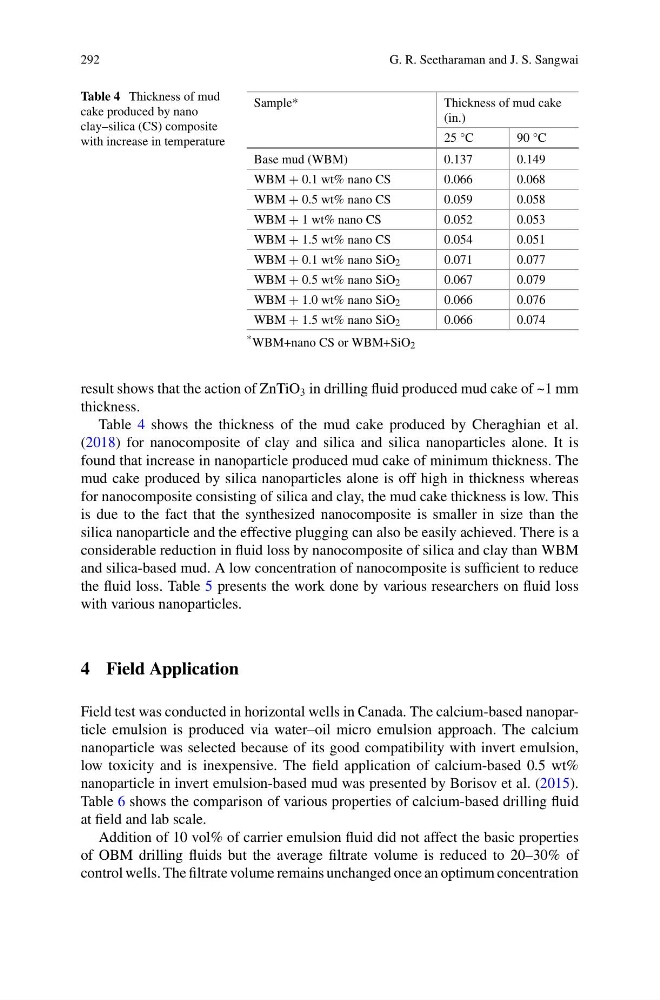
Table 4 shows the thickness of the mud cake produced by Cheraghian et al.
(2018) for nanocomposite of clay and silica and silica nanoparticles alone. It is
found that increase in nanoparticle produced mud cake of minimum thickness. The
mud cake produced by silica nanoparticles alone is off high in thickness whereas
for nanocomposite consisting of silica and clay, the mud cake thickness is low. This
is due to the fact that the synthesized nanocomposite is smaller in size than the
silica nanoparticle and the effective plugging can also be easily achieved. There is a
considerable reduction in fluid loss by nanocomposite of silica and clay than WBM
and silica-based mud. A low concentration of nanocomposite is sufficient to reduce
the fluid loss. Table 5 presents the work done by various researchers on fluid loss
with various nanoparticles.
4 Field Application
Field test was conducted in horizontal wells in Canada. The calcium-based nanoparticle emulsion is produced via water–oil micro emulsion approach. The calcium
nanoparticle was selected because of its good compatibility with invert emulsion,
low toxicity and is inexpensive. The field application of calcium-based 0.5 wt%
nanoparticle in invert emulsion-based mud was presented by Borisov et al. (2015).
Table 6 shows the comparison of various properties of calcium-based drilling fluid
at field and lab scale.
Addition of 10 vol% of carrier emulsion fluid did not affect the basic properties
of OBM drilling fluids but the average filtrate volume is reduced to 20–30% of
control wells. The filtrate volume remains unchanged once an optimum concentration
G. R. Seetharaman and J. S. Sangwai
Table 4 Thickness of mud
cake produced by nano
clay–silica (CS) composite
with increase in temperature
Sample*
Thickness of mud cake
(in.)
25 °C
90 °C
Base mud (WBM)
0.137
0.149
WBM + 0.1 wt% nano CS
0.066
0.068
WBM + 0.5 wt% nano CS
0.059
0.058
WBM + 1 wt% nano CS
0.052
0.053
WBM + 1.5 wt% nano CS
0.054
0.051
WBM + 0.1 wt% nano SiO 2
0.071
0.077
WBM + 0.5 wt% nano SiO 2
0.067
0.079
WBM + 1.0 wt% nano SiO 2
0.066
0.076
WBM + 1.5 wt% nano SiO 2
0.066
0.074
* WBM+nano CS or WBM+SiO 2
result shows that the action of ZnTiO 3 in drilling fluid produced mud cake of ~1 mm
thickness.
Table 4 shows the thickness of the mud cake produced by Cheraghian et al.
(2018) for nanocomposite of clay and silica and silica nanoparticles alone. It is
found that increase in nanoparticle produced mud cake of minimum thickness. The
mud cake produced by silica nanoparticles alone is off high in thickness whereas
for nanocomposite consisting of silica and clay, the mud cake thickness is low. This
is due to the fact that the synthesized nanocomposite is smaller in size than the
silica nanoparticle and the effective plugging can also be easily achieved. There is a
considerable reduction in fluid loss by nanocomposite of silica and clay than WBM
and silica-based mud. A low concentration of nanocomposite is sufficient to reduce
the fluid loss. Table 5 presents the work done by various researchers on fluid loss
with various nanoparticles.
4 Field Application
Field test was conducted in horizontal wells in Canada. The calcium-based nanoparticle emulsion is produced via water–oil micro emulsion approach. The calcium
nanoparticle was selected because of its good compatibility with invert emulsion,
low toxicity and is inexpensive. The field application of calcium-based 0.5 wt%
nanoparticle in invert emulsion-based mud was presented by Borisov et al. (2015).
Table 6 shows the comparison of various properties of calcium-based drilling fluid
at field and lab scale.
Addition of 10 vol% of carrier emulsion fluid did not affect the basic properties
of OBM drilling fluids but the average filtrate volume is reduced to 20–30% of
control wells. The filtrate volume remains unchanged once an optimum concentration