

290
G. R. Seetharaman and J. S. Sangwai
pressure that occurs between the formations and the wellbore. In the process of
filtration, a solid cake (or) filtration cake is produced by the solids and chemicals
present in the mud, to inhibit (or) stop the fluid invasion into the formation. Since the
particles associated with the conventional drilling fluids are usually large in size than
the pores of formation, it fails to inhibit the fluid loss. In this case, the filtration cake
produced by the drilling mud is usually thick resulting in pipe sticking and inability
to plug the pores. Loss circulation is another important issue in drilling fluid in which
the drilling fluid is lost at any depth. The nanoparticles added to the drilling mud
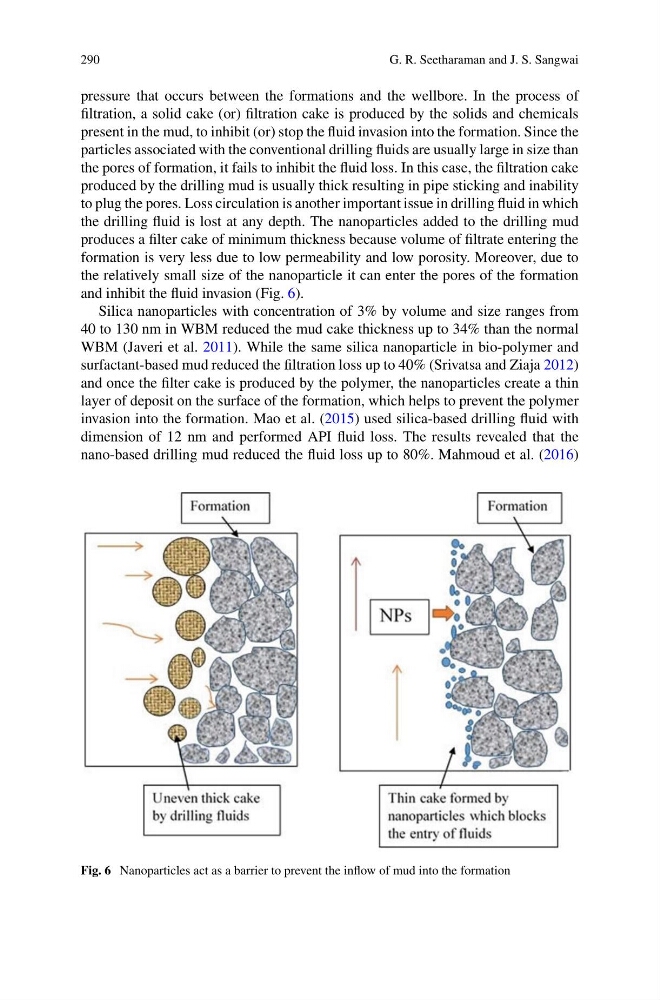
produces a filter cake of minimum thickness because volume of filtrate entering the
formation is very less due to low permeability and low porosity. Moreover, due to
the relatively small size of the nanoparticle it can enter the pores of the formation
and inhibit the fluid invasion (Fig. 6).
Silica nanoparticles with concentration of 3% by volume and size ranges from
40 to 130 nm in WBM reduced the mud cake thickness up to 34% than the normal
WBM (Javeri et al. 2011). While the same silica nanoparticle in bio-polymer and
surfactant-based mud reduced the filtration loss up to 40% (Srivatsa and Ziaja 2012)
and once the filter cake is produced by the polymer, the nanoparticles create a thin
layer of deposit on the surface of the formation, which helps to prevent the polymer
invasion into the formation. Mao et al. (2015) used silica-based drilling fluid with
dimension of 12 nm and performed API fluid loss. The results revealed that the
nano-based drilling mud reduced the fluid loss up to 80%. Mahmoud et al. (2016)
Fig. 6 Nanoparticles act as a barrier to prevent the inflow of mud into the formation
G. R. Seetharaman and J. S. Sangwai
pressure that occurs between the formations and the wellbore. In the process of
filtration, a solid cake (or) filtration cake is produced by the solids and chemicals
present in the mud, to inhibit (or) stop the fluid invasion into the formation. Since the
particles associated with the conventional drilling fluids are usually large in size than
the pores of formation, it fails to inhibit the fluid loss. In this case, the filtration cake
produced by the drilling mud is usually thick resulting in pipe sticking and inability
to plug the pores. Loss circulation is another important issue in drilling fluid in which
the drilling fluid is lost at any depth. The nanoparticles added to the drilling mud
produces a filter cake of minimum thickness because volume of filtrate entering the
formation is very less due to low permeability and low porosity. Moreover, due to
the relatively small size of the nanoparticle it can enter the pores of the formation
and inhibit the fluid invasion (Fig. 6).
Silica nanoparticles with concentration of 3% by volume and size ranges from
40 to 130 nm in WBM reduced the mud cake thickness up to 34% than the normal
WBM (Javeri et al. 2011). While the same silica nanoparticle in bio-polymer and
surfactant-based mud reduced the filtration loss up to 40% (Srivatsa and Ziaja 2012)
and once the filter cake is produced by the polymer, the nanoparticles create a thin
layer of deposit on the surface of the formation, which helps to prevent the polymer
invasion into the formation. Mao et al. (2015) used silica-based drilling fluid with
dimension of 12 nm and performed API fluid loss. The results revealed that the
nano-based drilling mud reduced the fluid loss up to 80%. Mahmoud et al. (2016)
Fig. 6 Nanoparticles act as a barrier to prevent the inflow of mud into the formation