

288
G. R. Seetharaman and J. S. Sangwai
thermal conductivity than 0.4 wt% due to increase in distance between particles
(Ho et al. 2014). Increase in temperature increased the thermal conductivity of the
nano-enhanced drilling fluid. Silver nanoparticles with diameter 5 nm dispersed in
kerosene-based mud showed higher conductivity at 50 °C than at 25 °C because of
the enhanced Brownian motion (Li et al. 2010). The increment in thermal conductivity of the drilling mud by the addition of nanoparticles made the mud to cool faster
as it moves up the surface. The increase in nanoparticle concentration increased the
thermal property of the drilling fluid. The enhancement in thermal conductivity was
higher in the case of CuO than ZnO for a particle concentration of 0.1, 0.3 and 0.5
wt% (William et al. 2014). The enhancement in thermal conductivity for nano-sized
particle was significant than with micro-sized particle. Nanoparticle concentration
(0.5 wt%) promoted better thermal conductivity and the value of thermal conductivity
will be lowered if the nanofluid was prepared in base fluid which are highly viscous in
nature (PEG 600) because the nanoparticles may get entrapped in the microstructure
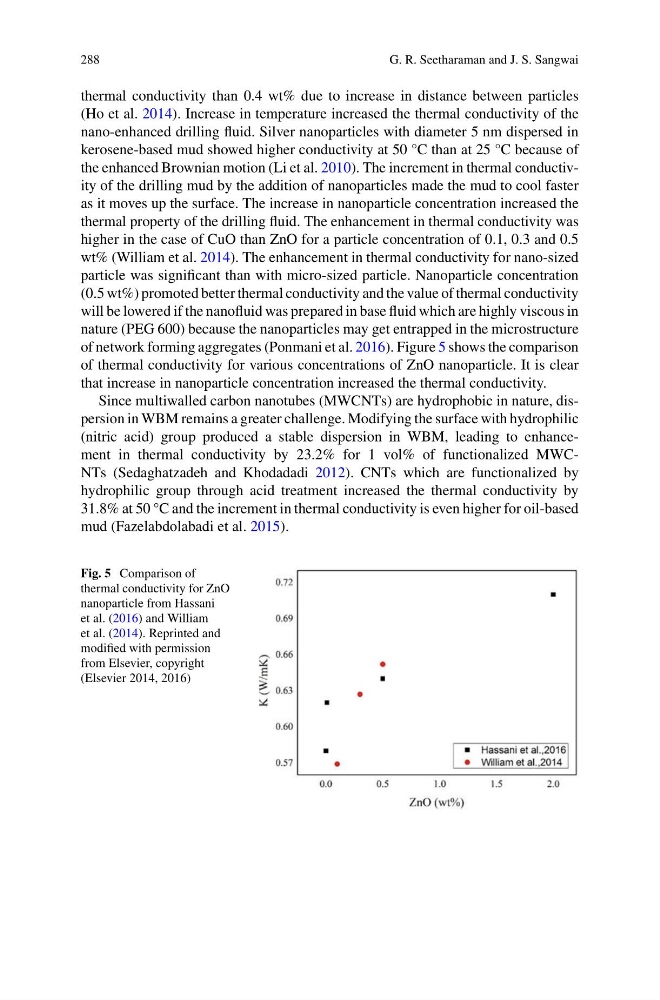
of network forming aggregates (Ponmani et al. 2016). Figure 5 shows the comparison
of thermal conductivity for various concentrations of ZnO nanoparticle. It is clear
that increase in nanoparticle concentration increased the thermal conductivity.
Since multiwalled carbon nanotubes (MWCNTs) are hydrophobic in nature, dispersion in WBM remains a greater challenge. Modifying the surface with hydrophilic
(nitric acid) group produced a stable dispersion in WBM, leading to enhancement in thermal conductivity by 23.2% for 1 vol% of functionalized MWCNTs (Sedaghatzadeh and Khodadadi 2012). CNTs which are functionalized by
hydrophilic group through acid treatment increased the thermal conductivity by
31.8% at 50 °C and the increment in thermal conductivity is even higher for oil-based
mud (Fazelabdolabadi et al. 2015).
Fig. 5 Comparison of
thermal conductivity for ZnO
nanoparticle from Hassani
et al. (2016) and William
et al. (2014). Reprinted and
modified with permission
from Elsevier, copyright
(Elsevier 2014, 2016)
G. R. Seetharaman and J. S. Sangwai
thermal conductivity than 0.4 wt% due to increase in distance between particles
(Ho et al. 2014). Increase in temperature increased the thermal conductivity of the
nano-enhanced drilling fluid. Silver nanoparticles with diameter 5 nm dispersed in
kerosene-based mud showed higher conductivity at 50 °C than at 25 °C because of
the enhanced Brownian motion (Li et al. 2010). The increment in thermal conductivity of the drilling mud by the addition of nanoparticles made the mud to cool faster
as it moves up the surface. The increase in nanoparticle concentration increased the
thermal property of the drilling fluid. The enhancement in thermal conductivity was
higher in the case of CuO than ZnO for a particle concentration of 0.1, 0.3 and 0.5
wt% (William et al. 2014). The enhancement in thermal conductivity for nano-sized
particle was significant than with micro-sized particle. Nanoparticle concentration
(0.5 wt%) promoted better thermal conductivity and the value of thermal conductivity
will be lowered if the nanofluid was prepared in base fluid which are highly viscous in
nature (PEG 600) because the nanoparticles may get entrapped in the microstructure
of network forming aggregates (Ponmani et al. 2016). Figure 5 shows the comparison
of thermal conductivity for various concentrations of ZnO nanoparticle. It is clear
that increase in nanoparticle concentration increased the thermal conductivity.
Since multiwalled carbon nanotubes (MWCNTs) are hydrophobic in nature, dispersion in WBM remains a greater challenge. Modifying the surface with hydrophilic
(nitric acid) group produced a stable dispersion in WBM, leading to enhancement in thermal conductivity by 23.2% for 1 vol% of functionalized MWCNTs (Sedaghatzadeh and Khodadadi 2012). CNTs which are functionalized by
hydrophilic group through acid treatment increased the thermal conductivity by
31.8% at 50 °C and the increment in thermal conductivity is even higher for oil-based
mud (Fazelabdolabadi et al. 2015).
Fig. 5 Comparison of
thermal conductivity for ZnO
nanoparticle from Hassani
et al. (2016) and William
et al. (2014). Reprinted and
modified with permission
from Elsevier, copyright
(Elsevier 2014, 2016)