

Effect of Nanoparticles on the Performance of Drilling Fluids
287
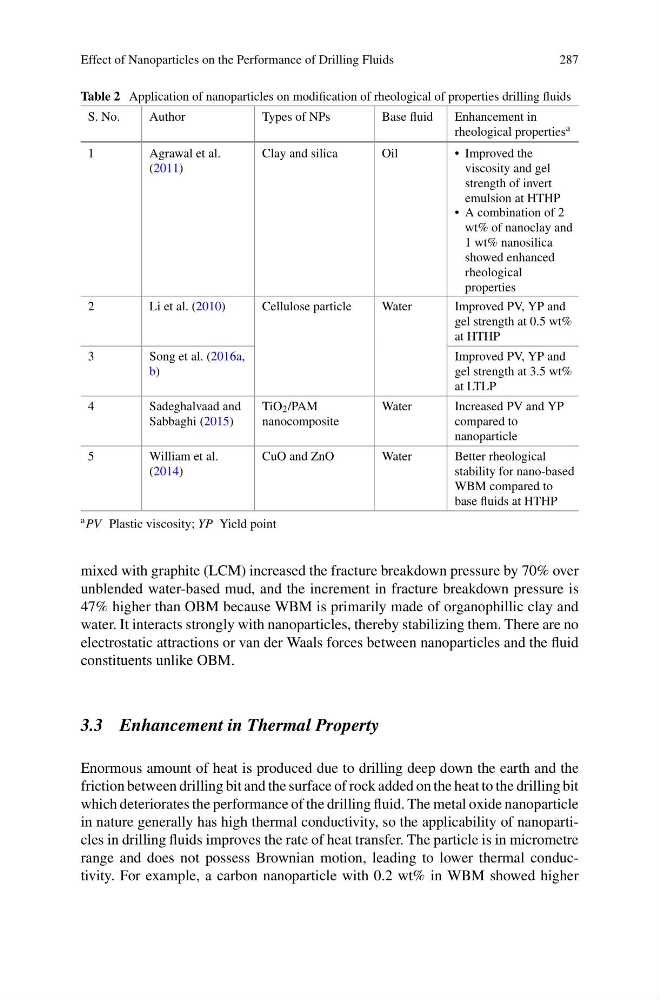
Table 2 Application of nanoparticles on modification of rheological of properties drilling fluids
S. No.
Author
Types of NPs
Base fluid
Enhancement in
rheological properties a
1
Agrawal et al.
(2011)
Clay and silica
Oil
• Improved the
viscosity and gel
strength of invert
emulsion at HTHP
• A combination of 2
wt% of nanoclay and
1 wt% nanosilica
showed enhanced
rheological
properties
2
Li et al. (2010)
Cellulose particle
Water
Improved PV, YP and
gel strength at 0.5 wt%
at HTHP
3
Song et al. (2016a,
b)
Improved PV, YP and
gel strength at 3.5 wt%
at LTLP
4
Sadeghalvaad and
Sabbaghi (2015)
TiO 2 /PAM
nanocomposite
Water
Increased PV and YP
compared to
nanoparticle
5
William et al.
(2014)
CuO and ZnO
Water
Better rheological
stability for nano-based
WBM compared to
base fluids at HTHP
a PV Plastic viscosity; YP Yield point
mixed with graphite (LCM) increased the fracture breakdown pressure by 70% over
unblended water-based mud, and the increment in fracture breakdown pressure is
47% higher than OBM because WBM is primarily made of organophillic clay and
water. It interacts strongly with nanoparticles, thereby stabilizing them. There are no
electrostatic attractions or van der Waals forces between nanoparticles and the fluid
constituents unlike OBM.
3.3 Enhancement in Thermal Property
Enormous amount of heat is produced due to drilling deep down the earth and the
friction between drilling bit and the surface of rock added on the heat to the drilling bit
which deteriorates the performance of the drilling fluid. The metal oxide nanoparticle
in nature generally has high thermal conductivity, so the applicability of nanoparticles in drilling fluids improves the rate of heat transfer. The particle is in micrometre
range and does not possess Brownian motion, leading to lower thermal conductivity. For example, a carbon nanoparticle with 0.2 wt% in WBM showed higher
287
Table 2 Application of nanoparticles on modification of rheological of properties drilling fluids
S. No.
Author
Types of NPs
Base fluid
Enhancement in
rheological properties a
1
Agrawal et al.
(2011)
Clay and silica
Oil
• Improved the
viscosity and gel
strength of invert
emulsion at HTHP
• A combination of 2
wt% of nanoclay and
1 wt% nanosilica
showed enhanced
rheological
properties
2
Li et al. (2010)
Cellulose particle
Water
Improved PV, YP and
gel strength at 0.5 wt%
at HTHP
3
Song et al. (2016a,
b)
Improved PV, YP and
gel strength at 3.5 wt%
at LTLP
4
Sadeghalvaad and
Sabbaghi (2015)
TiO 2 /PAM
nanocomposite
Water
Increased PV and YP
compared to
nanoparticle
5
William et al.
(2014)
CuO and ZnO
Water
Better rheological
stability for nano-based
WBM compared to
base fluids at HTHP
a PV Plastic viscosity; YP Yield point
mixed with graphite (LCM) increased the fracture breakdown pressure by 70% over
unblended water-based mud, and the increment in fracture breakdown pressure is
47% higher than OBM because WBM is primarily made of organophillic clay and
water. It interacts strongly with nanoparticles, thereby stabilizing them. There are no
electrostatic attractions or van der Waals forces between nanoparticles and the fluid
constituents unlike OBM.
3.3 Enhancement in Thermal Property
Enormous amount of heat is produced due to drilling deep down the earth and the
friction between drilling bit and the surface of rock added on the heat to the drilling bit
which deteriorates the performance of the drilling fluid. The metal oxide nanoparticle
in nature generally has high thermal conductivity, so the applicability of nanoparticles in drilling fluids improves the rate of heat transfer. The particle is in micrometre
range and does not possess Brownian motion, leading to lower thermal conductivity. For example, a carbon nanoparticle with 0.2 wt% in WBM showed higher