

286
G. R. Seetharaman and J. S. Sangwai
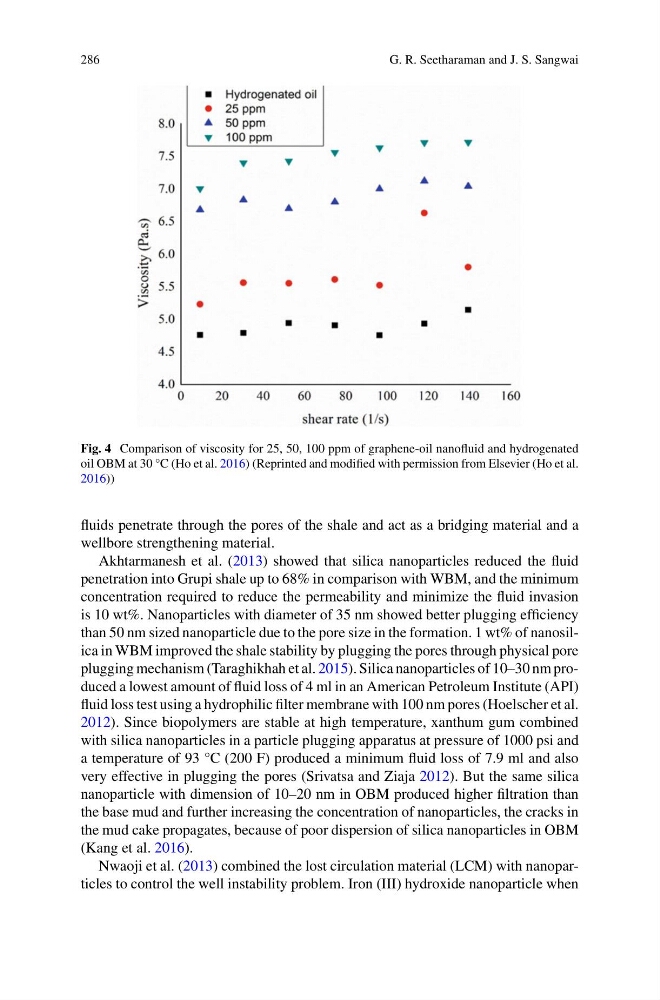
Fig. 4 Comparison of viscosity for 25, 50, 100 ppm of graphene-oil nanofluid and hydrogenated
oil OBM at 30 °C (Ho et al. 2016) (Reprinted and modified with permission from Elsevier (Ho et al.
2016))
fluids penetrate through the pores of the shale and act as a bridging material and a
wellbore strengthening material.
Akhtarmanesh et al. (2013) showed that silica nanoparticles reduced the fluid
penetration into Grupi shale up to 68% in comparison with WBM, and the minimum
concentration required to reduce the permeability and minimize the fluid invasion
is 10 wt%. Nanoparticles with diameter of 35 nm showed better plugging efficiency
than 50 nm sized nanoparticle due to the pore size in the formation. 1 wt% of nanosilica in WBM improved the shale stability by plugging the pores through physical pore
plugging mechanism (Taraghikhah et al. 2015). Silica nanoparticles of 10–30 nm produced a lowest amount of fluid loss of 4 ml in an American Petroleum Institute (API)
fluid loss test using a hydrophilic filter membrane with 100 nm pores (Hoelscher et al.
2012). Since biopolymers are stable at high temperature, xanthum gum combined
with silica nanoparticles in a particle plugging apparatus at pressure of 1000 psi and
a temperature of 93 °C (200 F) produced a minimum fluid loss of 7.9 ml and also
very effective in plugging the pores (Srivatsa and Ziaja 2012). But the same silica
nanoparticle with dimension of 10–20 nm in OBM produced higher filtration than
the base mud and further increasing the concentration of nanoparticles, the cracks in
the mud cake propagates, because of poor dispersion of silica nanoparticles in OBM
(Kang et al. 2016).
Nwaoji et al. (2013) combined the lost circulation material (LCM) with nanoparticles to control the well instability problem. Iron (III) hydroxide nanoparticle when
G. R. Seetharaman and J. S. Sangwai
Fig. 4 Comparison of viscosity for 25, 50, 100 ppm of graphene-oil nanofluid and hydrogenated
oil OBM at 30 °C (Ho et al. 2016) (Reprinted and modified with permission from Elsevier (Ho et al.
2016))
fluids penetrate through the pores of the shale and act as a bridging material and a
wellbore strengthening material.
Akhtarmanesh et al. (2013) showed that silica nanoparticles reduced the fluid
penetration into Grupi shale up to 68% in comparison with WBM, and the minimum
concentration required to reduce the permeability and minimize the fluid invasion
is 10 wt%. Nanoparticles with diameter of 35 nm showed better plugging efficiency
than 50 nm sized nanoparticle due to the pore size in the formation. 1 wt% of nanosilica in WBM improved the shale stability by plugging the pores through physical pore
plugging mechanism (Taraghikhah et al. 2015). Silica nanoparticles of 10–30 nm produced a lowest amount of fluid loss of 4 ml in an American Petroleum Institute (API)
fluid loss test using a hydrophilic filter membrane with 100 nm pores (Hoelscher et al.
2012). Since biopolymers are stable at high temperature, xanthum gum combined
with silica nanoparticles in a particle plugging apparatus at pressure of 1000 psi and
a temperature of 93 °C (200 F) produced a minimum fluid loss of 7.9 ml and also
very effective in plugging the pores (Srivatsa and Ziaja 2012). But the same silica
nanoparticle with dimension of 10–20 nm in OBM produced higher filtration than
the base mud and further increasing the concentration of nanoparticles, the cracks in
the mud cake propagates, because of poor dispersion of silica nanoparticles in OBM
(Kang et al. 2016).
Nwaoji et al. (2013) combined the lost circulation material (LCM) with nanoparticles to control the well instability problem. Iron (III) hydroxide nanoparticle when