

224
P. Narsimha et al.
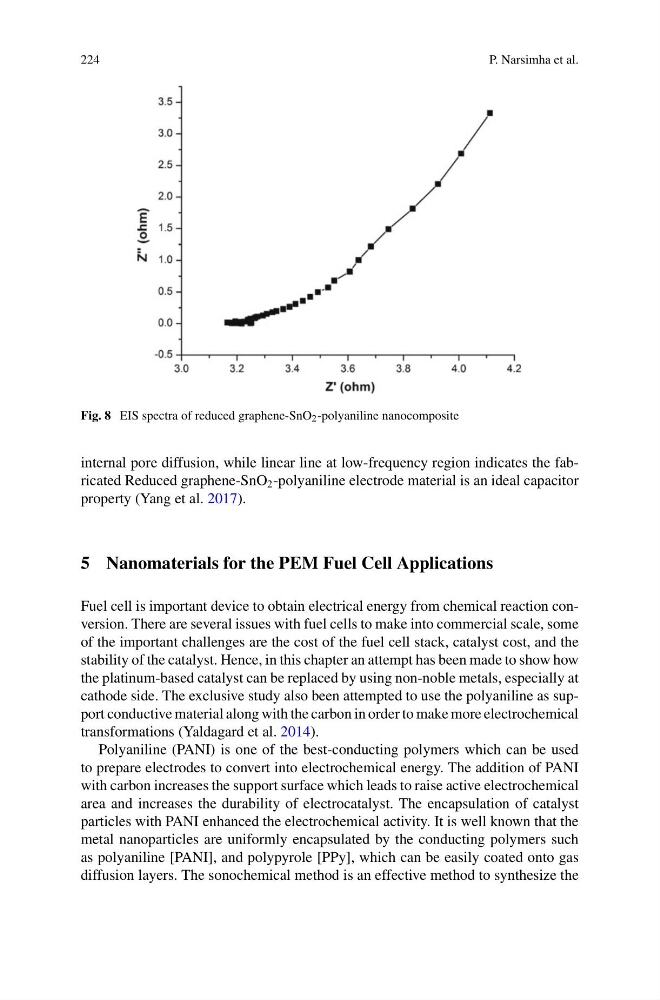
Fig. 8 EIS spectra of reduced graphene-SnO 2 -polyaniline nanocomposite
internal pore diffusion, while linear line at low-frequency region indicates the fabricated Reduced graphene-SnO 2 -polyaniline electrode material is an ideal capacitor
property (Yang et al. 2017).
5 Nanomaterials for the PEM Fuel Cell Applications
Fuel cell is important device to obtain electrical energy from chemical reaction conversion. There are several issues with fuel cells to make into commercial scale, some
of the important challenges are the cost of the fuel cell stack, catalyst cost, and the
stability of the catalyst. Hence, in this chapter an attempt has been made to show how
the platinum-based catalyst can be replaced by using non-noble metals, especially at
cathode side. The exclusive study also been attempted to use the polyaniline as support conductive material along with the carbon in order to make more electrochemical
transformations (Yaldagard et al. 2014).
Polyaniline (PANI) is one of the best-conducting polymers which can be used
to prepare electrodes to convert into electrochemical energy. The addition of PANI
with carbon increases the support surface which leads to raise active electrochemical
area and increases the durability of electrocatalyst. The encapsulation of catalyst
particles with PANI enhanced the electrochemical activity. It is well known that the
metal nanoparticles are uniformly encapsulated by the conducting polymers such
as polyaniline [PANI], and polypyrole [PPy], which can be easily coated onto gas
diffusion layers. The sonochemical method is an effective method to synthesize the
P. Narsimha et al.
Fig. 8 EIS spectra of reduced graphene-SnO 2 -polyaniline nanocomposite
internal pore diffusion, while linear line at low-frequency region indicates the fabricated Reduced graphene-SnO 2 -polyaniline electrode material is an ideal capacitor
property (Yang et al. 2017).
5 Nanomaterials for the PEM Fuel Cell Applications
Fuel cell is important device to obtain electrical energy from chemical reaction conversion. There are several issues with fuel cells to make into commercial scale, some
of the important challenges are the cost of the fuel cell stack, catalyst cost, and the
stability of the catalyst. Hence, in this chapter an attempt has been made to show how
the platinum-based catalyst can be replaced by using non-noble metals, especially at
cathode side. The exclusive study also been attempted to use the polyaniline as support conductive material along with the carbon in order to make more electrochemical
transformations (Yaldagard et al. 2014).
Polyaniline (PANI) is one of the best-conducting polymers which can be used
to prepare electrodes to convert into electrochemical energy. The addition of PANI
with carbon increases the support surface which leads to raise active electrochemical
area and increases the durability of electrocatalyst. The encapsulation of catalyst
particles with PANI enhanced the electrochemical activity. It is well known that the
metal nanoparticles are uniformly encapsulated by the conducting polymers such
as polyaniline [PANI], and polypyrole [PPy], which can be easily coated onto gas
diffusion layers. The sonochemical method is an effective method to synthesize the