

Synthesis of Nanomaterials for Energy Generation …
219
4 Synthesis and Characterizations of Reduced
Graphene-SnO 2 -Polyaniline Nanocomposites Using
Sonochemical Approach for Supercapacitor
4.1 Sonochemical Synthesis of Reduced
Graphene-SnO 2 -Polyaniline Composite
Using modified Hummers method, graphene oxide [GO] was prepared from graphite
powder (Guo et al. 2015). Then, the prepared GO was used as a precursor for
graphene. Sonochemical synthesis method was used for the preparation of reduced
graphene-SnO 2 -polyaniline. At first, the dispersion of GO in distilled water (8 gm/ml)
was carried out using ultra-sonification for a period of 30 min to obtain an exfoliated
yellow-brown GO suspension. Subsequently, 3 g of SnCl 4 .5H 2 O was added into the
GO suspension under sonication and stirring for 1 h to get a black GS solution. Then
0.5 mL aniline was slowly added. Further, the mixture was sonicated for 15 min
and then, added with drops of 10 mL aqueous solution containing 2 g ammonium
persulfate (APS). After the sonification process, the content was kept in ice bath for
1 h. Next, the Reduced graphene-SnO 2 -polyaniline nanocomposite was filtrated and
washed with ethanol and deionized water. Finally, the washed contents were dried
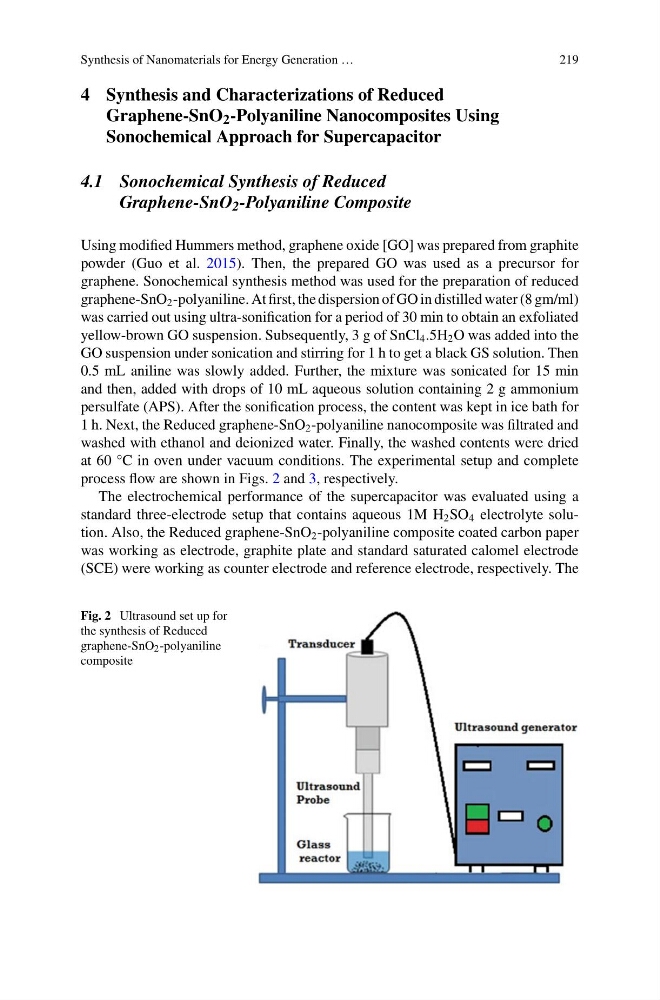
at 60 °C in oven under vacuum conditions. The experimental setup and complete
process flow are shown in Figs. 2 and 3, respectively.
The electrochemical performance of the supercapacitor was evaluated using a
standard three-electrode setup that contains aqueous 1M H 2 SO 4 electrolyte solution. Also, the Reduced graphene-SnO 2 -polyaniline composite coated carbon paper
was working as electrode, graphite plate and standard saturated calomel electrode
(SCE) were working as counter electrode and reference electrode, respectively. The
Fig. 2 Ultrasound set up for
the synthesis of Reduced
graphene-SnO 2 -polyaniline
composite
219
4 Synthesis and Characterizations of Reduced
Graphene-SnO 2 -Polyaniline Nanocomposites Using
Sonochemical Approach for Supercapacitor
4.1 Sonochemical Synthesis of Reduced
Graphene-SnO 2 -Polyaniline Composite
Using modified Hummers method, graphene oxide [GO] was prepared from graphite
powder (Guo et al. 2015). Then, the prepared GO was used as a precursor for
graphene. Sonochemical synthesis method was used for the preparation of reduced
graphene-SnO 2 -polyaniline. At first, the dispersion of GO in distilled water (8 gm/ml)
was carried out using ultra-sonification for a period of 30 min to obtain an exfoliated
yellow-brown GO suspension. Subsequently, 3 g of SnCl 4 .5H 2 O was added into the
GO suspension under sonication and stirring for 1 h to get a black GS solution. Then
0.5 mL aniline was slowly added. Further, the mixture was sonicated for 15 min
and then, added with drops of 10 mL aqueous solution containing 2 g ammonium
persulfate (APS). After the sonification process, the content was kept in ice bath for
1 h. Next, the Reduced graphene-SnO 2 -polyaniline nanocomposite was filtrated and
washed with ethanol and deionized water. Finally, the washed contents were dried
at 60 °C in oven under vacuum conditions. The experimental setup and complete
process flow are shown in Figs. 2 and 3, respectively.
The electrochemical performance of the supercapacitor was evaluated using a
standard three-electrode setup that contains aqueous 1M H 2 SO 4 electrolyte solution. Also, the Reduced graphene-SnO 2 -polyaniline composite coated carbon paper
was working as electrode, graphite plate and standard saturated calomel electrode
(SCE) were working as counter electrode and reference electrode, respectively. The
Fig. 2 Ultrasound set up for
the synthesis of Reduced
graphene-SnO 2 -polyaniline
composite