

218
P. Narsimha et al.
Table 1 (continued)
Chemical energy
Accumulators—Nano-structured
electrodes and separators for
recyclable batteries with cyclic
reactions that convert chemical
energy into useful energy
Nano-structures/Fuel storage
tanks—For storing liquid and
gaseous fuels without
hydrocarbon leakages
Fuel reforming/refining—Novel
nano-catalysts used for fuel
production or refining such as
petroleum refining and coal fuels
Thermal Energy
Nano-Phase Change Material and
Heat Transfer Nano
Fluids—industrial heat transfer
applications
Nanoporous adsorption storage
including metallo-organic
cage-like structures for storing
compressed and liquefied
hydrogen, methane, natural gas
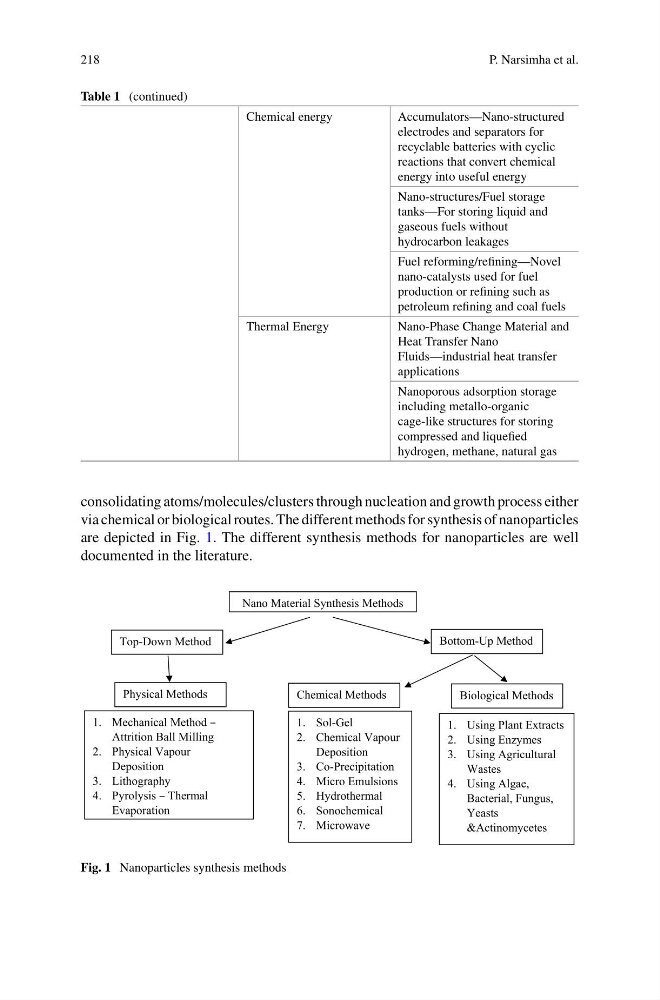
consolidating atoms/molecules/clusters through nucleation and growth process either
via chemical or biological routes. The different methods for synthesis of nanoparticles
are depicted in Fig. 1. The different synthesis methods for nanoparticles are well
documented in the literature.
Bottom-Up Method
Nano Material Synthesis Methods
Top-Down Method
Physical Methods
Chemical Methods
Biological Methods
1. Mechanical Method –
Attrition Ball Milling
2. Physical Vapour
Deposition
3. Lithography
4. Pyrolysis – Thermal
Evaporation
1. Sol-Gel
2. Chemical Vapour
Deposition
3. Co-Precipitation
4. Micro Emulsions
5. Hydrothermal
6. Sonochemical
7. Microwave
1. Using Plant Extracts
2. Using Enzymes
3. Using Agricultural
Wastes
4. Using Algae,
Bacterial, Fungus,
Yeasts
&Actinomycetes
Fig. 1 Nanoparticles synthesis methods
P. Narsimha et al.
Table 1 (continued)
Chemical energy
Accumulators—Nano-structured
electrodes and separators for
recyclable batteries with cyclic
reactions that convert chemical
energy into useful energy
Nano-structures/Fuel storage
tanks—For storing liquid and
gaseous fuels without
hydrocarbon leakages
Fuel reforming/refining—Novel
nano-catalysts used for fuel
production or refining such as
petroleum refining and coal fuels
Thermal Energy
Nano-Phase Change Material and
Heat Transfer Nano
Fluids—industrial heat transfer
applications
Nanoporous adsorption storage
including metallo-organic
cage-like structures for storing
compressed and liquefied
hydrogen, methane, natural gas
consolidating atoms/molecules/clusters through nucleation and growth process either
via chemical or biological routes. The different methods for synthesis of nanoparticles
are depicted in Fig. 1. The different synthesis methods for nanoparticles are well
documented in the literature.
Bottom-Up Method
Nano Material Synthesis Methods
Top-Down Method
Physical Methods
Chemical Methods
Biological Methods
1. Mechanical Method –
Attrition Ball Milling
2. Physical Vapour
Deposition
3. Lithography
4. Pyrolysis – Thermal
Evaporation
1. Sol-Gel
2. Chemical Vapour
Deposition
3. Co-Precipitation
4. Micro Emulsions
5. Hydrothermal
6. Sonochemical
7. Microwave
1. Using Plant Extracts
2. Using Enzymes
3. Using Agricultural
Wastes
4. Using Algae,
Bacterial, Fungus,
Yeasts
&Actinomycetes
Fig. 1 Nanoparticles synthesis methods