

Designing X-Agents Using FLAME
53
• Identify agents and their functions.
• Identify states which impose some order of function execution within
agents.
• Identify input and output messages of each function (including possible
filters on inputs).
• Identify memory as a set of variables, accessed by functions (including
possible conditions on variables for functions to occur).
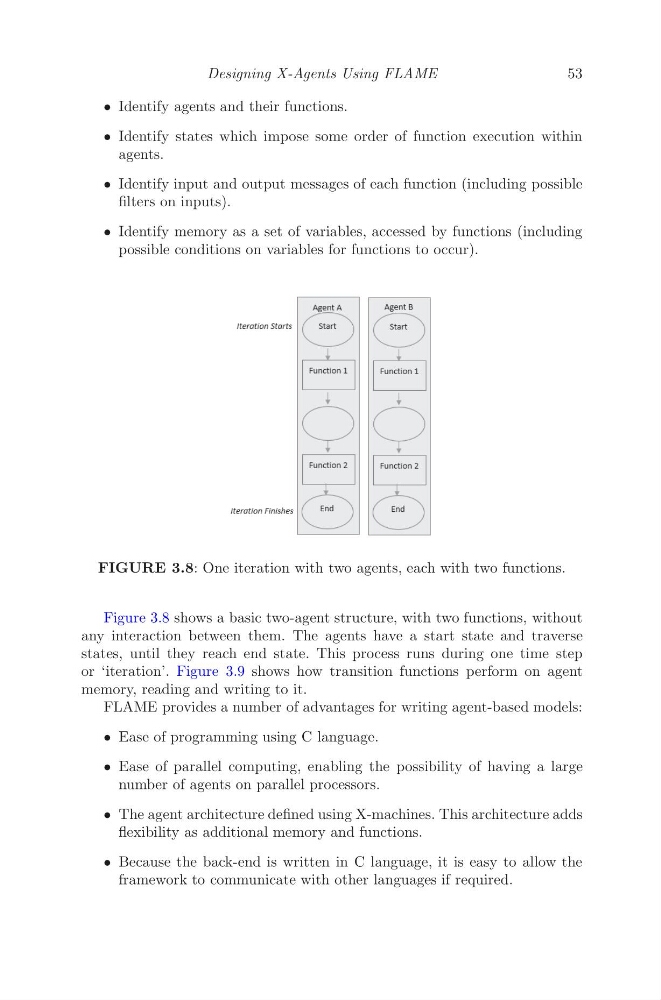
FIGURE 3.8: One iteration with two agents, each with two functions.
Figure 3.8 shows a basic two-agent structure, with two functions, without
any interaction between them. The agents have a start state and traverse
states, until they reach end state. This process runs during one time step
or ‘iteration’. Figure 3.9 shows how transition functions perform on agent
memory, reading and writing to it.
FLAME provides a number of advantages for writing agent-based models:
• Ease of programming using C language.
• Ease of parallel computing, enabling the possibility of having a large
number of agents on parallel processors.
• The agent architecture defined using X-machines. This architecture adds
flexibility as additional memory and functions.
• Because the back-end is written in C language, it is easy to allow the
framework to communicate with other languages if required.
53
• Identify agents and their functions.
• Identify states which impose some order of function execution within
agents.
• Identify input and output messages of each function (including possible
filters on inputs).
• Identify memory as a set of variables, accessed by functions (including
possible conditions on variables for functions to occur).
FIGURE 3.8: One iteration with two agents, each with two functions.
Figure 3.8 shows a basic two-agent structure, with two functions, without
any interaction between them. The agents have a start state and traverse
states, until they reach end state. This process runs during one time step
or ‘iteration’. Figure 3.9 shows how transition functions perform on agent
memory, reading and writing to it.
FLAME provides a number of advantages for writing agent-based models:
• Ease of programming using C language.
• Ease of parallel computing, enabling the possibility of having a large
number of agents on parallel processors.
• The agent architecture defined using X-machines. This architecture adds
flexibility as additional memory and functions.
• Because the back-end is written in C language, it is easy to allow the
framework to communicate with other languages if required.