

108
X-Machines for Agent-Based Modeling: FLAME Perspectives
0
10
20
30
40
50
60
0
20
40
60
80 100 120
Cumilative distribution
Sugar Distribution
overlap
random
separate
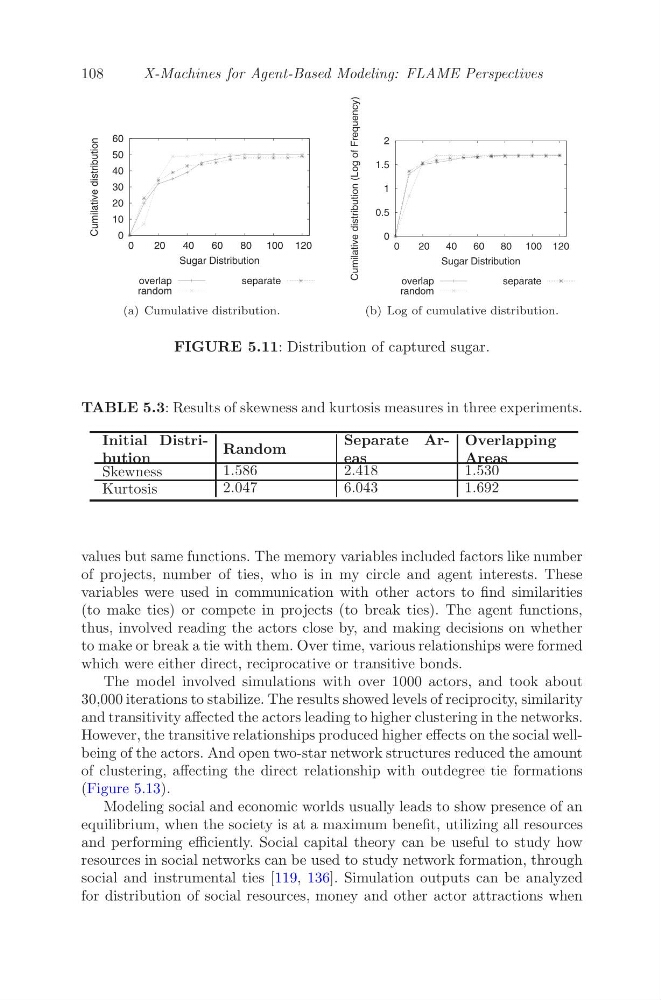
(a) Cumulative distribution.
0
0.5
1
1.5
2
0
20
40
60
80 100 120
Cumilative distribution (Log of Frequency)
Sugar Distribution
overlap
random
separate
(b) Log of cumulative distribution.
FIGURE 5.11: Distribution of captured sugar.
TABLE 5.3: Results of skewness and kurtosis measures in three experiments.
Initial Distribution
Random
Separate Areas
Overlapping
Areas
Skewness
1.586
2.418
1.530
Kurtosis
2.047
6.043
1.692
values but same functions. The memory variables included factors like number
of projects, number of ties, who is in my circle and agent interests. These
variables were used in communication with other actors to find similarities
(to make ties) or compete in projects (to break ties). The agent functions,
thus, involved reading the actors close by, and making decisions on whether
to make or break a tie with them. Over time, various relationships were formed
which were either direct, reciprocative or transitive bonds.
The model involved simulations with over 1000 actors, and took about
30,000 iterations to stabilize. The results showed levels of reciprocity, similarity
and transitivity affected the actors leading to higher clustering in the networks.
However, the transitive relationships produced higher effects on the social wellbeing of the actors. And open two-star network structures reduced the amount
of clustering, affecting the direct relationship with outdegree tie formations
(Figure 5.13).
Modeling social and economic worlds usually leads to show presence of an
equilibrium, when the society is at a maximum benefit, utilizing all resources
and performing efficiently. Social capital theory can be useful to study how
resources in social networks can be used to study network formation, through
social and instrumental ties [119, 136]. Simulation outputs can be analyzed
for distribution of social resources, money and other actor attractions when
X-Machines for Agent-Based Modeling: FLAME Perspectives
0
10
20
30
40
50
60
0
20
40
60
80 100 120
Cumilative distribution
Sugar Distribution
overlap
random
separate
(a) Cumulative distribution.
0
0.5
1
1.5
2
0
20
40
60
80 100 120
Cumilative distribution (Log of Frequency)
Sugar Distribution
overlap
random
separate
(b) Log of cumulative distribution.
FIGURE 5.11: Distribution of captured sugar.
TABLE 5.3: Results of skewness and kurtosis measures in three experiments.
Initial Distribution
Random
Separate Areas
Overlapping
Areas
Skewness
1.586
2.418
1.530
Kurtosis
2.047
6.043
1.692
values but same functions. The memory variables included factors like number
of projects, number of ties, who is in my circle and agent interests. These
variables were used in communication with other actors to find similarities
(to make ties) or compete in projects (to break ties). The agent functions,
thus, involved reading the actors close by, and making decisions on whether
to make or break a tie with them. Over time, various relationships were formed
which were either direct, reciprocative or transitive bonds.
The model involved simulations with over 1000 actors, and took about
30,000 iterations to stabilize. The results showed levels of reciprocity, similarity
and transitivity affected the actors leading to higher clustering in the networks.
However, the transitive relationships produced higher effects on the social wellbeing of the actors. And open two-star network structures reduced the amount
of clustering, affecting the direct relationship with outdegree tie formations
(Figure 5.13).
Modeling social and economic worlds usually leads to show presence of an
equilibrium, when the society is at a maximum benefit, utilizing all resources
and performing efficiently. Social capital theory can be useful to study how
resources in social networks can be used to study network formation, through
social and instrumental ties [119, 136]. Simulation outputs can be analyzed
for distribution of social resources, money and other actor attractions when