

Agents in Social Science
107
0
0.2
0.4
0.6
0.8
1
1.2
1.4
1.6
10 20 30 40 50 60 70
Numbers of Citizens (Log)
Sugar Distribution
(a) At time 100.
0
0.2
0.4
0.6
0.8
1
1.2
1.4
1.6
10 20 30 40 50 60 70
Numbers of Citizens (Log)
Sugar Distribution
(b) At time 200.
0
0.2
0.4
0.6
0.8
1
1.2
1.4
1.6
10 20 30 40 50 60 70
Numbers of Citizens (Log)
Sugar Distribution
(c) At time 350.
0
0.2
0.4
0.6
0.8
1
1.2
1.4
1.6
10 20 30 40 50 60 70
Numbers of Citizens (Log)
Sugar Distribution
(d) At time 500.
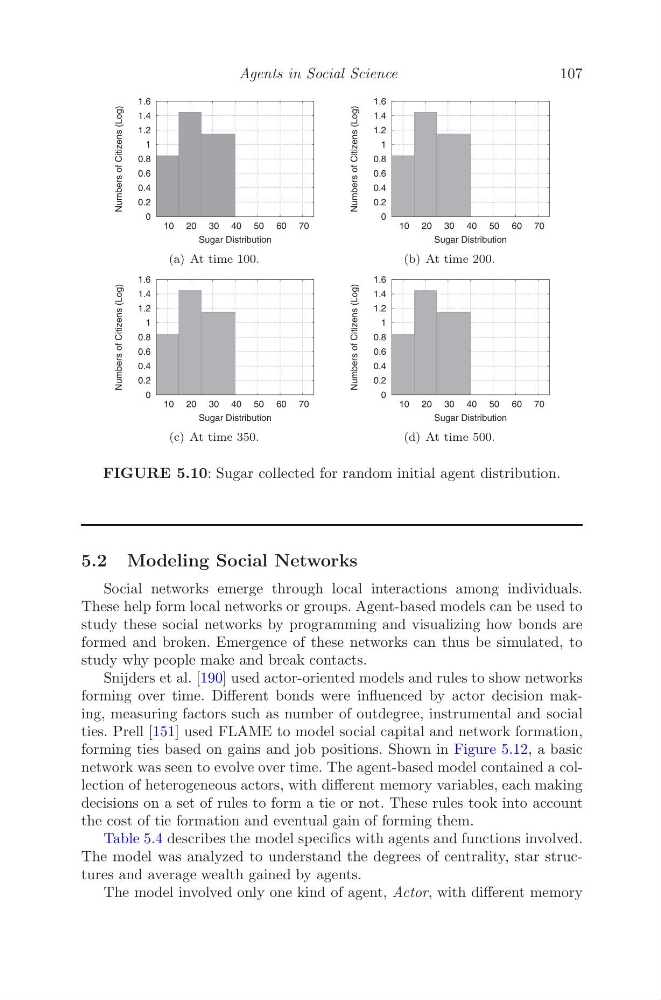
FIGURE 5.10: Sugar collected for random initial agent distribution.
5.2 Modeling Social Networks
Social networks emerge through local interactions among individuals.
These help form local networks or groups. Agent-based models can be used to
study these social networks by programming and visualizing how bonds are
formed and broken. Emergence of these networks can thus be simulated, to
study why people make and break contacts.
Snijders et al. [190] used actor-oriented models and rules to show networks
forming over time. Different bonds were influenced by actor decision making, measuring factors such as number of outdegree, instrumental and social
ties. Prell [151] used FLAME to model social capital and network formation,
forming ties based on gains and job positions. Shown in Figure 5.12, a basic
network was seen to evolve over time. The agent-based model contained a collection of heterogeneous actors, with different memory variables, each making
decisions on a set of rules to form a tie or not. These rules took into account
the cost of tie formation and eventual gain of forming them.
Table 5.4 describes the model specifics with agents and functions involved.
The model was analyzed to understand the degrees of centrality, star structures and average wealth gained by agents.
The model involved only one kind of agent, Actor, with different memory
107
0
0.2
0.4
0.6
0.8
1
1.2
1.4
1.6
10 20 30 40 50 60 70
Numbers of Citizens (Log)
Sugar Distribution
(a) At time 100.
0
0.2
0.4
0.6
0.8
1
1.2
1.4
1.6
10 20 30 40 50 60 70
Numbers of Citizens (Log)
Sugar Distribution
(b) At time 200.
0
0.2
0.4
0.6
0.8
1
1.2
1.4
1.6
10 20 30 40 50 60 70
Numbers of Citizens (Log)
Sugar Distribution
(c) At time 350.
0
0.2
0.4
0.6
0.8
1
1.2
1.4
1.6
10 20 30 40 50 60 70
Numbers of Citizens (Log)
Sugar Distribution
(d) At time 500.
FIGURE 5.10: Sugar collected for random initial agent distribution.
5.2 Modeling Social Networks
Social networks emerge through local interactions among individuals.
These help form local networks or groups. Agent-based models can be used to
study these social networks by programming and visualizing how bonds are
formed and broken. Emergence of these networks can thus be simulated, to
study why people make and break contacts.
Snijders et al. [190] used actor-oriented models and rules to show networks
forming over time. Different bonds were influenced by actor decision making, measuring factors such as number of outdegree, instrumental and social
ties. Prell [151] used FLAME to model social capital and network formation,
forming ties based on gains and job positions. Shown in Figure 5.12, a basic
network was seen to evolve over time. The agent-based model contained a collection of heterogeneous actors, with different memory variables, each making
decisions on a set of rules to form a tie or not. These rules took into account
the cost of tie formation and eventual gain of forming them.
Table 5.4 describes the model specifics with agents and functions involved.
The model was analyzed to understand the degrees of centrality, star structures and average wealth gained by agents.
The model involved only one kind of agent, Actor, with different memory