

M-SERVE and P-SERVE
71
is the cutting stress. The passing and cutting stresses are explicit functions of the
dislocation density, whose evolution is governed by the time-rate of dislocation
density evolution due to mechanisms like multiplication, locking, and annihilation.
In addition to statistically stored dislocations, geometrically necessary dislocations
are considered for local closure of the Burgers circuit, derived from the time rate
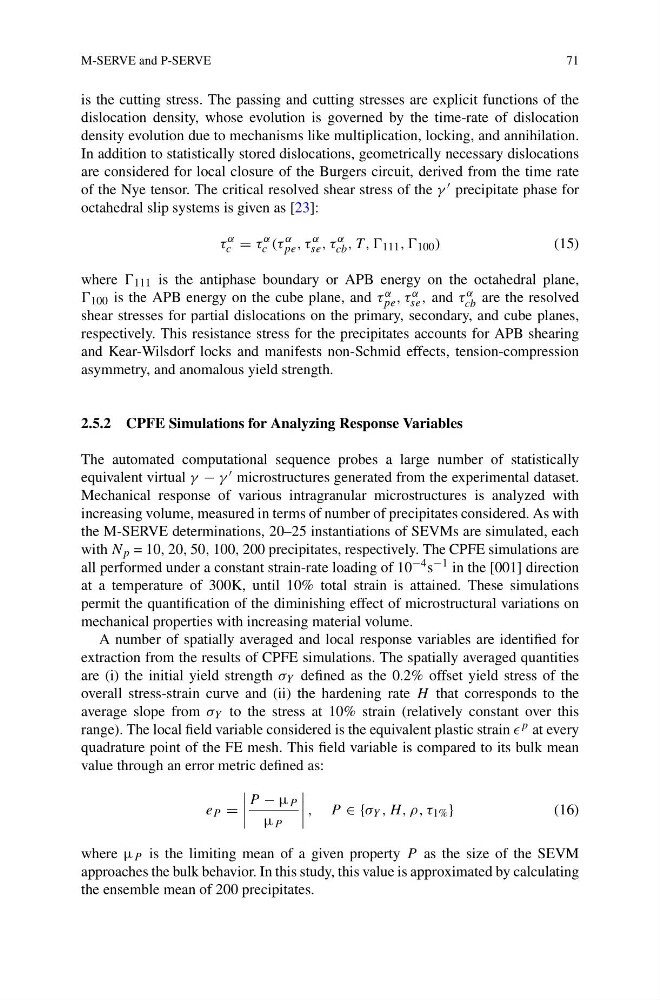
of the Nye tensor. The critical resolved shear stress of the γ precipitate phase for
octahedral slip systems is given as [23]:
τ
α
c = τ
α
c (τ
α
pe , τ
α
se , τ
α
cb , T , , 111 , , 100 )
(15)
where 111 is the antiphase boundary or APB energy on the octahedral plane,
100 is the APB energy on the cube plane, and τ α
pe , τ α
se , and τ α
cb are the resolved
shear stresses for partial dislocations on the primary, secondary, and cube planes,
respectively. This resistance stress for the precipitates accounts for APB shearing
and Kear-Wilsdorf locks and manifests non-Schmid effects, tension-compression
asymmetry, and anomalous yield strength.
2.5.2 CPFE Simulations for Analyzing Response Variables
The automated computational sequence probes a large number of statistically
equivalent virtual γ − γ microstructures generated from the experimental dataset.
Mechanical response of various intragranular microstructures is analyzed with
increasing volume, measured in terms of number of precipitates considered. As with
the M-SERVE determinations, 20–25 instantiations of SEVMs are simulated, each
with N p = 10, 20, 50, 100, 200 precipitates, respectively. The CPFE simulations are
all performed under a constant strain-rate loading of 10 −4 s −1 in the [001] direction
at a temperature of 300K, until 10% total strain is attained. These simulations
permit the quantification of the diminishing effect of microstructural variations on
mechanical properties with increasing material volume.
A number of spatially averaged and local response variables are identified for
extraction from the results of CPFE simulations. The spatially averaged quantities
are (i) the initial yield strength σ Y defined as the 0.2% offset yield stress of the
overall stress-strain curve and (ii) the hardening rate H that corresponds to the
average slope from σ Y to the stress at 10% strain (relatively constant over this
range). The local field variable considered is the equivalent plastic strain p at every
quadrature point of the FE mesh. This field variable is compared to its bulk mean
value through an error metric defined as:
e P =
P − μ P
μ P
, P ∈ {σ Y , H, ρ, τ 1% }
(16)
where μ P is the limiting mean of a given property P as the size of the SEVM
approaches the bulk behavior. In this study, this value is approximated by calculating
the ensemble mean of 200 precipitates.
71
is the cutting stress. The passing and cutting stresses are explicit functions of the
dislocation density, whose evolution is governed by the time-rate of dislocation
density evolution due to mechanisms like multiplication, locking, and annihilation.
In addition to statistically stored dislocations, geometrically necessary dislocations
are considered for local closure of the Burgers circuit, derived from the time rate
of the Nye tensor. The critical resolved shear stress of the γ precipitate phase for
octahedral slip systems is given as [23]:
τ
α
c = τ
α
c (τ
α
pe , τ
α
se , τ
α
cb , T , , 111 , , 100 )
(15)
where 111 is the antiphase boundary or APB energy on the octahedral plane,
100 is the APB energy on the cube plane, and τ α
pe , τ α
se , and τ α
cb are the resolved
shear stresses for partial dislocations on the primary, secondary, and cube planes,
respectively. This resistance stress for the precipitates accounts for APB shearing
and Kear-Wilsdorf locks and manifests non-Schmid effects, tension-compression
asymmetry, and anomalous yield strength.
2.5.2 CPFE Simulations for Analyzing Response Variables
The automated computational sequence probes a large number of statistically
equivalent virtual γ − γ microstructures generated from the experimental dataset.
Mechanical response of various intragranular microstructures is analyzed with
increasing volume, measured in terms of number of precipitates considered. As with
the M-SERVE determinations, 20–25 instantiations of SEVMs are simulated, each
with N p = 10, 20, 50, 100, 200 precipitates, respectively. The CPFE simulations are
all performed under a constant strain-rate loading of 10 −4 s −1 in the [001] direction
at a temperature of 300K, until 10% total strain is attained. These simulations
permit the quantification of the diminishing effect of microstructural variations on
mechanical properties with increasing material volume.
A number of spatially averaged and local response variables are identified for
extraction from the results of CPFE simulations. The spatially averaged quantities
are (i) the initial yield strength σ Y defined as the 0.2% offset yield stress of the
overall stress-strain curve and (ii) the hardening rate H that corresponds to the
average slope from σ Y to the stress at 10% strain (relatively constant over this
range). The local field variable considered is the equivalent plastic strain p at every
quadrature point of the FE mesh. This field variable is compared to its bulk mean
value through an error metric defined as:
e P =
P − μ P
μ P
, P ∈ {σ Y , H, ρ, τ 1% }
(16)
where μ P is the limiting mean of a given property P as the size of the SEVM
approaches the bulk behavior. In this study, this value is approximated by calculating
the ensemble mean of 200 precipitates.