

70
S. Ghosh et al.
volume needed for convergence of mechanical properties and response functions
to within a prescribed level of accuracy. Such properties may be classified into a
spatially averaged and a local category. Spatially averaged properties are mean-field
values over the entire SERVE, such as overall yield strength or hardening rate. Local
properties on the other hand are described in terms of the spatial distribution or the
extreme values of a response variable. Both classes are important when performing
a P-SERVE analysis. In this study, the P-SERVE is determined from convergence
of evolving fields and properties in the microstructure that are evaluated from
dislocation density-based crystal plasticity finite element (DD-CPFE) simulations.
While methods like discrete dislocation dynamics may be more appropriate at
the nm scales of γ channels, their current capabilities are not yet adequate for
simulating the large heterogeneous domains required for this problem.
A sequence of steps is executed to generate microstructure realizations and perform dislocation density-based crystal plasticity finite element (CPFE) simulations.
The steps are summarized below.
• Microstructure Generation: The SEVMs and M-SERVEs of the γ − γ
microstructure are generated.
• Precipitate Smoothing and Meshing: The voxelized precipitates are smoothed
using the Simmetrix code [53] to remove spurious artifacts. The cubic SERVE
is then meshed with four-noded tetrahedral (TET4) elements, capturing the
precipitate geometries.
• Pre-processing: FE input files are generated for the microstructure and loading
conditions.
• FE Simulation: Dislocation density-based crystal plasticity FE simulations with
locking-free TET4 elements are performed for multiple SEVMs.
• Output Extraction: The averaged and local fields are extracted from the CPFE
simulation results for use in analyzing properties.
2.5.1 Crystal Plasticity Models for Ni-Based Superalloys
Finite element simulations of the SEVMs for determining the P-SERVE are conducted with a dislocation density-based crystal plasticity constitutive law, developed
for intragranular γ − γ microstructures of Ni-based superalloys in [19, 23]. A brief
summary of these constitutive equations is provided here. Plastic slip on each slip
system α is governed by a flow rule derived from the Orowan equation for thermally
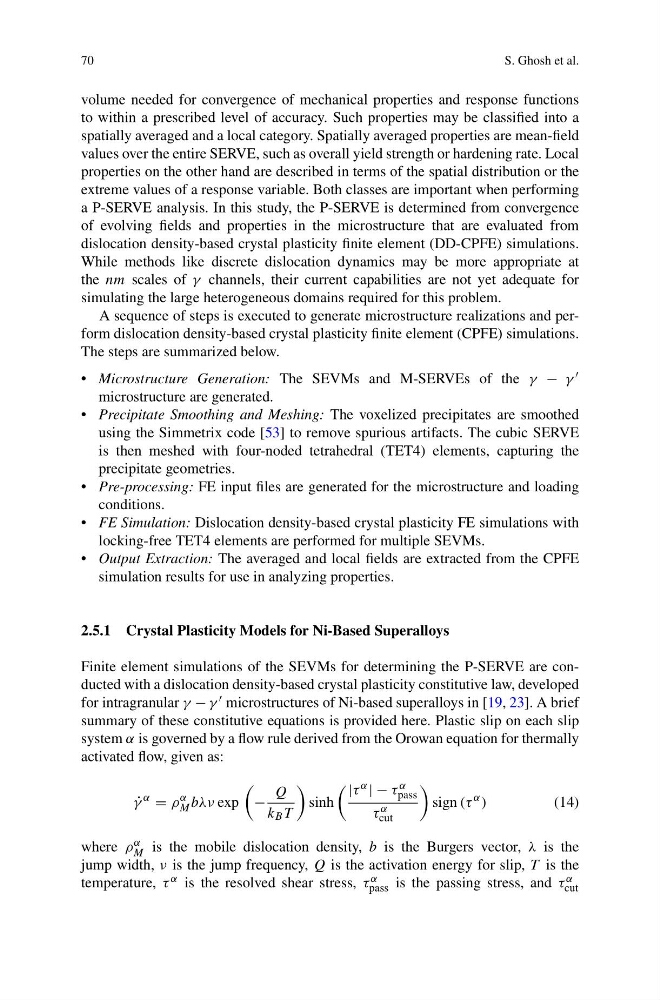
activated flow, given as:
˙
γ
α
= ρ
α
M bλν exp
−
Q
k B T
sinh
|τ α | − τ α
pass
τ α
cut
sign (τ
α )
(14)
where ρ α
M is the mobile dislocation density, b is the Burgers vector, λ is the
jump width, ν is the jump frequency, Q is the activation energy for slip, T is the
temperature, τ α is the resolved shear stress, τ α
pass is the passing stress, and τ α
cut
S. Ghosh et al.
volume needed for convergence of mechanical properties and response functions
to within a prescribed level of accuracy. Such properties may be classified into a
spatially averaged and a local category. Spatially averaged properties are mean-field
values over the entire SERVE, such as overall yield strength or hardening rate. Local
properties on the other hand are described in terms of the spatial distribution or the
extreme values of a response variable. Both classes are important when performing
a P-SERVE analysis. In this study, the P-SERVE is determined from convergence
of evolving fields and properties in the microstructure that are evaluated from
dislocation density-based crystal plasticity finite element (DD-CPFE) simulations.
While methods like discrete dislocation dynamics may be more appropriate at
the nm scales of γ channels, their current capabilities are not yet adequate for
simulating the large heterogeneous domains required for this problem.
A sequence of steps is executed to generate microstructure realizations and perform dislocation density-based crystal plasticity finite element (CPFE) simulations.
The steps are summarized below.
• Microstructure Generation: The SEVMs and M-SERVEs of the γ − γ
microstructure are generated.
• Precipitate Smoothing and Meshing: The voxelized precipitates are smoothed
using the Simmetrix code [53] to remove spurious artifacts. The cubic SERVE
is then meshed with four-noded tetrahedral (TET4) elements, capturing the
precipitate geometries.
• Pre-processing: FE input files are generated for the microstructure and loading
conditions.
• FE Simulation: Dislocation density-based crystal plasticity FE simulations with
locking-free TET4 elements are performed for multiple SEVMs.
• Output Extraction: The averaged and local fields are extracted from the CPFE
simulation results for use in analyzing properties.
2.5.1 Crystal Plasticity Models for Ni-Based Superalloys
Finite element simulations of the SEVMs for determining the P-SERVE are conducted with a dislocation density-based crystal plasticity constitutive law, developed
for intragranular γ − γ microstructures of Ni-based superalloys in [19, 23]. A brief
summary of these constitutive equations is provided here. Plastic slip on each slip
system α is governed by a flow rule derived from the Orowan equation for thermally
activated flow, given as:
˙
γ
α
= ρ
α
M bλν exp
−
Q
k B T
sinh
|τ α | − τ α
pass
τ α
cut
sign (τ
α )
(14)
where ρ α
M is the mobile dislocation density, b is the Burgers vector, λ is the
jump width, ν is the jump frequency, Q is the activation energy for slip, T is the
temperature, τ α is the resolved shear stress, τ α
pass is the passing stress, and τ α
cut