

374
M. Gonzales and N. N. Thadhani
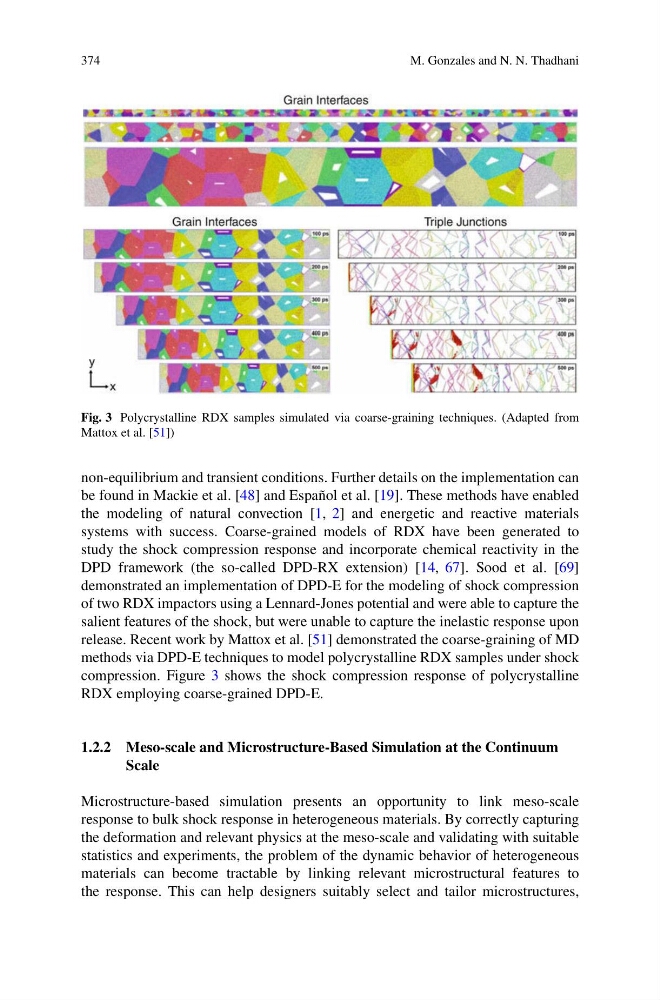
Fig. 3 Polycrystalline RDX samples simulated via coarse-graining techniques. (Adapted from
Mattox et al. [51])
non-equilibrium and transient conditions. Further details on the implementation can
be found in Mackie et al. [48] and Español et al. [19]. These methods have enabled
the modeling of natural convection [1, 2] and energetic and reactive materials
systems with success. Coarse-grained models of RDX have been generated to
study the shock compression response and incorporate chemical reactivity in the
DPD framework (the so-called DPD-RX extension) [14, 67]. Sood et al. [69]
demonstrated an implementation of DPD-E for the modeling of shock compression
of two RDX impactors using a Lennard-Jones potential and were able to capture the
salient features of the shock, but were unable to capture the inelastic response upon
release. Recent work by Mattox et al. [51] demonstrated the coarse-graining of MD
methods via DPD-E techniques to model polycrystalline RDX samples under shock
compression. Figure 3 shows the shock compression response of polycrystalline
RDX employing coarse-grained DPD-E.
1.2.2 Meso-scale and Microstructure-Based Simulation at the Continuum
Scale
Microstructure-based simulation presents an opportunity to link meso-scale
response to bulk shock response in heterogeneous materials. By correctly capturing
the deformation and relevant physics at the meso-scale and validating with suitable
statistics and experiments, the problem of the dynamic behavior of heterogeneous
materials can become tractable by linking relevant microstructural features to
the response. This can help designers suitably select and tailor microstructures,
M. Gonzales and N. N. Thadhani
Fig. 3 Polycrystalline RDX samples simulated via coarse-graining techniques. (Adapted from
Mattox et al. [51])
non-equilibrium and transient conditions. Further details on the implementation can
be found in Mackie et al. [48] and Español et al. [19]. These methods have enabled
the modeling of natural convection [1, 2] and energetic and reactive materials
systems with success. Coarse-grained models of RDX have been generated to
study the shock compression response and incorporate chemical reactivity in the
DPD framework (the so-called DPD-RX extension) [14, 67]. Sood et al. [69]
demonstrated an implementation of DPD-E for the modeling of shock compression
of two RDX impactors using a Lennard-Jones potential and were able to capture the
salient features of the shock, but were unable to capture the inelastic response upon
release. Recent work by Mattox et al. [51] demonstrated the coarse-graining of MD
methods via DPD-E techniques to model polycrystalline RDX samples under shock
compression. Figure 3 shows the shock compression response of polycrystalline
RDX employing coarse-grained DPD-E.
1.2.2 Meso-scale and Microstructure-Based Simulation at the Continuum
Scale
Microstructure-based simulation presents an opportunity to link meso-scale
response to bulk shock response in heterogeneous materials. By correctly capturing
the deformation and relevant physics at the meso-scale and validating with suitable
statistics and experiments, the problem of the dynamic behavior of heterogeneous
materials can become tractable by linking relevant microstructural features to
the response. This can help designers suitably select and tailor microstructures,