

Challenges in Understanding the Dynamic Behavior of Heterogeneous Materials
373
f i = ˙
p i ,
(7)
f ij =
j =i
(F
C
ij + F
D
ij + F
R
ij ),
(8)
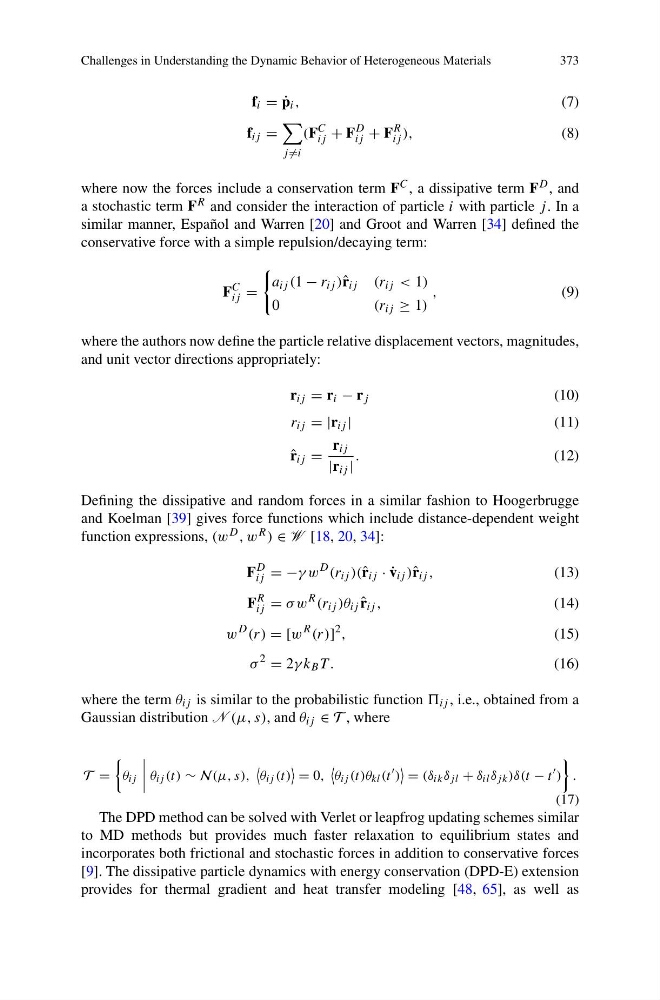
where now the forces include a conservation term F C , a dissipative term F D , and
a stochastic term F R and consider the interaction of particle i with particle j . In a
similar manner, Español and Warren [20] and Groot and Warren [34] defined the
conservative force with a simple repulsion/decaying term:
F
C
ij =
a ij (1 − r ij )ˆ r ij (r ij < 1)
0
(r ij ≥ 1)
,
(9)
where the authors now define the particle relative displacement vectors, magnitudes,
and unit vector directions appropriately:
r ij = r i − r j
(10)
r ij = |r ij |
(11)
ˆ
r ij =
r ij
|r ij |
.
(12)
Defining the dissipative and random forces in a similar fashion to Hoogerbrugge
and Koelman [39] gives force functions which include distance-dependent weight
function expressions, (w D , w R ) ∈ W [18, 20, 34]:
F
D
ij = −γ w
D (r ij )(ˆ r ij · ˙
v ij )ˆ r ij ,
(13)
F
R
ij = σ w
R (r ij )θ ij ˆ
r ij ,
(14)
w
D (r) = [w
R (r)]
2 ,
(15)
σ
2
= 2γ k B T .
(16)
where the term θ ij is similar to the probabilistic function ij , i.e., obtained from a
Gaussian distribution N (μ, s), and θ ij ∈ T , where
T =
θ ij
θ ij (t) ∼ N(μ, s),
θ ij (t)
= 0,
θ ij (t)θ kl (t
)
= (δ ik δ jl + δ il δ jk )δ(t − t
)
.
(17)
The DPD method can be solved with Verlet or leapfrog updating schemes similar
to MD methods but provides much faster relaxation to equilibrium states and
incorporates both frictional and stochastic forces in addition to conservative forces
[9]. The dissipative particle dynamics with energy conservation (DPD-E) extension
provides for thermal gradient and heat transfer modeling [48, 65], as well as
373
f i = ˙
p i ,
(7)
f ij =
j =i
(F
C
ij + F
D
ij + F
R
ij ),
(8)
where now the forces include a conservation term F C , a dissipative term F D , and
a stochastic term F R and consider the interaction of particle i with particle j . In a
similar manner, Español and Warren [20] and Groot and Warren [34] defined the
conservative force with a simple repulsion/decaying term:
F
C
ij =
a ij (1 − r ij )ˆ r ij (r ij < 1)
0
(r ij ≥ 1)
,
(9)
where the authors now define the particle relative displacement vectors, magnitudes,
and unit vector directions appropriately:
r ij = r i − r j
(10)
r ij = |r ij |
(11)
ˆ
r ij =
r ij
|r ij |
.
(12)
Defining the dissipative and random forces in a similar fashion to Hoogerbrugge
and Koelman [39] gives force functions which include distance-dependent weight
function expressions, (w D , w R ) ∈ W [18, 20, 34]:
F
D
ij = −γ w
D (r ij )(ˆ r ij · ˙
v ij )ˆ r ij ,
(13)
F
R
ij = σ w
R (r ij )θ ij ˆ
r ij ,
(14)
w
D (r) = [w
R (r)]
2 ,
(15)
σ
2
= 2γ k B T .
(16)
where the term θ ij is similar to the probabilistic function ij , i.e., obtained from a
Gaussian distribution N (μ, s), and θ ij ∈ T , where
T =
θ ij
θ ij (t) ∼ N(μ, s),
θ ij (t)
= 0,
θ ij (t)θ kl (t
)
= (δ ik δ jl + δ il δ jk )δ(t − t
)
.
(17)
The DPD method can be solved with Verlet or leapfrog updating schemes similar
to MD methods but provides much faster relaxation to equilibrium states and
incorporates both frictional and stochastic forces in addition to conservative forces
[9]. The dissipative particle dynamics with energy conservation (DPD-E) extension
provides for thermal gradient and heat transfer modeling [48, 65], as well as