

Challenges in Understanding the Dynamic Behavior of Heterogeneous Materials
375
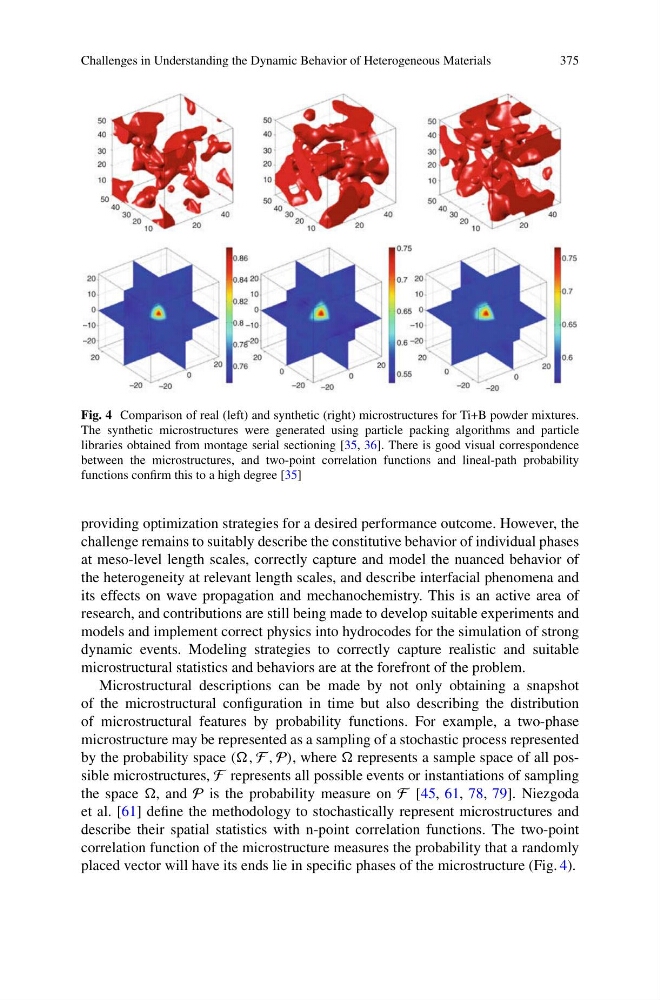
Fig. 4 Comparison of real (left) and synthetic (right) microstructures for Ti+B powder mixtures.
The synthetic microstructures were generated using particle packing algorithms and particle
libraries obtained from montage serial sectioning [35, 36]. There is good visual correspondence
between the microstructures, and two-point correlation functions and lineal-path probability
functions confirm this to a high degree [35]
providing optimization strategies for a desired performance outcome. However, the
challenge remains to suitably describe the constitutive behavior of individual phases
at meso-level length scales, correctly capture and model the nuanced behavior of
the heterogeneity at relevant length scales, and describe interfacial phenomena and
its effects on wave propagation and mechanochemistry. This is an active area of
research, and contributions are still being made to develop suitable experiments and
models and implement correct physics into hydrocodes for the simulation of strong
dynamic events. Modeling strategies to correctly capture realistic and suitable
microstructural statistics and behaviors are at the forefront of the problem.
Microstructural descriptions can be made by not only obtaining a snapshot
of the microstructural configuration in time but also describing the distribution
of microstructural features by probability functions. For example, a two-phase
microstructure may be represented as a sampling of a stochastic process represented
by the probability space ((, F , P), where represents a sample space of all possible microstructures, F represents all possible events or instantiations of sampling
the space , and P is the probability measure on F [45, 61, 78, 79]. Niezgoda
et al. [61] define the methodology to stochastically represent microstructures and
describe their spatial statistics with n-point correlation functions. The two-point
correlation function of the microstructure measures the probability that a randomly
placed vector will have its ends lie in specific phases of the microstructure (Fig. 4).
375
Fig. 4 Comparison of real (left) and synthetic (right) microstructures for Ti+B powder mixtures.
The synthetic microstructures were generated using particle packing algorithms and particle
libraries obtained from montage serial sectioning [35, 36]. There is good visual correspondence
between the microstructures, and two-point correlation functions and lineal-path probability
functions confirm this to a high degree [35]
providing optimization strategies for a desired performance outcome. However, the
challenge remains to suitably describe the constitutive behavior of individual phases
at meso-level length scales, correctly capture and model the nuanced behavior of
the heterogeneity at relevant length scales, and describe interfacial phenomena and
its effects on wave propagation and mechanochemistry. This is an active area of
research, and contributions are still being made to develop suitable experiments and
models and implement correct physics into hydrocodes for the simulation of strong
dynamic events. Modeling strategies to correctly capture realistic and suitable
microstructural statistics and behaviors are at the forefront of the problem.
Microstructural descriptions can be made by not only obtaining a snapshot
of the microstructural configuration in time but also describing the distribution
of microstructural features by probability functions. For example, a two-phase
microstructure may be represented as a sampling of a stochastic process represented
by the probability space ((, F , P), where represents a sample space of all possible microstructures, F represents all possible events or instantiations of sampling
the space , and P is the probability measure on F [45, 61, 78, 79]. Niezgoda
et al. [61] define the methodology to stochastically represent microstructures and
describe their spatial statistics with n-point correlation functions. The two-point
correlation function of the microstructure measures the probability that a randomly
placed vector will have its ends lie in specific phases of the microstructure (Fig. 4).