

342
S. Zacek et al.
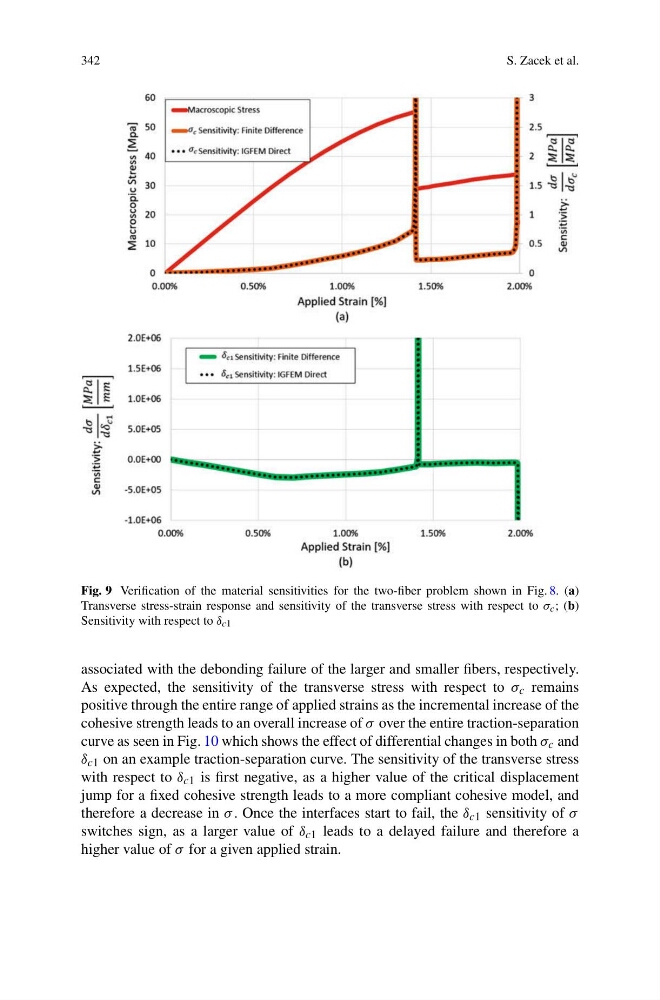
Fig. 9 Verification of the material sensitivities for the two-fiber problem shown in Fig. 8. (a)
Transverse stress-strain response and sensitivity of the transverse stress with respect to σ c ; (b)
Sensitivity with respect to δ c1
associated with the debonding failure of the larger and smaller fibers, respectively.
As expected, the sensitivity of the transverse stress with respect to σ c remains
positive through the entire range of applied strains as the incremental increase of the
cohesive strength leads to an overall increase of σ over the entire traction-separation
curve as seen in Fig. 10 which shows the effect of differential changes in both σ c and
δ c1 on an example traction-separation curve. The sensitivity of the transverse stress
with respect to δ c1 is first negative, as a higher value of the critical displacement
jump for a fixed cohesive strength leads to a more compliant cohesive model, and
therefore a decrease in σ . Once the interfaces start to fail, the δ c1 sensitivity of σ
switches sign, as a larger value of δ c1 leads to a delayed failure and therefore a
higher value of σ for a given applied strain.
S. Zacek et al.
Fig. 9 Verification of the material sensitivities for the two-fiber problem shown in Fig. 8. (a)
Transverse stress-strain response and sensitivity of the transverse stress with respect to σ c ; (b)
Sensitivity with respect to δ c1
associated with the debonding failure of the larger and smaller fibers, respectively.
As expected, the sensitivity of the transverse stress with respect to σ c remains
positive through the entire range of applied strains as the incremental increase of the
cohesive strength leads to an overall increase of σ over the entire traction-separation
curve as seen in Fig. 10 which shows the effect of differential changes in both σ c and
δ c1 on an example traction-separation curve. The sensitivity of the transverse stress
with respect to δ c1 is first negative, as a higher value of the critical displacement
jump for a fixed cohesive strength leads to a more compliant cohesive model, and
therefore a decrease in σ . Once the interfaces start to fail, the δ c1 sensitivity of σ
switches sign, as a larger value of δ c1 leads to a delayed failure and therefore a
higher value of σ for a given applied strain.