

Transverse Failure of Unidirectional Composites: Sensitivity to Interfacial Properties
341
The explicit partial derivative of Equation (2) with respect to σ c yields
∂ n t gp
∂σ c
=
∂ n t
∂σ c
1
n δ
[β
2 n
δ + (1 − β
2 )(
n
δ · n)n],
(18)
where
∂t
∂σ c
is readily obtained from Equation (3) as
∂t
∂σ c
=
⎧
⎪ ⎪ ⎪ ⎨
⎪ ⎪ ⎪ ⎩
2(
δ
δ c1
) − (
δ
δ c1
)
2
if 0 ≤ δ < δ c1 ,
1
i f δ c1 ≤ δ < δ c2 ,
2(
δ−δ c2
δ c3 −δ c2
)
3 − 3(
δ−δ c2
δ c3 −δ c2
)
2 + 1 if δ c2 ≤ δ < δ c3 ,
0
i f δ ≥ δ c3 .
(19)
5 Sensitivity Analysis: Verification
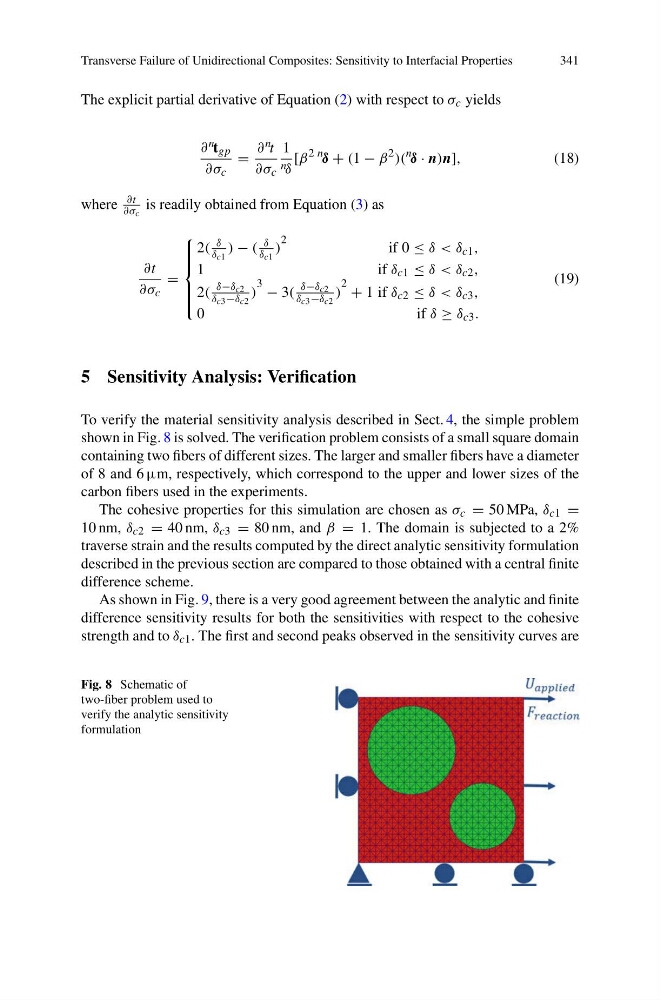
To verify the material sensitivity analysis described in Sect. 4, the simple problem
shown in Fig. 8 is solved. The verification problem consists of a small square domain
containing two fibers of different sizes. The larger and smaller fibers have a diameter
of 8 and 6 μm, respectively, which correspond to the upper and lower sizes of the
carbon fibers used in the experiments.
The cohesive properties for this simulation are chosen as σ c = 50 MPa, δ c1 =
10 nm, δ c2 = 40 nm, δ c3 = 80 nm, and β = 1. The domain is subjected to a 2%
traverse strain and the results computed by the direct analytic sensitivity formulation
described in the previous section are compared to those obtained with a central finite
difference scheme.
As shown in Fig. 9, there is a very good agreement between the analytic and finite
difference sensitivity results for both the sensitivities with respect to the cohesive
strength and to δ c1 . The first and second peaks observed in the sensitivity curves are
Fig. 8 Schematic of
two-fiber problem used to
verify the analytic sensitivity
formulation
341
The explicit partial derivative of Equation (2) with respect to σ c yields
∂ n t gp
∂σ c
=
∂ n t
∂σ c
1
n δ
[β
2 n
δ + (1 − β
2 )(
n
δ · n)n],
(18)
where
∂t
∂σ c
is readily obtained from Equation (3) as
∂t
∂σ c
=
⎧
⎪ ⎪ ⎪ ⎨
⎪ ⎪ ⎪ ⎩
2(
δ
δ c1
) − (
δ
δ c1
)
2
if 0 ≤ δ < δ c1 ,
1
i f δ c1 ≤ δ < δ c2 ,
2(
δ−δ c2
δ c3 −δ c2
)
3 − 3(
δ−δ c2
δ c3 −δ c2
)
2 + 1 if δ c2 ≤ δ < δ c3 ,
0
i f δ ≥ δ c3 .
(19)
5 Sensitivity Analysis: Verification
To verify the material sensitivity analysis described in Sect. 4, the simple problem
shown in Fig. 8 is solved. The verification problem consists of a small square domain
containing two fibers of different sizes. The larger and smaller fibers have a diameter
of 8 and 6 μm, respectively, which correspond to the upper and lower sizes of the
carbon fibers used in the experiments.
The cohesive properties for this simulation are chosen as σ c = 50 MPa, δ c1 =
10 nm, δ c2 = 40 nm, δ c3 = 80 nm, and β = 1. The domain is subjected to a 2%
traverse strain and the results computed by the direct analytic sensitivity formulation
described in the previous section are compared to those obtained with a central finite
difference scheme.
As shown in Fig. 9, there is a very good agreement between the analytic and finite
difference sensitivity results for both the sensitivities with respect to the cohesive
strength and to δ c1 . The first and second peaks observed in the sensitivity curves are
Fig. 8 Schematic of
two-fiber problem used to
verify the analytic sensitivity
formulation