

336
S. Zacek et al.
3.3 Mesoscale Simulations
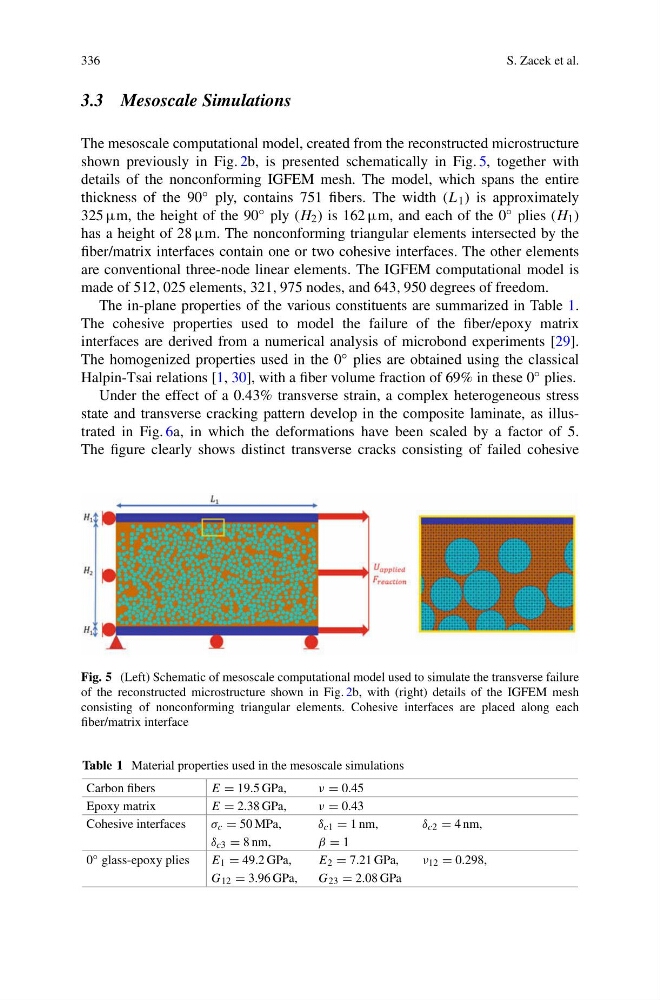
The mesoscale computational model, created from the reconstructed microstructure
shown previously in Fig. 2b, is presented schematically in Fig. 5, together with
details of the nonconforming IGFEM mesh. The model, which spans the entire
thickness of the 90 ◦ ply, contains 751 fibers. The width (L 1 ) is approximately
325 μm, the height of the 90 ◦ ply (H 2 ) is 162 μm, and each of the 0 ◦ plies (H 1 )
has a height of 28 μm. The nonconforming triangular elements intersected by the
fiber/matrix interfaces contain one or two cohesive interfaces. The other elements
are conventional three-node linear elements. The IGFEM computational model is
made of 512, 025 elements, 321, 975 nodes, and 643, 950 degrees of freedom.
The in-plane properties of the various constituents are summarized in Table 1.
The cohesive properties used to model the failure of the fiber/epoxy matrix
interfaces are derived from a numerical analysis of microbond experiments [29].
The homogenized properties used in the 0 ◦ plies are obtained using the classical
Halpin-Tsai relations [1, 30], with a fiber volume fraction of 69% in these 0 ◦ plies.
Under the effect of a 0.43% transverse strain, a complex heterogeneous stress
state and transverse cracking pattern develop in the composite laminate, as illustrated in Fig. 6a, in which the deformations have been scaled by a factor of 5.
The figure clearly shows distinct transverse cracks consisting of failed cohesive
Fig. 5 (Left) Schematic of mesoscale computational model used to simulate the transverse failure
of the reconstructed microstructure shown in Fig. 2b, with (right) details of the IGFEM mesh
consisting of nonconforming triangular elements. Cohesive interfaces are placed along each
fiber/matrix interface
Table 1 Material properties used in the mesoscale simulations
Carbon fibers
E = 19.5 GPa,
ν = 0.45
Epoxy matrix
E = 2.38 GPa,
ν = 0.43
Cohesive interfaces
σ c = 50 MPa,
δ c1 = 1 nm,
δ c2 = 4 nm,
δ c3 = 8 nm,
β = 1
0 ◦ glass-epoxy plies
E 1 = 49.2 GPa,
E 2 = 7.21 GPa,
ν 12 = 0.298,
G 12 = 3.96 GPa,
G 23 = 2.08 GPa
S. Zacek et al.
3.3 Mesoscale Simulations
The mesoscale computational model, created from the reconstructed microstructure
shown previously in Fig. 2b, is presented schematically in Fig. 5, together with
details of the nonconforming IGFEM mesh. The model, which spans the entire
thickness of the 90 ◦ ply, contains 751 fibers. The width (L 1 ) is approximately
325 μm, the height of the 90 ◦ ply (H 2 ) is 162 μm, and each of the 0 ◦ plies (H 1 )
has a height of 28 μm. The nonconforming triangular elements intersected by the
fiber/matrix interfaces contain one or two cohesive interfaces. The other elements
are conventional three-node linear elements. The IGFEM computational model is
made of 512, 025 elements, 321, 975 nodes, and 643, 950 degrees of freedom.
The in-plane properties of the various constituents are summarized in Table 1.
The cohesive properties used to model the failure of the fiber/epoxy matrix
interfaces are derived from a numerical analysis of microbond experiments [29].
The homogenized properties used in the 0 ◦ plies are obtained using the classical
Halpin-Tsai relations [1, 30], with a fiber volume fraction of 69% in these 0 ◦ plies.
Under the effect of a 0.43% transverse strain, a complex heterogeneous stress
state and transverse cracking pattern develop in the composite laminate, as illustrated in Fig. 6a, in which the deformations have been scaled by a factor of 5.
The figure clearly shows distinct transverse cracks consisting of failed cohesive
Fig. 5 (Left) Schematic of mesoscale computational model used to simulate the transverse failure
of the reconstructed microstructure shown in Fig. 2b, with (right) details of the IGFEM mesh
consisting of nonconforming triangular elements. Cohesive interfaces are placed along each
fiber/matrix interface
Table 1 Material properties used in the mesoscale simulations
Carbon fibers
E = 19.5 GPa,
ν = 0.45
Epoxy matrix
E = 2.38 GPa,
ν = 0.43
Cohesive interfaces
σ c = 50 MPa,
δ c1 = 1 nm,
δ c2 = 4 nm,
δ c3 = 8 nm,
β = 1
0 ◦ glass-epoxy plies
E 1 = 49.2 GPa,
E 2 = 7.21 GPa,
ν 12 = 0.298,
G 12 = 3.96 GPa,
G 23 = 2.08 GPa