

Transverse Failure of Unidirectional Composites: Sensitivity to Interfacial Properties
335
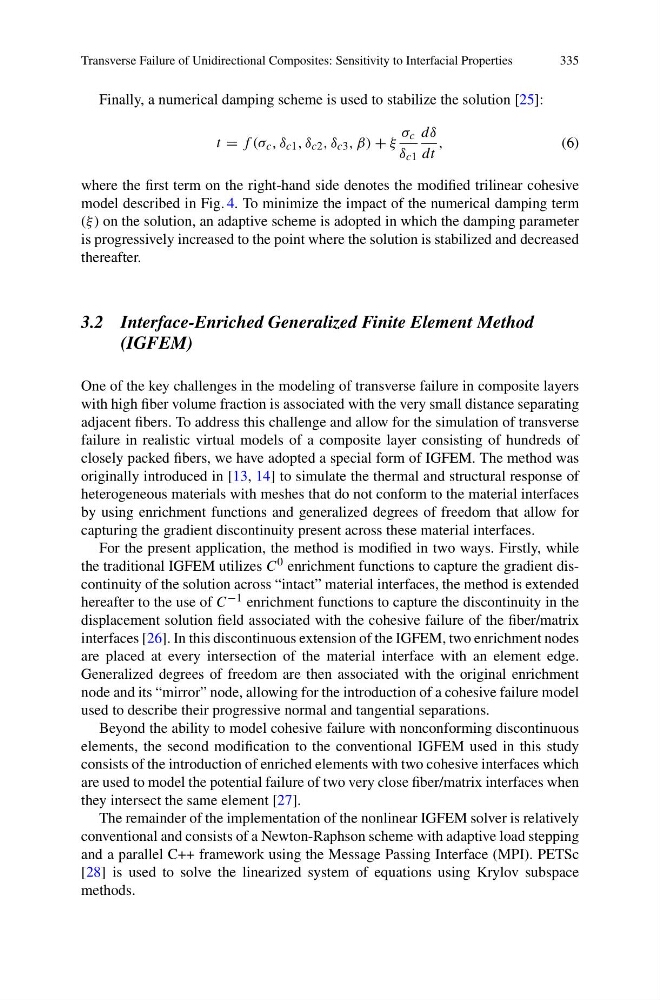
Finally, a numerical damping scheme is used to stabilize the solution [25]:
t = f (σ c , δ c1 , δ c2 , δ c3 , β) + ξ
σ c
δ c1
dδ
dt
,
(6)
where the first term on the right-hand side denotes the modified trilinear cohesive
model described in Fig. 4. To minimize the impact of the numerical damping term
(ξ ) on the solution, an adaptive scheme is adopted in which the damping parameter
is progressively increased to the point where the solution is stabilized and decreased
thereafter.
3.2 Interface-Enriched Generalized Finite Element Method
(IGFEM)
One of the key challenges in the modeling of transverse failure in composite layers
with high fiber volume fraction is associated with the very small distance separating
adjacent fibers. To address this challenge and allow for the simulation of transverse
failure in realistic virtual models of a composite layer consisting of hundreds of
closely packed fibers, we have adopted a special form of IGFEM. The method was
originally introduced in [13, 14] to simulate the thermal and structural response of
heterogeneous materials with meshes that do not conform to the material interfaces
by using enrichment functions and generalized degrees of freedom that allow for
capturing the gradient discontinuity present across these material interfaces.
For the present application, the method is modified in two ways. Firstly, while
the traditional IGFEM utilizes C 0 enrichment functions to capture the gradient discontinuity of the solution across “intact” material interfaces, the method is extended
hereafter to the use of C −1 enrichment functions to capture the discontinuity in the
displacement solution field associated with the cohesive failure of the fiber/matrix
interfaces [26]. In this discontinuous extension of the IGFEM, two enrichment nodes
are placed at every intersection of the material interface with an element edge.
Generalized degrees of freedom are then associated with the original enrichment
node and its “mirror” node, allowing for the introduction of a cohesive failure model
used to describe their progressive normal and tangential separations.
Beyond the ability to model cohesive failure with nonconforming discontinuous
elements, the second modification to the conventional IGFEM used in this study
consists of the introduction of enriched elements with two cohesive interfaces which
are used to model the potential failure of two very close fiber/matrix interfaces when
they intersect the same element [27].
The remainder of the implementation of the nonlinear IGFEM solver is relatively
conventional and consists of a Newton-Raphson scheme with adaptive load stepping
and a parallel C++ framework using the Message Passing Interface (MPI). PETSc
[28] is used to solve the linearized system of equations using Krylov subspace
methods.
335
Finally, a numerical damping scheme is used to stabilize the solution [25]:
t = f (σ c , δ c1 , δ c2 , δ c3 , β) + ξ
σ c
δ c1
dδ
dt
,
(6)
where the first term on the right-hand side denotes the modified trilinear cohesive
model described in Fig. 4. To minimize the impact of the numerical damping term
(ξ ) on the solution, an adaptive scheme is adopted in which the damping parameter
is progressively increased to the point where the solution is stabilized and decreased
thereafter.
3.2 Interface-Enriched Generalized Finite Element Method
(IGFEM)
One of the key challenges in the modeling of transverse failure in composite layers
with high fiber volume fraction is associated with the very small distance separating
adjacent fibers. To address this challenge and allow for the simulation of transverse
failure in realistic virtual models of a composite layer consisting of hundreds of
closely packed fibers, we have adopted a special form of IGFEM. The method was
originally introduced in [13, 14] to simulate the thermal and structural response of
heterogeneous materials with meshes that do not conform to the material interfaces
by using enrichment functions and generalized degrees of freedom that allow for
capturing the gradient discontinuity present across these material interfaces.
For the present application, the method is modified in two ways. Firstly, while
the traditional IGFEM utilizes C 0 enrichment functions to capture the gradient discontinuity of the solution across “intact” material interfaces, the method is extended
hereafter to the use of C −1 enrichment functions to capture the discontinuity in the
displacement solution field associated with the cohesive failure of the fiber/matrix
interfaces [26]. In this discontinuous extension of the IGFEM, two enrichment nodes
are placed at every intersection of the material interface with an element edge.
Generalized degrees of freedom are then associated with the original enrichment
node and its “mirror” node, allowing for the introduction of a cohesive failure model
used to describe their progressive normal and tangential separations.
Beyond the ability to model cohesive failure with nonconforming discontinuous
elements, the second modification to the conventional IGFEM used in this study
consists of the introduction of enriched elements with two cohesive interfaces which
are used to model the potential failure of two very close fiber/matrix interfaces when
they intersect the same element [27].
The remainder of the implementation of the nonlinear IGFEM solver is relatively
conventional and consists of a Newton-Raphson scheme with adaptive load stepping
and a parallel C++ framework using the Message Passing Interface (MPI). PETSc
[28] is used to solve the linearized system of equations using Krylov subspace
methods.