

312
S. Ghosh et al.
Fig. 8 Contour plot showing the difference in the maximum principal stresses in the SERVE for:
(a) ATDBC and ESBC using S 2 (r, θ) (b) ESBCs using S 2 (r) and S 2 (r, θ), normalized by the
matrix modulus. (Reprinted from: Kubair and Ghosh [35])
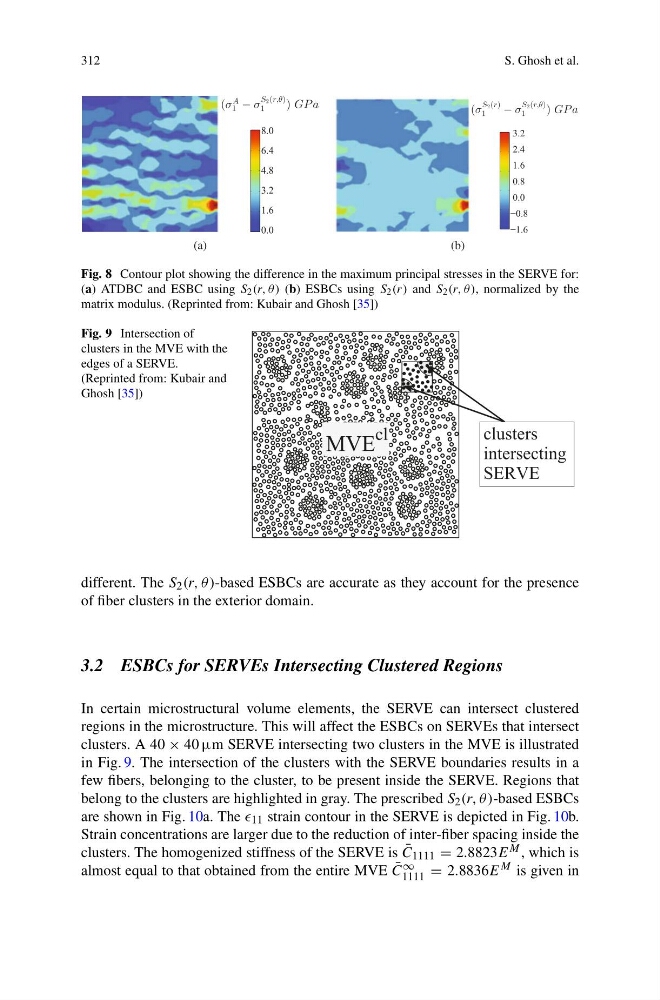
Fig. 9 Intersection of
clusters in the MVE with the
edges of a SERVE.
(Reprinted from: Kubair and
Ghosh [35])
different. The S 2 (r, θ )-based ESBCs are accurate as they account for the presence
of fiber clusters in the exterior domain.
3.2 ESBCs for SERVEs Intersecting Clustered Regions
In certain microstructural volume elements, the SERVE can intersect clustered
regions in the microstructure. This will affect the ESBCs on SERVEs that intersect
clusters. A 40 × 40 μm SERVE intersecting two clusters in the MVE is illustrated
in Fig. 9. The intersection of the clusters with the SERVE boundaries results in a
few fibers, belonging to the cluster, to be present inside the SERVE. Regions that
belong to the clusters are highlighted in gray. The prescribed S 2 (r, θ )-based ESBCs
are shown in Fig. 10a. The 11 strain contour in the SERVE is depicted in Fig. 10b.
Strain concentrations are larger due to the reduction of inter-fiber spacing inside the
clusters. The homogenized stiffness of the SERVE is ¯
C 1111 = 2.8823E M , which is
almost equal to that obtained from the entire MVE ¯
C ∞
1111 = 2.8836E M is given in
S. Ghosh et al.
Fig. 8 Contour plot showing the difference in the maximum principal stresses in the SERVE for:
(a) ATDBC and ESBC using S 2 (r, θ) (b) ESBCs using S 2 (r) and S 2 (r, θ), normalized by the
matrix modulus. (Reprinted from: Kubair and Ghosh [35])
Fig. 9 Intersection of
clusters in the MVE with the
edges of a SERVE.
(Reprinted from: Kubair and
Ghosh [35])
different. The S 2 (r, θ )-based ESBCs are accurate as they account for the presence
of fiber clusters in the exterior domain.
3.2 ESBCs for SERVEs Intersecting Clustered Regions
In certain microstructural volume elements, the SERVE can intersect clustered
regions in the microstructure. This will affect the ESBCs on SERVEs that intersect
clusters. A 40 × 40 μm SERVE intersecting two clusters in the MVE is illustrated
in Fig. 9. The intersection of the clusters with the SERVE boundaries results in a
few fibers, belonging to the cluster, to be present inside the SERVE. Regions that
belong to the clusters are highlighted in gray. The prescribed S 2 (r, θ )-based ESBCs
are shown in Fig. 10a. The 11 strain contour in the SERVE is depicted in Fig. 10b.
Strain concentrations are larger due to the reduction of inter-fiber spacing inside the
clusters. The homogenized stiffness of the SERVE is ¯
C 1111 = 2.8823E M , which is
almost equal to that obtained from the entire MVE ¯
C ∞
1111 = 2.8836E M is given in