

262
D. Patel et al.
orientation g o in a spatial bin s, the corresponding GSH coefficients are simply given
by
M
μn
ls = (2l + 1) ˙ ˙
T
μn∗
l
(g o )
(4)
For simplicity of notation, we will simply map every distinct combination of
(l, μ, n) to a single index L in all of the ensuing equations. As a result of this
simplification, M
μn
ls will be henceforth denoted simply as M L
s . Extending the
concept above to the description of the two-point spatial (Eq. 1) correlations, the
orientations in the polycrystalline microstructure can be expressed as
f
g, g
r
≈
K
L
S
t=1
F
LK
t
˙ ˙
T
L
(g) ˙ ˙
T
K
g
χ t (r)
(5)
As mentioned earlier, the set of two-point statistics yields a large and unwieldy
dataset. A lower dimensional representation can similarly be sought using PCA.
Over the past decade, numerous structure-property linkage studies are illustrated to
predict the bulk properties of polycrystalline microstructure using the framework.
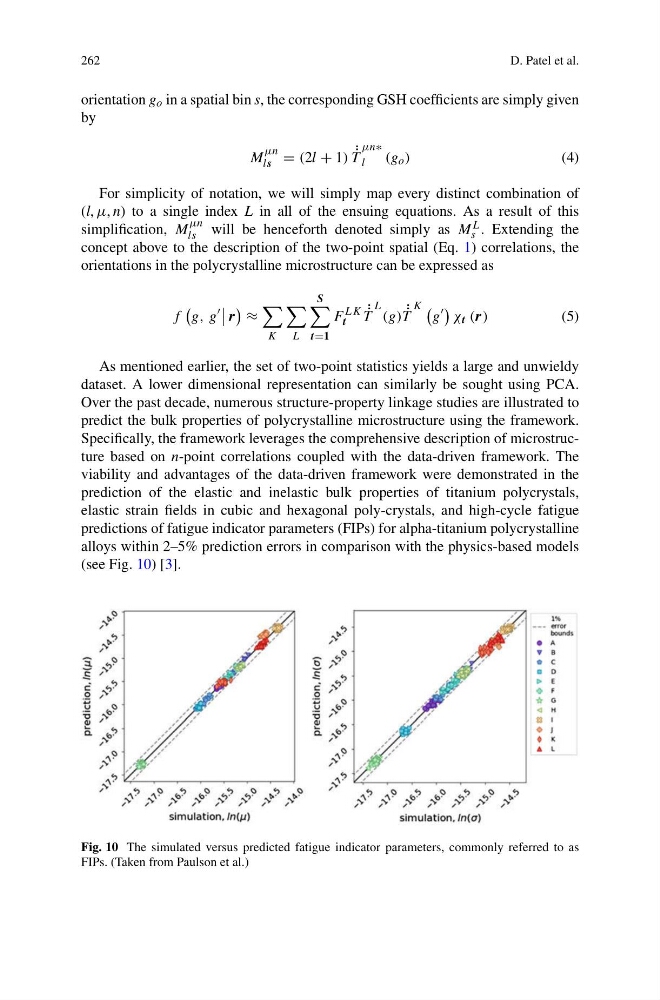
Specifically, the framework leverages the comprehensive description of microstructure based on n-point correlations coupled with the data-driven framework. The
viability and advantages of the data-driven framework were demonstrated in the
prediction of the elastic and inelastic bulk properties of titanium polycrystals,
elastic strain fields in cubic and hexagonal poly-crystals, and high-cycle fatigue
predictions of fatigue indicator parameters (FIPs) for alpha-titanium polycrystalline
alloys within 2–5% prediction errors in comparison with the physics-based models
(see Fig. 10) [3].
Fig. 10 The simulated versus predicted fatigue indicator parameters, commonly referred to as
FIPs. (Taken from Paulson et al.)
D. Patel et al.
orientation g o in a spatial bin s, the corresponding GSH coefficients are simply given
by
M
μn
ls = (2l + 1) ˙ ˙
T
μn∗
l
(g o )
(4)
For simplicity of notation, we will simply map every distinct combination of
(l, μ, n) to a single index L in all of the ensuing equations. As a result of this
simplification, M
μn
ls will be henceforth denoted simply as M L
s . Extending the
concept above to the description of the two-point spatial (Eq. 1) correlations, the
orientations in the polycrystalline microstructure can be expressed as
f
g, g
r
≈
K
L
S
t=1
F
LK
t
˙ ˙
T
L
(g) ˙ ˙
T
K
g
χ t (r)
(5)
As mentioned earlier, the set of two-point statistics yields a large and unwieldy
dataset. A lower dimensional representation can similarly be sought using PCA.
Over the past decade, numerous structure-property linkage studies are illustrated to
predict the bulk properties of polycrystalline microstructure using the framework.
Specifically, the framework leverages the comprehensive description of microstructure based on n-point correlations coupled with the data-driven framework. The
viability and advantages of the data-driven framework were demonstrated in the
prediction of the elastic and inelastic bulk properties of titanium polycrystals,
elastic strain fields in cubic and hexagonal poly-crystals, and high-cycle fatigue
predictions of fatigue indicator parameters (FIPs) for alpha-titanium polycrystalline
alloys within 2–5% prediction errors in comparison with the physics-based models
(see Fig. 10) [3].
Fig. 10 The simulated versus predicted fatigue indicator parameters, commonly referred to as
FIPs. (Taken from Paulson et al.)