

Material Agnostic Data-Driven Framework to Develop Structure-Property Linkages
261
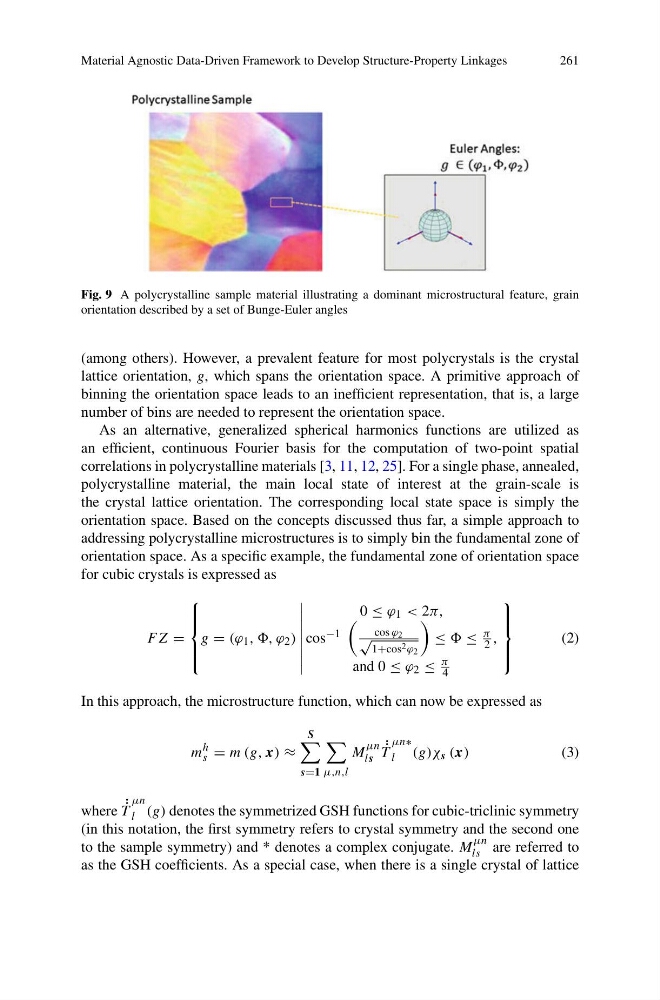
Fig. 9 A polycrystalline sample material illustrating a dominant microstructural feature, grain
orientation described by a set of Bunge-Euler angles
(among others). However, a prevalent feature for most polycrystals is the crystal
lattice orientation, g, which spans the orientation space. A primitive approach of
binning the orientation space leads to an inefficient representation, that is, a large
number of bins are needed to represent the orientation space.
As an alternative, generalized spherical harmonics functions are utilized as
an efficient, continuous Fourier basis for the computation of two-point spatial
correlations in polycrystalline materials [3, 11, 12, 25]. For a single phase, annealed,
polycrystalline material, the main local state of interest at the grain-scale is
the crystal lattice orientation. The corresponding local state space is simply the
orientation space. Based on the concepts discussed thus far, a simple approach to
addressing polycrystalline microstructures is to simply bin the fundamental zone of
orientation space. As a specific example, the fundamental zone of orientation space
for cubic crystals is expressed as
F Z =
⎧
⎪ ⎪ ⎨
⎪ ⎪ ⎩
g = (ϕ 1 , ,, ϕ 2 )
0 ≤ ϕ 1 < 2π,
cos −1
cos ϕ 2
√
1+cos 2 ϕ 2
≤ ≤
π
2 ,
and 0 ≤ ϕ 2 ≤
π
4
⎫
⎪ ⎪ ⎬
⎪ ⎪ ⎭
(2)
In this approach, the microstructure function, which can now be expressed as
m
h
s = m (g, x) ≈
S
s=1
μ,n,l
M
μn
ls
˙ ˙
T
μn∗
l
(g)χ s (x)
(3)
where ˙ ˙
T
μn
l (g) denotes the symmetrized GSH functions for cubic-triclinic symmetry
(in this notation, the first symmetry refers to crystal symmetry and the second one
to the sample symmetry) and * denotes a complex conjugate. M
μn
ls are referred to
as the GSH coefficients. As a special case, when there is a single crystal of lattice
261
Fig. 9 A polycrystalline sample material illustrating a dominant microstructural feature, grain
orientation described by a set of Bunge-Euler angles
(among others). However, a prevalent feature for most polycrystals is the crystal
lattice orientation, g, which spans the orientation space. A primitive approach of
binning the orientation space leads to an inefficient representation, that is, a large
number of bins are needed to represent the orientation space.
As an alternative, generalized spherical harmonics functions are utilized as
an efficient, continuous Fourier basis for the computation of two-point spatial
correlations in polycrystalline materials [3, 11, 12, 25]. For a single phase, annealed,
polycrystalline material, the main local state of interest at the grain-scale is
the crystal lattice orientation. The corresponding local state space is simply the
orientation space. Based on the concepts discussed thus far, a simple approach to
addressing polycrystalline microstructures is to simply bin the fundamental zone of
orientation space. As a specific example, the fundamental zone of orientation space
for cubic crystals is expressed as
F Z =
⎧
⎪ ⎪ ⎨
⎪ ⎪ ⎩
g = (ϕ 1 , ,, ϕ 2 )
0 ≤ ϕ 1 < 2π,
cos −1
cos ϕ 2
√
1+cos 2 ϕ 2
≤ ≤
π
2 ,
and 0 ≤ ϕ 2 ≤
π
4
⎫
⎪ ⎪ ⎬
⎪ ⎪ ⎭
(2)
In this approach, the microstructure function, which can now be expressed as
m
h
s = m (g, x) ≈
S
s=1
μ,n,l
M
μn
ls
˙ ˙
T
μn∗
l
(g)χ s (x)
(3)
where ˙ ˙
T
μn
l (g) denotes the symmetrized GSH functions for cubic-triclinic symmetry
(in this notation, the first symmetry refers to crystal symmetry and the second one
to the sample symmetry) and * denotes a complex conjugate. M
μn
ls are referred to
as the GSH coefficients. As a special case, when there is a single crystal of lattice