

260
D. Patel et al.
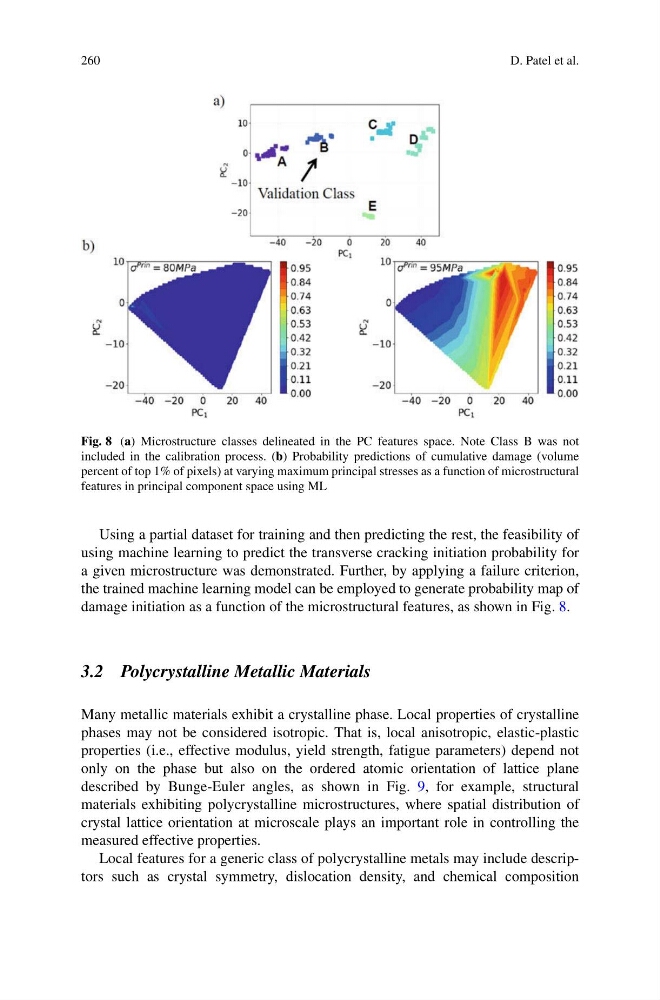
Fig. 8 (a) Microstructure classes delineated in the PC features space. Note Class B was not
included in the calibration process. (b) Probability predictions of cumulative damage (volume
percent of top 1% of pixels) at varying maximum principal stresses as a function of microstructural
features in principal component space using ML
Using a partial dataset for training and then predicting the rest, the feasibility of
using machine learning to predict the transverse cracking initiation probability for
a given microstructure was demonstrated. Further, by applying a failure criterion,
the trained machine learning model can be employed to generate probability map of
damage initiation as a function of the microstructural features, as shown in Fig. 8.
3.2 Polycrystalline Metallic Materials
Many metallic materials exhibit a crystalline phase. Local properties of crystalline
phases may not be considered isotropic. That is, local anisotropic, elastic-plastic
properties (i.e., effective modulus, yield strength, fatigue parameters) depend not
only on the phase but also on the ordered atomic orientation of lattice plane
described by Bunge-Euler angles, as shown in Fig. 9, for example, structural
materials exhibiting polycrystalline microstructures, where spatial distribution of
crystal lattice orientation at microscale plays an important role in controlling the
measured effective properties.
Local features for a generic class of polycrystalline metals may include descriptors such as crystal symmetry, dislocation density, and chemical composition
D. Patel et al.
Fig. 8 (a) Microstructure classes delineated in the PC features space. Note Class B was not
included in the calibration process. (b) Probability predictions of cumulative damage (volume
percent of top 1% of pixels) at varying maximum principal stresses as a function of microstructural
features in principal component space using ML
Using a partial dataset for training and then predicting the rest, the feasibility of
using machine learning to predict the transverse cracking initiation probability for
a given microstructure was demonstrated. Further, by applying a failure criterion,
the trained machine learning model can be employed to generate probability map of
damage initiation as a function of the microstructural features, as shown in Fig. 8.
3.2 Polycrystalline Metallic Materials
Many metallic materials exhibit a crystalline phase. Local properties of crystalline
phases may not be considered isotropic. That is, local anisotropic, elastic-plastic
properties (i.e., effective modulus, yield strength, fatigue parameters) depend not
only on the phase but also on the ordered atomic orientation of lattice plane
described by Bunge-Euler angles, as shown in Fig. 9, for example, structural
materials exhibiting polycrystalline microstructures, where spatial distribution of
crystal lattice orientation at microscale plays an important role in controlling the
measured effective properties.
Local features for a generic class of polycrystalline metals may include descriptors such as crystal symmetry, dislocation density, and chemical composition