

Material Agnostic Data-Driven Framework to Develop Structure-Property Linkages
263
This data-driven framework has also been applied to polymeric materials as well.
In particular, the transport properties of porous microstructures used in fuel cell
applications were linked to the microstructural features of polymers, a gas diffusion
layer (GDL), and the microporous layers (MPL) [6]. It was clearly shown that
the diffusivity coefficient prediction from the data-driven model outperforms the
conventional semi-empirical correlations.
Further, the data-driven framework was applied to inverse design problems to
extract single crystal elastic-plastic properties of a polycrystalline sample. A datadriven model was calibrated using a physics-based model of nanoindentation to
establish the relationship between the input parameters, that is, elastic constants,
yield strength, and hardening parameters on the indentation stress-strain response
[19, 26]. In particular, a functional dependence (i.e., calibrated model) of respective
elastic-plastic properties extracted from the indentation stress-strain curve on its
input parameters (e.g., elastic stiffness constants and initial slip resistance) was
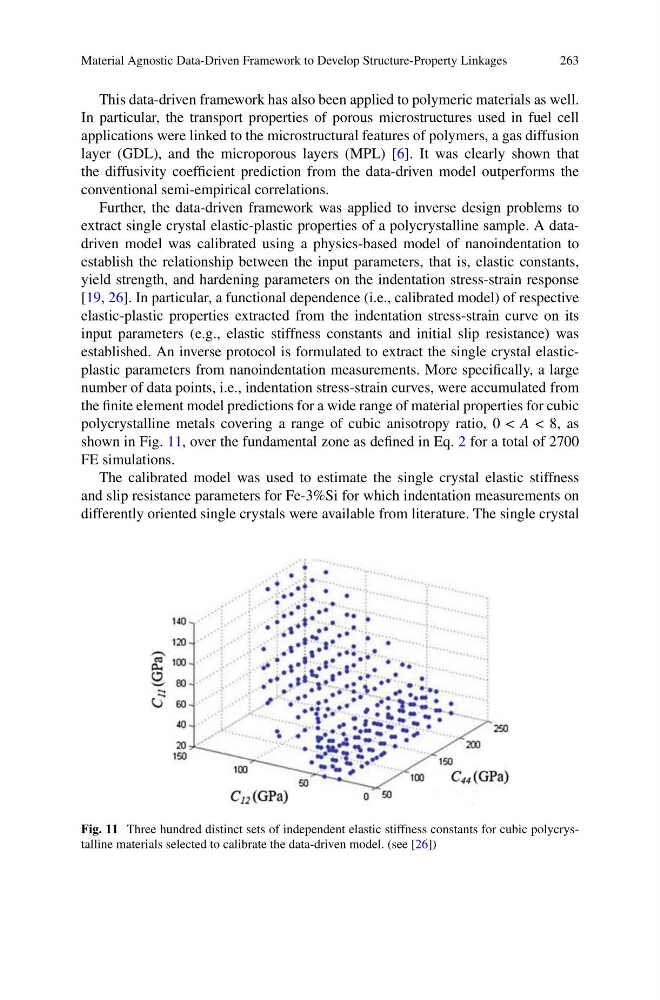
established. An inverse protocol is formulated to extract the single crystal elasticplastic parameters from nanoindentation measurements. More specifically, a large
number of data points, i.e., indentation stress-strain curves, were accumulated from
the finite element model predictions for a wide range of material properties for cubic
polycrystalline metals covering a range of cubic anisotropy ratio, 0 < A < 8, as
shown in Fig. 11, over the fundamental zone as defined in Eq. 2 for a total of 2700
FE simulations.
The calibrated model was used to estimate the single crystal elastic stiffness
and slip resistance parameters for Fe-3%Si for which indentation measurements on
differently oriented single crystals were available from literature. The single crystal
Fig. 11 Three hundred distinct sets of independent elastic stiffness constants for cubic polycrystalline materials selected to calibrate the data-driven model. (see [26])
263
This data-driven framework has also been applied to polymeric materials as well.
In particular, the transport properties of porous microstructures used in fuel cell
applications were linked to the microstructural features of polymers, a gas diffusion
layer (GDL), and the microporous layers (MPL) [6]. It was clearly shown that
the diffusivity coefficient prediction from the data-driven model outperforms the
conventional semi-empirical correlations.
Further, the data-driven framework was applied to inverse design problems to
extract single crystal elastic-plastic properties of a polycrystalline sample. A datadriven model was calibrated using a physics-based model of nanoindentation to
establish the relationship between the input parameters, that is, elastic constants,
yield strength, and hardening parameters on the indentation stress-strain response
[19, 26]. In particular, a functional dependence (i.e., calibrated model) of respective
elastic-plastic properties extracted from the indentation stress-strain curve on its
input parameters (e.g., elastic stiffness constants and initial slip resistance) was
established. An inverse protocol is formulated to extract the single crystal elasticplastic parameters from nanoindentation measurements. More specifically, a large
number of data points, i.e., indentation stress-strain curves, were accumulated from
the finite element model predictions for a wide range of material properties for cubic
polycrystalline metals covering a range of cubic anisotropy ratio, 0 < A < 8, as
shown in Fig. 11, over the fundamental zone as defined in Eq. 2 for a total of 2700
FE simulations.
The calibrated model was used to estimate the single crystal elastic stiffness
and slip resistance parameters for Fe-3%Si for which indentation measurements on
differently oriented single crystals were available from literature. The single crystal
Fig. 11 Three hundred distinct sets of independent elastic stiffness constants for cubic polycrystalline materials selected to calibrate the data-driven model. (see [26])