

A Framework for Quantifying Effects of Characterization Error on the. . .
239
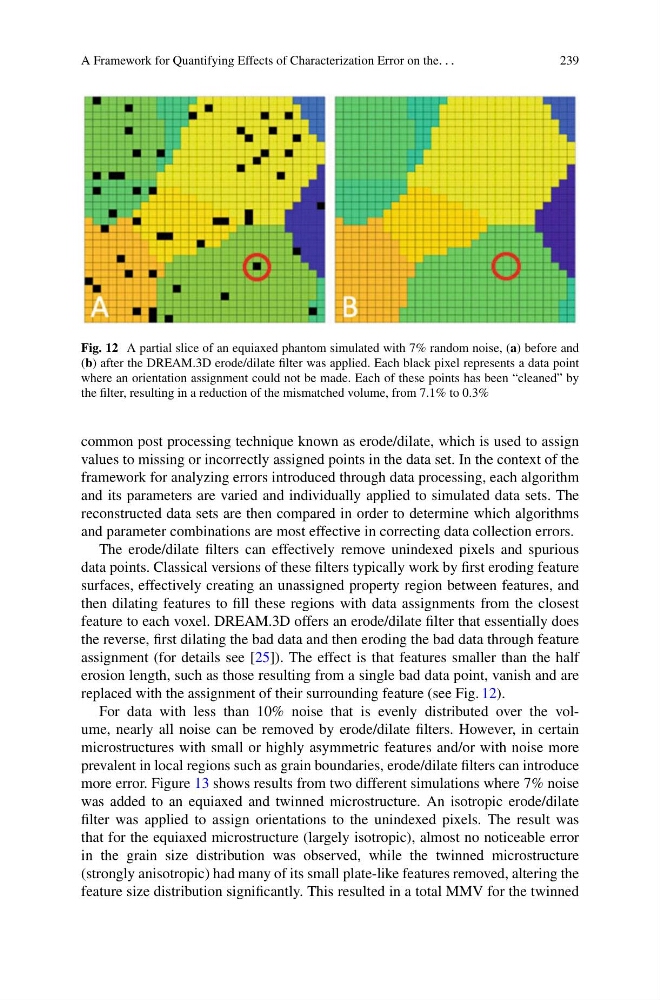
Fig. 12 A partial slice of an equiaxed phantom simulated with 7% random noise, (a) before and
(b) after the DREAM.3D erode/dilate filter was applied. Each black pixel represents a data point
where an orientation assignment could not be made. Each of these points has been “cleaned” by
the filter, resulting in a reduction of the mismatched volume, from 7.1% to 0.3%
common post processing technique known as erode/dilate, which is used to assign
values to missing or incorrectly assigned points in the data set. In the context of the
framework for analyzing errors introduced through data processing, each algorithm
and its parameters are varied and individually applied to simulated data sets. The
reconstructed data sets are then compared in order to determine which algorithms
and parameter combinations are most effective in correcting data collection errors.
The erode/dilate filters can effectively remove unindexed pixels and spurious
data points. Classical versions of these filters typically work by first eroding feature
surfaces, effectively creating an unassigned property region between features, and
then dilating features to fill these regions with data assignments from the closest
feature to each voxel. DREAM.3D offers an erode/dilate filter that essentially does
the reverse, first dilating the bad data and then eroding the bad data through feature
assignment (for details see [25]). The effect is that features smaller than the half
erosion length, such as those resulting from a single bad data point, vanish and are
replaced with the assignment of their surrounding feature (see Fig. 12).
For data with less than 10% noise that is evenly distributed over the volume, nearly all noise can be removed by erode/dilate filters. However, in certain
microstructures with small or highly asymmetric features and/or with noise more
prevalent in local regions such as grain boundaries, erode/dilate filters can introduce
more error. Figure 13 shows results from two different simulations where 7% noise
was added to an equiaxed and twinned microstructure. An isotropic erode/dilate
filter was applied to assign orientations to the unindexed pixels. The result was
that for the equiaxed microstructure (largely isotropic), almost no noticeable error
in the grain size distribution was observed, while the twinned microstructure
(strongly anisotropic) had many of its small plate-like features removed, altering the
feature size distribution significantly. This resulted in a total MMV for the twinned
239
Fig. 12 A partial slice of an equiaxed phantom simulated with 7% random noise, (a) before and
(b) after the DREAM.3D erode/dilate filter was applied. Each black pixel represents a data point
where an orientation assignment could not be made. Each of these points has been “cleaned” by
the filter, resulting in a reduction of the mismatched volume, from 7.1% to 0.3%
common post processing technique known as erode/dilate, which is used to assign
values to missing or incorrectly assigned points in the data set. In the context of the
framework for analyzing errors introduced through data processing, each algorithm
and its parameters are varied and individually applied to simulated data sets. The
reconstructed data sets are then compared in order to determine which algorithms
and parameter combinations are most effective in correcting data collection errors.
The erode/dilate filters can effectively remove unindexed pixels and spurious
data points. Classical versions of these filters typically work by first eroding feature
surfaces, effectively creating an unassigned property region between features, and
then dilating features to fill these regions with data assignments from the closest
feature to each voxel. DREAM.3D offers an erode/dilate filter that essentially does
the reverse, first dilating the bad data and then eroding the bad data through feature
assignment (for details see [25]). The effect is that features smaller than the half
erosion length, such as those resulting from a single bad data point, vanish and are
replaced with the assignment of their surrounding feature (see Fig. 12).
For data with less than 10% noise that is evenly distributed over the volume, nearly all noise can be removed by erode/dilate filters. However, in certain
microstructures with small or highly asymmetric features and/or with noise more
prevalent in local regions such as grain boundaries, erode/dilate filters can introduce
more error. Figure 13 shows results from two different simulations where 7% noise
was added to an equiaxed and twinned microstructure. An isotropic erode/dilate
filter was applied to assign orientations to the unindexed pixels. The result was
that for the equiaxed microstructure (largely isotropic), almost no noticeable error
in the grain size distribution was observed, while the twinned microstructure
(strongly anisotropic) had many of its small plate-like features removed, altering the
feature size distribution significantly. This resulted in a total MMV for the twinned