

238
N. Wade et al.
3.4 Unindexed Pixels
During EBSD data collection, it is common that some interrogation points will
return diffraction patterns that are unable to be indexed to the local crystal
orientation. These points become unindexed pixels or “bad data” which often needs
to be accounted for after data collection is completed. As described in Sect. 2.2.3, the
primary way that these unindexed pixels enter our model is through the assignment
of a dwell time which produces a corresponding level of random noise. A second
means by which unindexed pixels can be accounted for is through the assignment of
a threshold to the interaction volume (i.e., if a certain percentage of the interaction
volume is not dominated by a single grain, an unindexed pixel is assigned). As
both of these methods are dependent on user input, quantifying the resulting error
is trivial. For example, an assigned dwell time associated with 10% noise produces
10% mismatched volume. However, the incorporation of unindexed pixels into the
simulation is very important, since this supports a study of how well these pixels are
corrected during the data processing step.
3.5 Data Processing Parameters
Data processing algorithms come in many forms. There are algorithms for addressing known errors in the collected data set, e.g., assigning values to unindexed
interrogation points, and those which transform or alter the data to be used in other
ways, e.g., creating a meshing for finite element analysis (FEM). Depending on the
data, and its desired use, different algorithms may be applied, with each algorithm
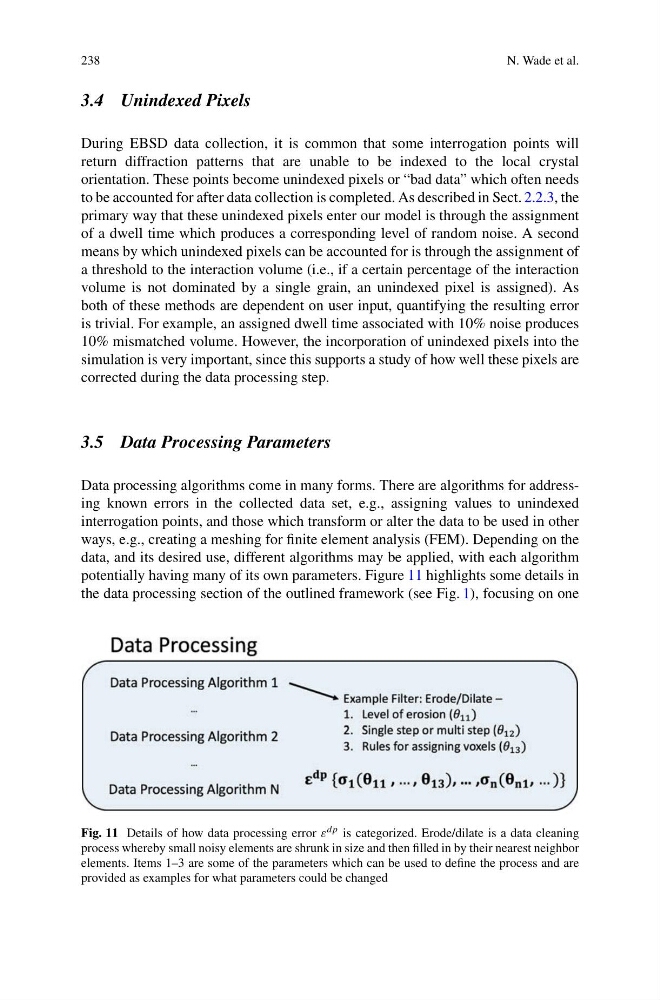
potentially having many of its own parameters. Figure 11 highlights some details in
the data processing section of the outlined framework (see Fig. 1), focusing on one
Fig. 11 Details of how data processing error ε dp is categorized. Erode/dilate is a data cleaning
process whereby small noisy elements are shrunk in size and then filled in by their nearest neighbor
elements. Items 1–3 are some of the parameters which can be used to define the process and are
provided as examples for what parameters could be changed
N. Wade et al.
3.4 Unindexed Pixels
During EBSD data collection, it is common that some interrogation points will
return diffraction patterns that are unable to be indexed to the local crystal
orientation. These points become unindexed pixels or “bad data” which often needs
to be accounted for after data collection is completed. As described in Sect. 2.2.3, the
primary way that these unindexed pixels enter our model is through the assignment
of a dwell time which produces a corresponding level of random noise. A second
means by which unindexed pixels can be accounted for is through the assignment of
a threshold to the interaction volume (i.e., if a certain percentage of the interaction
volume is not dominated by a single grain, an unindexed pixel is assigned). As
both of these methods are dependent on user input, quantifying the resulting error
is trivial. For example, an assigned dwell time associated with 10% noise produces
10% mismatched volume. However, the incorporation of unindexed pixels into the
simulation is very important, since this supports a study of how well these pixels are
corrected during the data processing step.
3.5 Data Processing Parameters
Data processing algorithms come in many forms. There are algorithms for addressing known errors in the collected data set, e.g., assigning values to unindexed
interrogation points, and those which transform or alter the data to be used in other
ways, e.g., creating a meshing for finite element analysis (FEM). Depending on the
data, and its desired use, different algorithms may be applied, with each algorithm
potentially having many of its own parameters. Figure 11 highlights some details in
the data processing section of the outlined framework (see Fig. 1), focusing on one
Fig. 11 Details of how data processing error ε dp is categorized. Erode/dilate is a data cleaning
process whereby small noisy elements are shrunk in size and then filled in by their nearest neighbor
elements. Items 1–3 are some of the parameters which can be used to define the process and are
provided as examples for what parameters could be changed