

A Framework for Quantifying Effects of Characterization Error on the. . .
227
2.2 Step 2: Simulation of Data Collection
To model the serial sectioning data collection process, a simulation-based model
is employed. Some efforts have been made to model more specific aspects of
the EBSD process [18–20]; however, these efforts focused primarily on a single
aspect such as simulating the diffraction pattern. In the current work, the efforts
focus on the effects of resolution, sample size, interaction volume, and random
noise. Of course, the framework allows expansion to any number of data collection
parameters.
2.2.1 Resolution
One of the most important experimental determinations to be made is assessing
where to collect data and at what resolution. To model this, the EBSD simulation
allows users to individually vary sample spacing in the x−, y− and z− directions.
The sampling points are not limited to uniform spacing. A common example of
this could be randomly varying the slice thicknesses removed from the sample
due to variations in the serial sectioning process, for example, as often observed
in metallographic polishing.
2.2.2 Interaction Volume
The physics of EBSD is a complicated but well-understood process [26]. In short,
the diffraction process occurs within a region of material in which electrons from an
incident beam are forward scattered out of the sample, with some of these electrons
collected on a detector. The pattern of scattered electrons, comprised of what are
known as Kikuchi bands, is analyzed to assign a crystallographic orientation to the
interrogation point. It is important to note that the diffraction pattern represents a
finite volume of the material (known as the interaction volume), and it is not truly a
point process. This interaction volume is related to the incident beam energy, which
is one of the tuned parameters available to the user in serial-sectioned EBSD. One
common method of approximating this interaction volume was proposed by Kanaya
and Okayama in 1972. Their estimate of the interaction volume was given as the
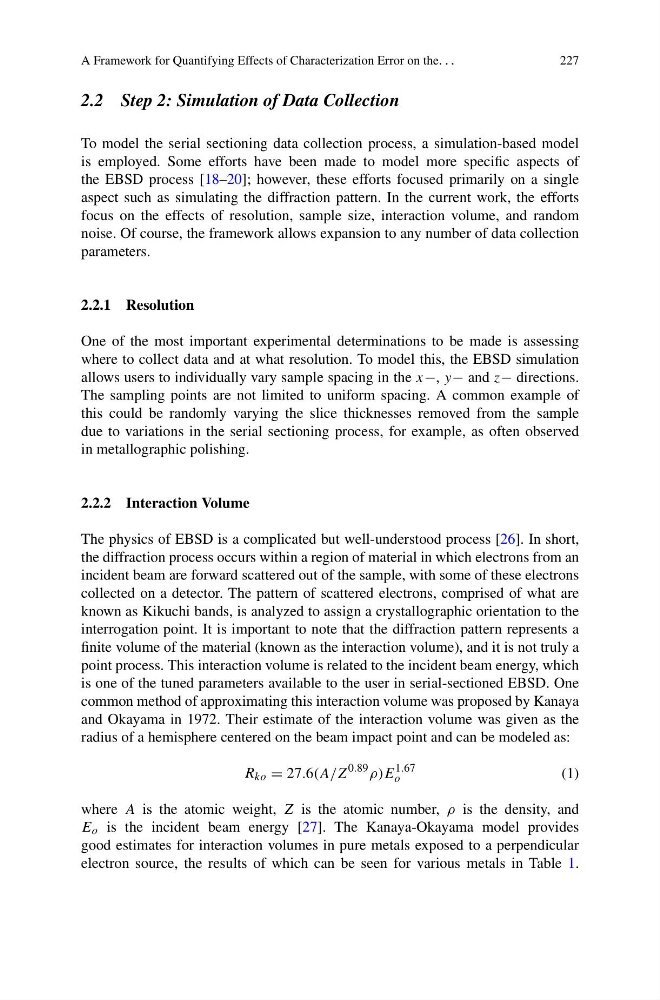
radius of a hemisphere centered on the beam impact point and can be modeled as:
R ko = 27.6(A/Z
0.89 ρ)E
1.67
o
(1)
where A is the atomic weight, Z is the atomic number, ρ is the density, and
E o is the incident beam energy [27]. The Kanaya-Okayama model provides
good estimates for interaction volumes in pure metals exposed to a perpendicular
electron source, the results of which can be seen for various metals in Table 1.
227
2.2 Step 2: Simulation of Data Collection
To model the serial sectioning data collection process, a simulation-based model
is employed. Some efforts have been made to model more specific aspects of
the EBSD process [18–20]; however, these efforts focused primarily on a single
aspect such as simulating the diffraction pattern. In the current work, the efforts
focus on the effects of resolution, sample size, interaction volume, and random
noise. Of course, the framework allows expansion to any number of data collection
parameters.
2.2.1 Resolution
One of the most important experimental determinations to be made is assessing
where to collect data and at what resolution. To model this, the EBSD simulation
allows users to individually vary sample spacing in the x−, y− and z− directions.
The sampling points are not limited to uniform spacing. A common example of
this could be randomly varying the slice thicknesses removed from the sample
due to variations in the serial sectioning process, for example, as often observed
in metallographic polishing.
2.2.2 Interaction Volume
The physics of EBSD is a complicated but well-understood process [26]. In short,
the diffraction process occurs within a region of material in which electrons from an
incident beam are forward scattered out of the sample, with some of these electrons
collected on a detector. The pattern of scattered electrons, comprised of what are
known as Kikuchi bands, is analyzed to assign a crystallographic orientation to the
interrogation point. It is important to note that the diffraction pattern represents a
finite volume of the material (known as the interaction volume), and it is not truly a
point process. This interaction volume is related to the incident beam energy, which
is one of the tuned parameters available to the user in serial-sectioned EBSD. One
common method of approximating this interaction volume was proposed by Kanaya
and Okayama in 1972. Their estimate of the interaction volume was given as the
radius of a hemisphere centered on the beam impact point and can be modeled as:
R ko = 27.6(A/Z
0.89 ρ)E
1.67
o
(1)
where A is the atomic weight, Z is the atomic number, ρ is the density, and
E o is the incident beam energy [27]. The Kanaya-Okayama model provides
good estimates for interaction volumes in pure metals exposed to a perpendicular
electron source, the results of which can be seen for various metals in Table 1.