

226
N. Wade et al.
“ground truth” results to which the virtually reconstructed results are compared.
This provides a quantitative way to measure the error associated with different
choices of data collection and processing parameters on computational models
associated with the microstructure. This framework is meant to be general and
can be adapted for a number of serial sectioning techniques and/or computational
models of interest. Each of these steps is described in greater detail in the subsequent
subsections.
2.1 Step 1: Synthetic Material Generation – Phantoms
One of the challenges associated with 3D serial sectioning techniques is the inherently destructive nature of the process. Reevaluation of the sample is impossible,
which makes comparisons between measurement strategies difficult. This motivates
our use of a virtual material which can be copied and resampled repeatedly [19].
This virtual material, or phantom, should reasonably represent the true physical
material of interest through statistical similarities of key microstructural properties,
such as the grain size, orientation distributions, neighbor distributions, etc. The
intention is that while the phantom may not be an exact instantiation of a physical
material, its properties are presumed to be similar enough that it can be assumed that
parameter studies based on the phantom will generalize to the material of interest.
The generation of synthetic volumes has seen many developments. A review of
several possible techniques for polycrystalline materials can be found in [24]. For
the examples described in this work, phantoms are generated using a DREAM.3D
[22] synthetic microstructure generation pipeline. A simple example of this process
can be found in the DREAM.3D software tutorials [25]. Various phantoms were
used but in general phantoms featured on the order of 1000’s of grains and typically
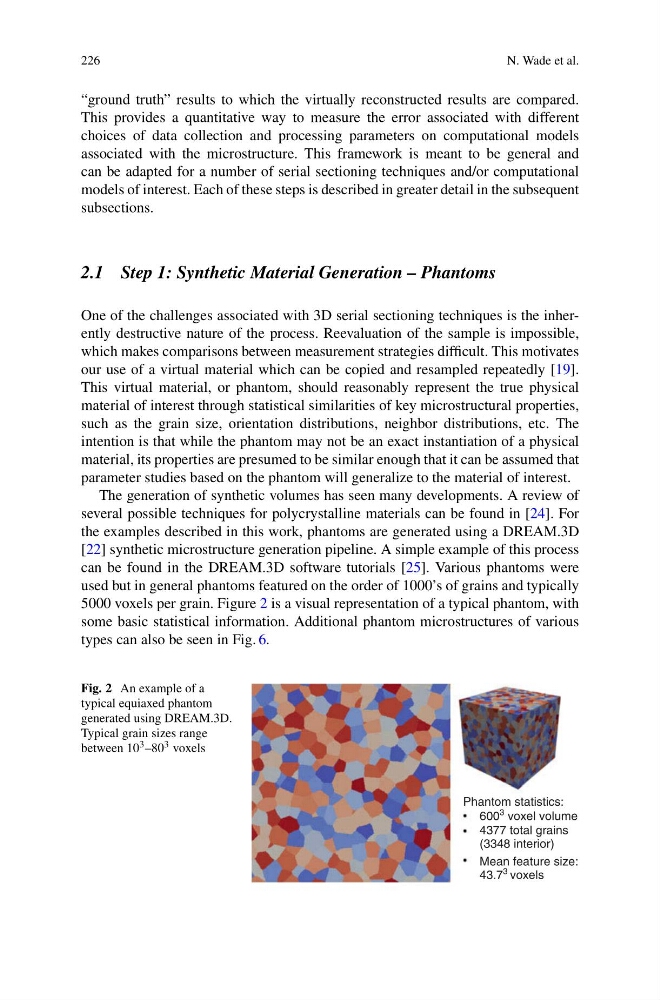
5000 voxels per grain. Figure 2 is a visual representation of a typical phantom, with
some basic statistical information. Additional phantom microstructures of various
types can also be seen in Fig. 6.
Fig. 2 An example of a
typical equiaxed phantom
generated using DREAM.3D.
Typical grain sizes range
between 10 3 –80 3 voxels
Phantom statistics:
600
3 voxel volume
4377 total grains
(3348 interior)
Mean feature size:
43.7
3 voxels
N. Wade et al.
“ground truth” results to which the virtually reconstructed results are compared.
This provides a quantitative way to measure the error associated with different
choices of data collection and processing parameters on computational models
associated with the microstructure. This framework is meant to be general and
can be adapted for a number of serial sectioning techniques and/or computational
models of interest. Each of these steps is described in greater detail in the subsequent
subsections.
2.1 Step 1: Synthetic Material Generation – Phantoms
One of the challenges associated with 3D serial sectioning techniques is the inherently destructive nature of the process. Reevaluation of the sample is impossible,
which makes comparisons between measurement strategies difficult. This motivates
our use of a virtual material which can be copied and resampled repeatedly [19].
This virtual material, or phantom, should reasonably represent the true physical
material of interest through statistical similarities of key microstructural properties,
such as the grain size, orientation distributions, neighbor distributions, etc. The
intention is that while the phantom may not be an exact instantiation of a physical
material, its properties are presumed to be similar enough that it can be assumed that
parameter studies based on the phantom will generalize to the material of interest.
The generation of synthetic volumes has seen many developments. A review of
several possible techniques for polycrystalline materials can be found in [24]. For
the examples described in this work, phantoms are generated using a DREAM.3D
[22] synthetic microstructure generation pipeline. A simple example of this process
can be found in the DREAM.3D software tutorials [25]. Various phantoms were
used but in general phantoms featured on the order of 1000’s of grains and typically
5000 voxels per grain. Figure 2 is a visual representation of a typical phantom, with
some basic statistical information. Additional phantom microstructures of various
types can also be seen in Fig. 6.
Fig. 2 An example of a
typical equiaxed phantom
generated using DREAM.3D.
Typical grain sizes range
between 10 3 –80 3 voxels
Phantom statistics:
600
3 voxel volume
4377 total grains
(3348 interior)
Mean feature size:
43.7
3 voxels