

A Framework for Quantifying Effects of Characterization Error on the. . .
225
Throughout these studies, several authors have noted that estimation of the
uncertainty of 3D microstructures has been underdeveloped and is key to implementing ICME [19, 21]. This work aims to introduce a framework for which the
error associated with a given choice of characterization parameters is evaluated.
Ultimately, such a framework will enable identification of the optimal data collection and cleanup parameters for a given class of materials. The approach makes
use of synthetically generated phantom microstructures that represent “ground
truth” specimens. Section 2 describes the method for simulating the data collection
process. Section 3 evaluates the error in the resulting reconstructed microstructures,
resulting from variations in four sources of error: resolution, interaction volume,
random noise, and data processing parameters. Section 4 addresses the effect of
data collection errors on the predictions from computational models developed from
the associated reconstructed microstructure, specifically for linear elastic stresses.
Section 5 provides some conclusions and thoughts on possible future work.
2 Methods
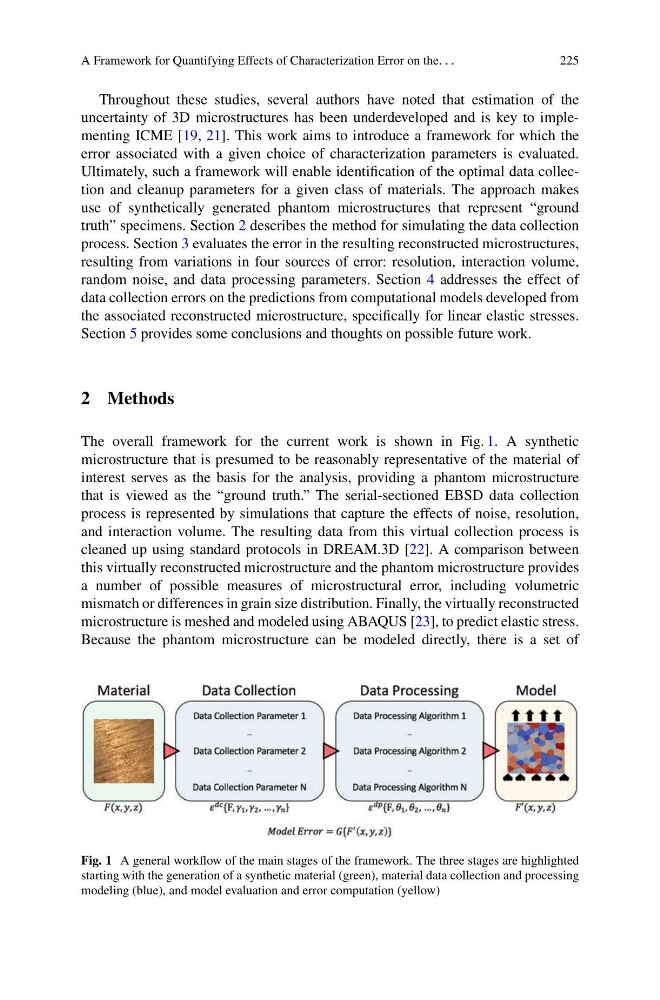
The overall framework for the current work is shown in Fig. 1. A synthetic
microstructure that is presumed to be reasonably representative of the material of
interest serves as the basis for the analysis, providing a phantom microstructure
that is viewed as the “ground truth.” The serial-sectioned EBSD data collection
process is represented by simulations that capture the effects of noise, resolution,
and interaction volume. The resulting data from this virtual collection process is
cleaned up using standard protocols in DREAM.3D [22]. A comparison between
this virtually reconstructed microstructure and the phantom microstructure provides
a number of possible measures of microstructural error, including volumetric
mismatch or differences in grain size distribution. Finally, the virtually reconstructed
microstructure is meshed and modeled using ABAQUS [23], to predict elastic stress.
Because the phantom microstructure can be modeled directly, there is a set of
Fig. 1 A general workflow of the main stages of the framework. The three stages are highlighted
starting with the generation of a synthetic material (green), material data collection and processing
modeling (blue), and model evaluation and error computation (yellow)
225
Throughout these studies, several authors have noted that estimation of the
uncertainty of 3D microstructures has been underdeveloped and is key to implementing ICME [19, 21]. This work aims to introduce a framework for which the
error associated with a given choice of characterization parameters is evaluated.
Ultimately, such a framework will enable identification of the optimal data collection and cleanup parameters for a given class of materials. The approach makes
use of synthetically generated phantom microstructures that represent “ground
truth” specimens. Section 2 describes the method for simulating the data collection
process. Section 3 evaluates the error in the resulting reconstructed microstructures,
resulting from variations in four sources of error: resolution, interaction volume,
random noise, and data processing parameters. Section 4 addresses the effect of
data collection errors on the predictions from computational models developed from
the associated reconstructed microstructure, specifically for linear elastic stresses.
Section 5 provides some conclusions and thoughts on possible future work.
2 Methods
The overall framework for the current work is shown in Fig. 1. A synthetic
microstructure that is presumed to be reasonably representative of the material of
interest serves as the basis for the analysis, providing a phantom microstructure
that is viewed as the “ground truth.” The serial-sectioned EBSD data collection
process is represented by simulations that capture the effects of noise, resolution,
and interaction volume. The resulting data from this virtual collection process is
cleaned up using standard protocols in DREAM.3D [22]. A comparison between
this virtually reconstructed microstructure and the phantom microstructure provides
a number of possible measures of microstructural error, including volumetric
mismatch or differences in grain size distribution. Finally, the virtually reconstructed
microstructure is meshed and modeled using ABAQUS [23], to predict elastic stress.
Because the phantom microstructure can be modeled directly, there is a set of
Fig. 1 A general workflow of the main stages of the framework. The three stages are highlighted
starting with the generation of a synthetic material (green), material data collection and processing
modeling (blue), and model evaluation and error computation (yellow)