

Local Stress and Damage Response of Polycrystal Materials to Light Shock. . .
207
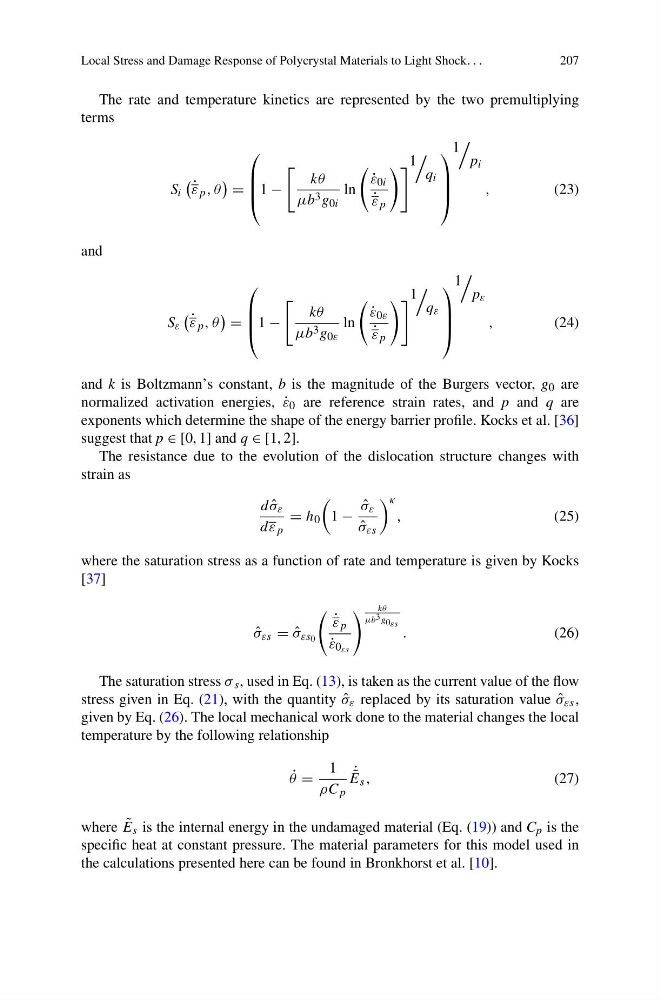
The rate and temperature kinetics are represented by the two premultiplying
terms
S i
˙
ε p , θ
=
⎛
⎜
⎜
⎝ 1 −
kθ
μb 3 g 0i
ln
˙
ε 0i
˙
ε p
1
q i
⎞
⎟
⎟
⎠
1
p i
,
(23)
and
S ε
˙
ε p , θ
=
⎛
⎜
⎜
⎝ 1 −
kθ
μb 3 g 0ε
ln
˙
ε 0ε
˙
ε p
1
q ε
⎞
⎟
⎟
⎠
1
p ε
,
(24)
and k is Boltzmann’s constant, b is the magnitude of the Burgers vector, g 0 are
normalized activation energies, ˙
ε 0 are reference strain rates, and p and q are
exponents which determine the shape of the energy barrier profile. Kocks et al. [36]
suggest that p ∈ [0, 1] and q ∈ [1, 2].
The resistance due to the evolution of the dislocation structure changes with
strain as
d ˆ
σ ε
dε p
= h 0
1 −
ˆ
σ ε
ˆ
σ εs
κ
,
(25)
where the saturation stress as a function of rate and temperature is given by Kocks
[37]
ˆ
σ εs = ˆ
σ εs 0
˙
ε p
˙
ε 0 εs
kθ
μb 3 g 0εs
.
(26)
The saturation stress σ s , used in Eq. (13), is taken as the current value of the flow
stress given in Eq. (21), with the quantity ˆ
σ ε replaced by its saturation value ˆ
σ εs ,
given by Eq. (26). The local mechanical work done to the material changes the local
temperature by the following relationship
˙
θ =
1
ρC p
˙ ˜
E s ,
(27)
where ˜
E s is the internal energy in the undamaged material (Eq. (19)) and C p is the
specific heat at constant pressure. The material parameters for this model used in
the calculations presented here can be found in Bronkhorst et al. [10].
207
The rate and temperature kinetics are represented by the two premultiplying
terms
S i
˙
ε p , θ
=
⎛
⎜
⎜
⎝ 1 −
kθ
μb 3 g 0i
ln
˙
ε 0i
˙
ε p
1
q i
⎞
⎟
⎟
⎠
1
p i
,
(23)
and
S ε
˙
ε p , θ
=
⎛
⎜
⎜
⎝ 1 −
kθ
μb 3 g 0ε
ln
˙
ε 0ε
˙
ε p
1
q ε
⎞
⎟
⎟
⎠
1
p ε
,
(24)
and k is Boltzmann’s constant, b is the magnitude of the Burgers vector, g 0 are
normalized activation energies, ˙
ε 0 are reference strain rates, and p and q are
exponents which determine the shape of the energy barrier profile. Kocks et al. [36]
suggest that p ∈ [0, 1] and q ∈ [1, 2].
The resistance due to the evolution of the dislocation structure changes with
strain as
d ˆ
σ ε
dε p
= h 0
1 −
ˆ
σ ε
ˆ
σ εs
κ
,
(25)
where the saturation stress as a function of rate and temperature is given by Kocks
[37]
ˆ
σ εs = ˆ
σ εs 0
˙
ε p
˙
ε 0 εs
kθ
μb 3 g 0εs
.
(26)
The saturation stress σ s , used in Eq. (13), is taken as the current value of the flow
stress given in Eq. (21), with the quantity ˆ
σ ε replaced by its saturation value ˆ
σ εs ,
given by Eq. (26). The local mechanical work done to the material changes the local
temperature by the following relationship
˙
θ =
1
ρC p
˙ ˜
E s ,
(27)
where ˜
E s is the internal energy in the undamaged material (Eq. (19)) and C p is the
specific heat at constant pressure. The material parameters for this model used in
the calculations presented here can be found in Bronkhorst et al. [10].