

206
C. A. Bronkhorst et al.
where
˜
β =
˜
ρ
˜
ρ 0
− 1,
(17)
ρ = (1 − φ) ˜
ρ,
(18)
˜
E s =
σ ˙
ε − ˜
P tr
D
e
+ D
d
J dt,
(19)
σ =
3
2
T · T .
(20)
K 1 , K 2 , and K 3 are coefficients.
The rate and temperature sensitivity of the plastic deformation response is
represented through the flow stress. The deformation of tantalum at rates observed
here has been shown to be well represented by several constitutive models [11,
12, 15, 38, 41] which are based upon the thermal activation kinetics developed
by Kocks et al. [36]. We employ here the isotropic mechanical threshold strength
(MTS) model, which has been well established for tantalum and is evolved from the
work of Follansbee and Kocks [18], Chen and Gray [15], and Maudlin et al. [39].
The MTS model is based on the concept of a superposition of resistances to the
glide of dislocations. Generally, they are grouped as athermal barriers (e.g., grain
boundaries) and thermally influenced barriers (e.g., Peierls stress – intrinsic lattice
resistance, forest dislocations, dislocation structure, solute atoms). The mechanical
threshold stress is the deformation resistance at 0 K. The flow stress used here is
the stress adjusted to current temperature and strain rate. The reader is referred to
Follansbee and Kocks [18] and Chen and Gray [15] for more details.
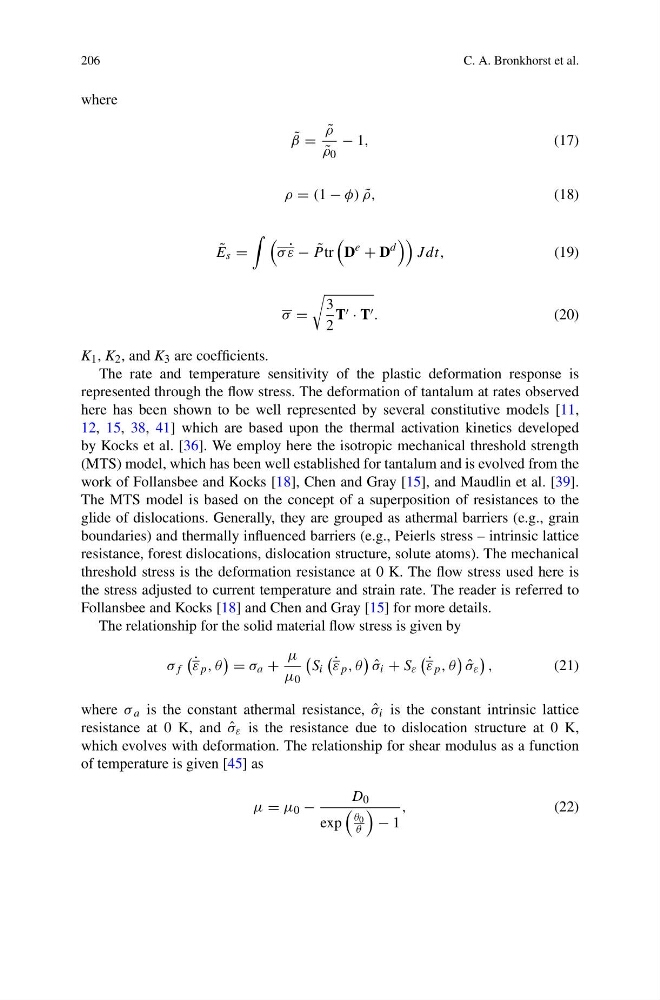
The relationship for the solid material flow stress is given by
σ f
˙
ε p , θ
= σ a +
μ
μ 0
S i
˙
ε p , θ
ˆ
σ i + S ε
˙
ε p , θ
ˆ
σ ε
,
(21)
where σ a is the constant athermal resistance, ˆ
σ i is the constant intrinsic lattice
resistance at 0 K, and ˆ
σ ε is the resistance due to dislocation structure at 0 K,
which evolves with deformation. The relationship for shear modulus as a function
of temperature is given [45] as
μ = μ 0 −
D 0
exp
θ 0
θ
− 1
,
(22)
C. A. Bronkhorst et al.
where
˜
β =
˜
ρ
˜
ρ 0
− 1,
(17)
ρ = (1 − φ) ˜
ρ,
(18)
˜
E s =
σ ˙
ε − ˜
P tr
D
e
+ D
d
J dt,
(19)
σ =
3
2
T · T .
(20)
K 1 , K 2 , and K 3 are coefficients.
The rate and temperature sensitivity of the plastic deformation response is
represented through the flow stress. The deformation of tantalum at rates observed
here has been shown to be well represented by several constitutive models [11,
12, 15, 38, 41] which are based upon the thermal activation kinetics developed
by Kocks et al. [36]. We employ here the isotropic mechanical threshold strength
(MTS) model, which has been well established for tantalum and is evolved from the
work of Follansbee and Kocks [18], Chen and Gray [15], and Maudlin et al. [39].
The MTS model is based on the concept of a superposition of resistances to the
glide of dislocations. Generally, they are grouped as athermal barriers (e.g., grain
boundaries) and thermally influenced barriers (e.g., Peierls stress – intrinsic lattice
resistance, forest dislocations, dislocation structure, solute atoms). The mechanical
threshold stress is the deformation resistance at 0 K. The flow stress used here is
the stress adjusted to current temperature and strain rate. The reader is referred to
Follansbee and Kocks [18] and Chen and Gray [15] for more details.
The relationship for the solid material flow stress is given by
σ f
˙
ε p , θ
= σ a +
μ
μ 0
S i
˙
ε p , θ
ˆ
σ i + S ε
˙
ε p , θ
ˆ
σ ε
,
(21)
where σ a is the constant athermal resistance, ˆ
σ i is the constant intrinsic lattice
resistance at 0 K, and ˆ
σ ε is the resistance due to dislocation structure at 0 K,
which evolves with deformation. The relationship for shear modulus as a function
of temperature is given [45] as
μ = μ 0 −
D 0
exp
θ 0
θ
− 1
,
(22)