

Local Stress and Damage Response of Polycrystal Materials to Light Shock. . .
205
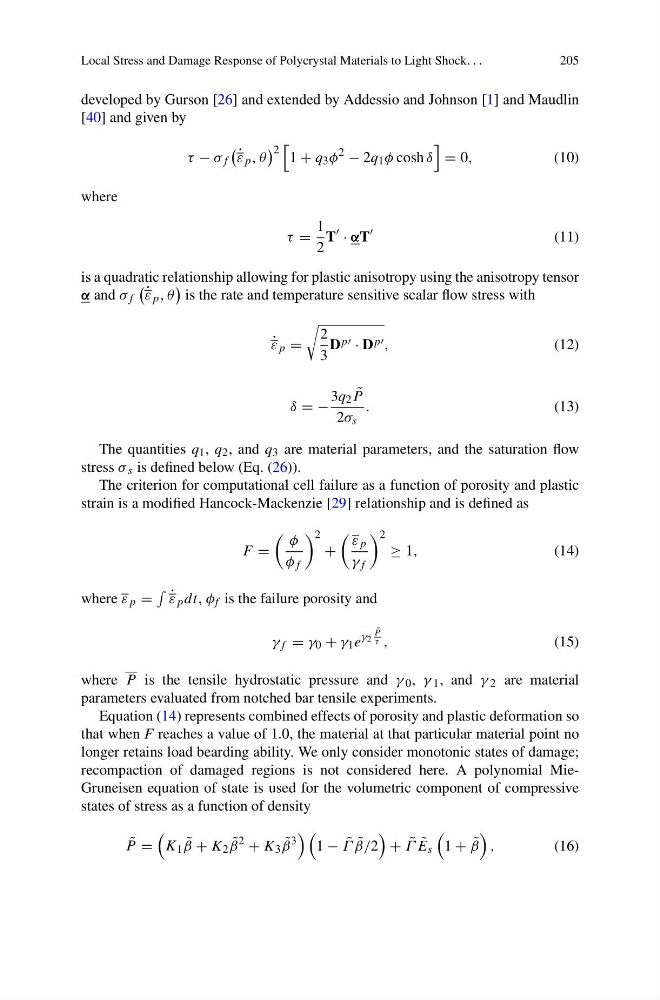
developed by Gurson [26] and extended by Addessio and Johnson [1] and Maudlin
[40] and given by
τ − σ f
˙
ε p , θ
2
1 + q 3 φ
2
− 2q 1 φ cosh δ
= 0,
(10)
where
τ =
1
2
T
· αT
(11)
is a quadratic relationship allowing for plastic anisotropy using the anisotropy tensor
α and σ f
˙
ε p , θ
is the rate and temperature sensitive scalar flow stress with
˙
ε p =
2
3
D p · D p ,
(12)
δ = −
3q 2 ˜
P
2σ s
.
(13)
The quantities q 1 , q 2 , and q 3 are material parameters, and the saturation flow
stress σ s is defined below (Eq. (26)).
The criterion for computational cell failure as a function of porosity and plastic
strain is a modified Hancock-Mackenzie [29] relationship and is defined as
F =
φ
φ f
2
+
ε p
γ f
2
≥ 1,
(14)
where ε p =
˙
ε p dt, φ f is the failure porosity and
γ f = γ 0 + γ 1 e
γ 2
˜
P
τ ,
(15)
where P is the tensile hydrostatic pressure and γ 0 , γ 1 , and γ 2 are material
parameters evaluated from notched bar tensile experiments.
Equation (14) represents combined effects of porosity and plastic deformation so
that when F reaches a value of 1.0, the material at that particular material point no
longer retains load bearding ability. We only consider monotonic states of damage;
recompaction of damaged regions is not considered here. A polynomial MieGruneisen equation of state is used for the volumetric component of compressive
states of stress as a function of density
˜
P =
K 1 ˜
β + K 2 ˜
β
2
+ K 3 ˜
β
3
1 − ˜
Γ ˜
β/2
+ ˜
Γ ˜
E s
1 + ˜
β
,
(16)
205
developed by Gurson [26] and extended by Addessio and Johnson [1] and Maudlin
[40] and given by
τ − σ f
˙
ε p , θ
2
1 + q 3 φ
2
− 2q 1 φ cosh δ
= 0,
(10)
where
τ =
1
2
T
· αT
(11)
is a quadratic relationship allowing for plastic anisotropy using the anisotropy tensor
α and σ f
˙
ε p , θ
is the rate and temperature sensitive scalar flow stress with
˙
ε p =
2
3
D p · D p ,
(12)
δ = −
3q 2 ˜
P
2σ s
.
(13)
The quantities q 1 , q 2 , and q 3 are material parameters, and the saturation flow
stress σ s is defined below (Eq. (26)).
The criterion for computational cell failure as a function of porosity and plastic
strain is a modified Hancock-Mackenzie [29] relationship and is defined as
F =
φ
φ f
2
+
ε p
γ f
2
≥ 1,
(14)
where ε p =
˙
ε p dt, φ f is the failure porosity and
γ f = γ 0 + γ 1 e
γ 2
˜
P
τ ,
(15)
where P is the tensile hydrostatic pressure and γ 0 , γ 1 , and γ 2 are material
parameters evaluated from notched bar tensile experiments.
Equation (14) represents combined effects of porosity and plastic deformation so
that when F reaches a value of 1.0, the material at that particular material point no
longer retains load bearding ability. We only consider monotonic states of damage;
recompaction of damaged regions is not considered here. A polynomial MieGruneisen equation of state is used for the volumetric component of compressive
states of stress as a function of density
˜
P =
K 1 ˜
β + K 2 ˜
β
2
+ K 3 ˜
β
3
1 − ˜
Γ ˜
β/2
+ ˜
Γ ˜
E s
1 + ˜
β
,
(16)