

204
C. A. Bronkhorst et al.
where ˜
L is the fourth order elastic stiffness tensor, J = ˜
ρ 0 / ˜
ρ, ˜
K s is the isentropic
solid bulk modulus, ˜
Γ is the Gruneisen coefficient and
˜
P = −
1
3
tr ˜
T.
(5)
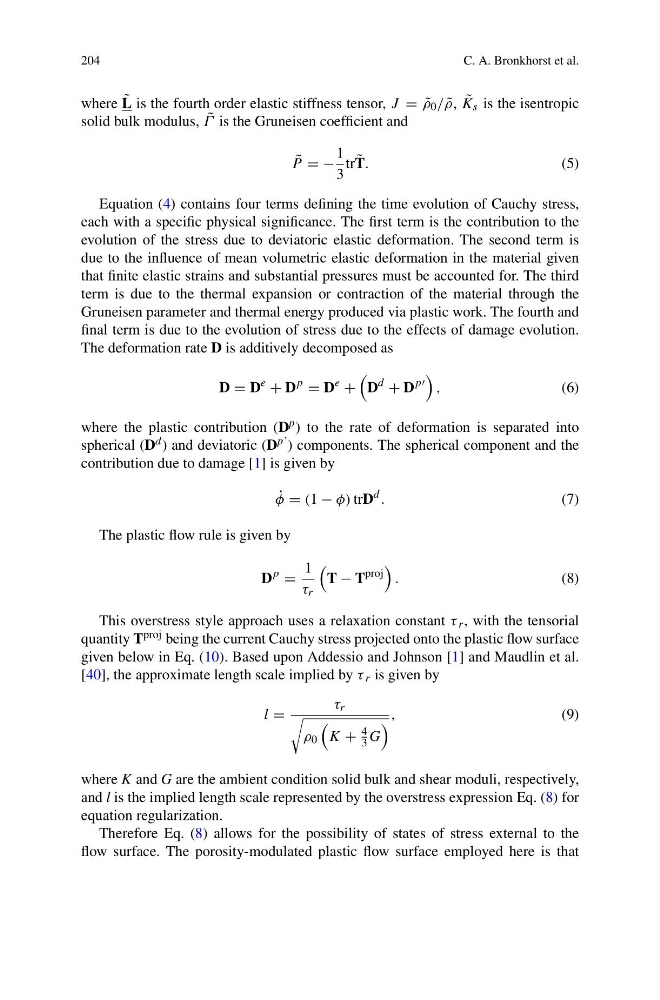
Equation (4) contains four terms defining the time evolution of Cauchy stress,
each with a specific physical significance. The first term is the contribution to the
evolution of the stress due to deviatoric elastic deformation. The second term is
due to the influence of mean volumetric elastic deformation in the material given
that finite elastic strains and substantial pressures must be accounted for. The third
term is due to the thermal expansion or contraction of the material through the
Gruneisen parameter and thermal energy produced via plastic work. The fourth and
final term is due to the evolution of stress due to the effects of damage evolution.
The deformation rate D is additively decomposed as
D = D
e
+ D
p
= D
e
+
D
d
+ D
p
,
(6)
where the plastic contribution (D p ) to the rate of deformation is separated into
spherical (D d ) and deviatoric (D p’ ) components. The spherical component and the
contribution due to damage [1] is given by
˙
φ = (1 − φ) trD
d .
(7)
The plastic flow rule is given by
D
p
=
1
τ r
T − T
proj
.
(8)
This overstress style approach uses a relaxation constant τ r , with the tensorial
quantity T proj being the current Cauchy stress projected onto the plastic flow surface
given below in Eq. (10). Based upon Addessio and Johnson [1] and Maudlin et al.
[40], the approximate length scale implied by τ r is given by
l =
τ r
ρ 0
K +
4
3 G
,
(9)
where K and G are the ambient condition solid bulk and shear moduli, respectively,
and l is the implied length scale represented by the overstress expression Eq. (8) for
equation regularization.
Therefore Eq. (8) allows for the possibility of states of stress external to the
flow surface. The porosity-modulated plastic flow surface employed here is that
C. A. Bronkhorst et al.
where ˜
L is the fourth order elastic stiffness tensor, J = ˜
ρ 0 / ˜
ρ, ˜
K s is the isentropic
solid bulk modulus, ˜
Γ is the Gruneisen coefficient and
˜
P = −
1
3
tr ˜
T.
(5)
Equation (4) contains four terms defining the time evolution of Cauchy stress,
each with a specific physical significance. The first term is the contribution to the
evolution of the stress due to deviatoric elastic deformation. The second term is
due to the influence of mean volumetric elastic deformation in the material given
that finite elastic strains and substantial pressures must be accounted for. The third
term is due to the thermal expansion or contraction of the material through the
Gruneisen parameter and thermal energy produced via plastic work. The fourth and
final term is due to the evolution of stress due to the effects of damage evolution.
The deformation rate D is additively decomposed as
D = D
e
+ D
p
= D
e
+
D
d
+ D
p
,
(6)
where the plastic contribution (D p ) to the rate of deformation is separated into
spherical (D d ) and deviatoric (D p’ ) components. The spherical component and the
contribution due to damage [1] is given by
˙
φ = (1 − φ) trD
d .
(7)
The plastic flow rule is given by
D
p
=
1
τ r
T − T
proj
.
(8)
This overstress style approach uses a relaxation constant τ r , with the tensorial
quantity T proj being the current Cauchy stress projected onto the plastic flow surface
given below in Eq. (10). Based upon Addessio and Johnson [1] and Maudlin et al.
[40], the approximate length scale implied by τ r is given by
l =
τ r
ρ 0
K +
4
3 G
,
(9)
where K and G are the ambient condition solid bulk and shear moduli, respectively,
and l is the implied length scale represented by the overstress expression Eq. (8) for
equation regularization.
Therefore Eq. (8) allows for the possibility of states of stress external to the
flow surface. The porosity-modulated plastic flow surface employed here is that