

188
J. Hochhalter et al.
0.000
0.002
0.004
0.006
0.008
0.010
Strain
0
50
100
150
200
Stress [MPa]
simulated experiment
simulated experiment with added noise
0.004
0.006
0.008
0.010
230
240
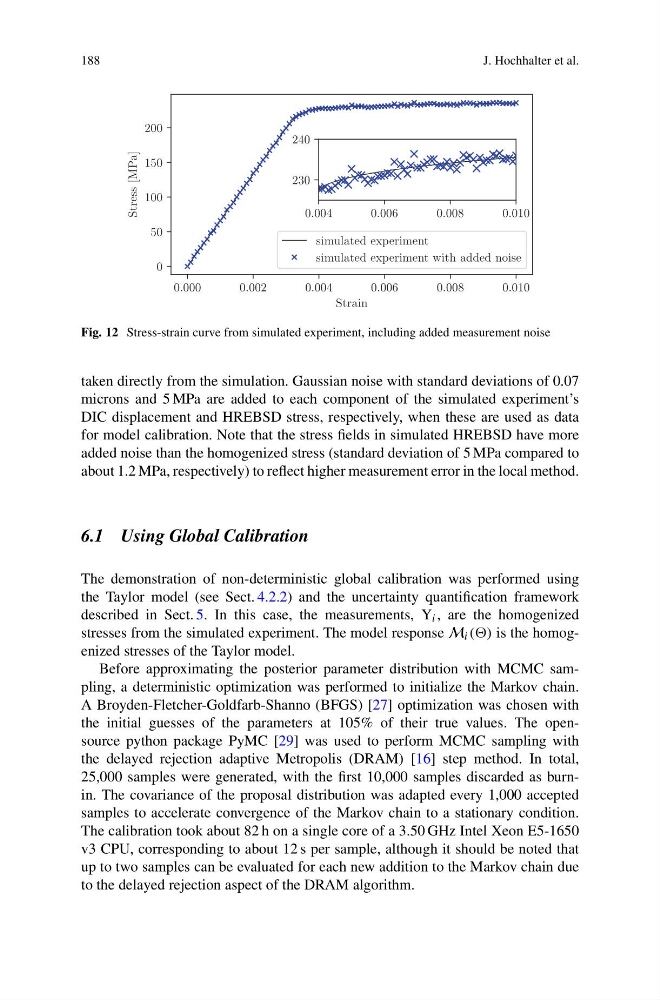
Fig. 12 Stress-strain curve from simulated experiment, including added measurement noise
taken directly from the simulation. Gaussian noise with standard deviations of 0.07
microns and 5 MPa are added to each component of the simulated experiment’s
DIC displacement and HREBSD stress, respectively, when these are used as data
for model calibration. Note that the stress fields in simulated HREBSD have more
added noise than the homogenized stress (standard deviation of 5 MPa compared to
about 1.2 MPa, respectively) to reflect higher measurement error in the local method.
6.1 Using Global Calibration
The demonstration of non-deterministic global calibration was performed using
the Taylor model (see Sect. 4.2.2) and the uncertainty quantification framework
described in Sect. 5. In this case, the measurements, Y i , are the homogenized
stresses from the simulated experiment. The model response M i (() is the homogenized stresses of the Taylor model.
Before approximating the posterior parameter distribution with MCMC sampling, a deterministic optimization was performed to initialize the Markov chain.
A Broyden-Fletcher-Goldfarb-Shanno (BFGS) [27] optimization was chosen with
the initial guesses of the parameters at 105% of their true values. The opensource python package PyMC [29] was used to perform MCMC sampling with
the delayed rejection adaptive Metropolis (DRAM) [16] step method. In total,
25,000 samples were generated, with the first 10,000 samples discarded as burnin. The covariance of the proposal distribution was adapted every 1,000 accepted
samples to accelerate convergence of the Markov chain to a stationary condition.
The calibration took about 82 h on a single core of a 3.50 GHz Intel Xeon E5-1650
v3 CPU, corresponding to about 12 s per sample, although it should be noted that
up to two samples can be evaluated for each new addition to the Markov chain due
to the delayed rejection aspect of the DRAM algorithm.
J. Hochhalter et al.
0.000
0.002
0.004
0.006
0.008
0.010
Strain
0
50
100
150
200
Stress [MPa]
simulated experiment
simulated experiment with added noise
0.004
0.006
0.008
0.010
230
240
Fig. 12 Stress-strain curve from simulated experiment, including added measurement noise
taken directly from the simulation. Gaussian noise with standard deviations of 0.07
microns and 5 MPa are added to each component of the simulated experiment’s
DIC displacement and HREBSD stress, respectively, when these are used as data
for model calibration. Note that the stress fields in simulated HREBSD have more
added noise than the homogenized stress (standard deviation of 5 MPa compared to
about 1.2 MPa, respectively) to reflect higher measurement error in the local method.
6.1 Using Global Calibration
The demonstration of non-deterministic global calibration was performed using
the Taylor model (see Sect. 4.2.2) and the uncertainty quantification framework
described in Sect. 5. In this case, the measurements, Y i , are the homogenized
stresses from the simulated experiment. The model response M i (() is the homogenized stresses of the Taylor model.
Before approximating the posterior parameter distribution with MCMC sampling, a deterministic optimization was performed to initialize the Markov chain.
A Broyden-Fletcher-Goldfarb-Shanno (BFGS) [27] optimization was chosen with
the initial guesses of the parameters at 105% of their true values. The opensource python package PyMC [29] was used to perform MCMC sampling with
the delayed rejection adaptive Metropolis (DRAM) [16] step method. In total,
25,000 samples were generated, with the first 10,000 samples discarded as burnin. The covariance of the proposal distribution was adapted every 1,000 accepted
samples to accelerate convergence of the Markov chain to a stationary condition.
The calibration took about 82 h on a single core of a 3.50 GHz Intel Xeon E5-1650
v3 CPU, corresponding to about 12 s per sample, although it should be noted that
up to two samples can be evaluated for each new addition to the Markov chain due
to the delayed rejection aspect of the DRAM algorithm.