

186
J. Hochhalter et al.
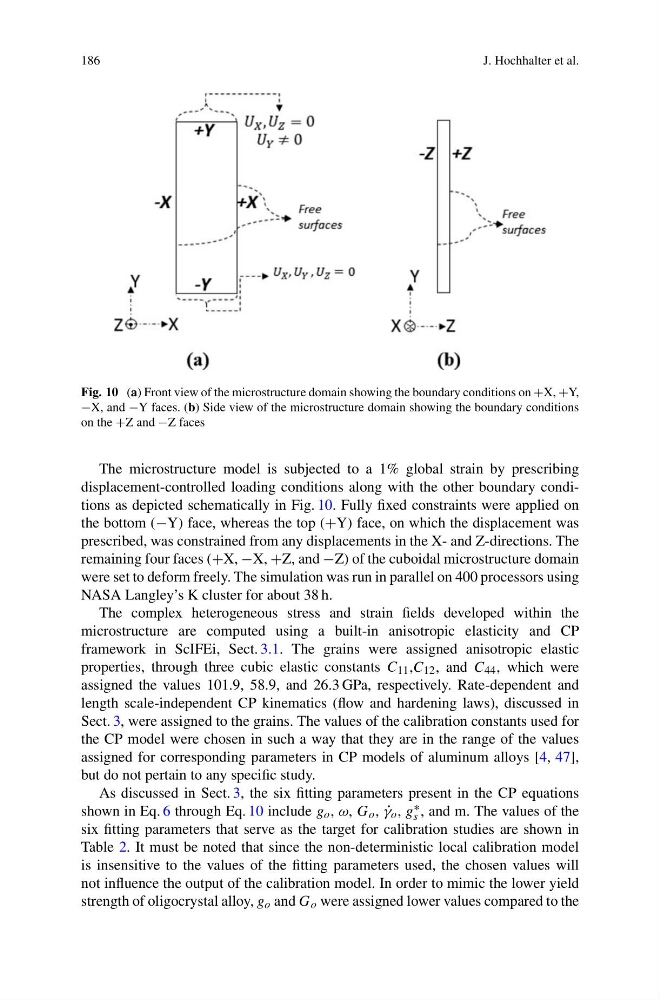
Fig. 10 (a) Front view of the microstructure domain showing the boundary conditions on +X, +Y,
−X, and −Y faces. (b) Side view of the microstructure domain showing the boundary conditions
on the +Z and −Z faces
The microstructure model is subjected to a 1% global strain by prescribing
displacement-controlled loading conditions along with the other boundary conditions as depicted schematically in Fig. 10. Fully fixed constraints were applied on
the bottom (−Y) face, whereas the top (+Y) face, on which the displacement was
prescribed, was constrained from any displacements in the X- and Z-directions. The
remaining four faces (+X, −X, +Z, and −Z) of the cuboidal microstructure domain
were set to deform freely. The simulation was run in parallel on 400 processors using
NASA Langley’s K cluster for about 38 h.
The complex heterogeneous stress and strain fields developed within the
microstructure are computed using a built-in anisotropic elasticity and CP
framework in ScIFEi, Sect. 3.1. The grains were assigned anisotropic elastic
properties, through three cubic elastic constants C 11 ,C 12 , and C 44 , which were
assigned the values 101.9, 58.9, and 26.3 GPa, respectively. Rate-dependent and
length scale-independent CP kinematics (flow and hardening laws), discussed in
Sect. 3, were assigned to the grains. The values of the calibration constants used for
the CP model were chosen in such a way that they are in the range of the values
assigned for corresponding parameters in CP models of aluminum alloys [4, 47],
but do not pertain to any specific study.
As discussed in Sect. 3, the six fitting parameters present in the CP equations
shown in Eq. 6 through Eq. 10 include g o , ω, G o , ˙
γ o , g ∗
s , and m. The values of the
six fitting parameters that serve as the target for calibration studies are shown in
Table 2. It must be noted that since the non-deterministic local calibration model
is insensitive to the values of the fitting parameters used, the chosen values will
not influence the output of the calibration model. In order to mimic the lower yield
strength of oligocrystal alloy, g o and G o were assigned lower values compared to the
J. Hochhalter et al.
Fig. 10 (a) Front view of the microstructure domain showing the boundary conditions on +X, +Y,
−X, and −Y faces. (b) Side view of the microstructure domain showing the boundary conditions
on the +Z and −Z faces
The microstructure model is subjected to a 1% global strain by prescribing
displacement-controlled loading conditions along with the other boundary conditions as depicted schematically in Fig. 10. Fully fixed constraints were applied on
the bottom (−Y) face, whereas the top (+Y) face, on which the displacement was
prescribed, was constrained from any displacements in the X- and Z-directions. The
remaining four faces (+X, −X, +Z, and −Z) of the cuboidal microstructure domain
were set to deform freely. The simulation was run in parallel on 400 processors using
NASA Langley’s K cluster for about 38 h.
The complex heterogeneous stress and strain fields developed within the
microstructure are computed using a built-in anisotropic elasticity and CP
framework in ScIFEi, Sect. 3.1. The grains were assigned anisotropic elastic
properties, through three cubic elastic constants C 11 ,C 12 , and C 44 , which were
assigned the values 101.9, 58.9, and 26.3 GPa, respectively. Rate-dependent and
length scale-independent CP kinematics (flow and hardening laws), discussed in
Sect. 3, were assigned to the grains. The values of the calibration constants used for
the CP model were chosen in such a way that they are in the range of the values
assigned for corresponding parameters in CP models of aluminum alloys [4, 47],
but do not pertain to any specific study.
As discussed in Sect. 3, the six fitting parameters present in the CP equations
shown in Eq. 6 through Eq. 10 include g o , ω, G o , ˙
γ o , g ∗
s , and m. The values of the
six fitting parameters that serve as the target for calibration studies are shown in
Table 2. It must be noted that since the non-deterministic local calibration model
is insensitive to the values of the fitting parameters used, the chosen values will
not influence the output of the calibration model. In order to mimic the lower yield
strength of oligocrystal alloy, g o and G o were assigned lower values compared to the