

Non-deterministic Calibration
185
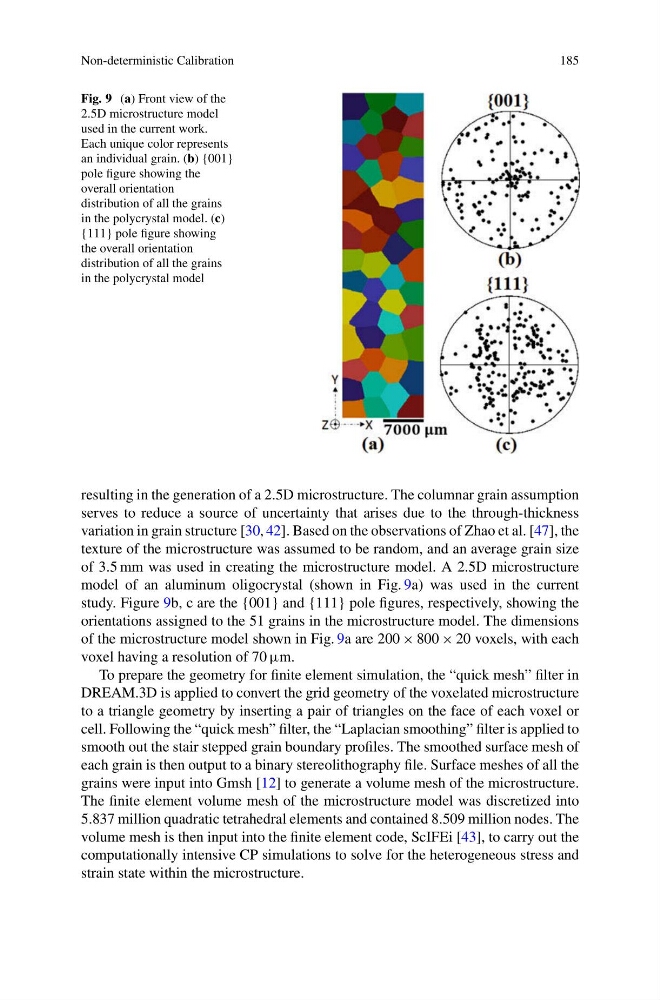
Fig. 9 (a) Front view of the
2.5D microstructure model
used in the current work.
Each unique color represents
an individual grain. (b) {001}
pole figure showing the
overall orientation
distribution of all the grains
in the polycrystal model. (c)
{111} pole figure showing
the overall orientation
distribution of all the grains
in the polycrystal model
resulting in the generation of a 2.5D microstructure. The columnar grain assumption
serves to reduce a source of uncertainty that arises due to the through-thickness
variation in grain structure [30, 42]. Based on the observations of Zhao et al. [47], the
texture of the microstructure was assumed to be random, and an average grain size
of 3.5 mm was used in creating the microstructure model. A 2.5D microstructure
model of an aluminum oligocrystal (shown in Fig. 9a) was used in the current
study. Figure 9b, c are the {001} and {111} pole figures, respectively, showing the
orientations assigned to the 51 grains in the microstructure model. The dimensions
of the microstructure model shown in Fig. 9a are 200 × 800 × 20 voxels, with each
voxel having a resolution of 70 μm.
To prepare the geometry for finite element simulation, the “quick mesh” filter in
DREAM.3D is applied to convert the grid geometry of the voxelated microstructure
to a triangle geometry by inserting a pair of triangles on the face of each voxel or
cell. Following the “quick mesh” filter, the “Laplacian smoothing” filter is applied to
smooth out the stair stepped grain boundary profiles. The smoothed surface mesh of
each grain is then output to a binary stereolithography file. Surface meshes of all the
grains were input into Gmsh [12] to generate a volume mesh of the microstructure.
The finite element volume mesh of the microstructure model was discretized into
5.837 million quadratic tetrahedral elements and contained 8.509 million nodes. The
volume mesh is then input into the finite element code, ScIFEi [43], to carry out the
computationally intensive CP simulations to solve for the heterogeneous stress and
strain state within the microstructure.
185
Fig. 9 (a) Front view of the
2.5D microstructure model
used in the current work.
Each unique color represents
an individual grain. (b) {001}
pole figure showing the
overall orientation
distribution of all the grains
in the polycrystal model. (c)
{111} pole figure showing
the overall orientation
distribution of all the grains
in the polycrystal model
resulting in the generation of a 2.5D microstructure. The columnar grain assumption
serves to reduce a source of uncertainty that arises due to the through-thickness
variation in grain structure [30, 42]. Based on the observations of Zhao et al. [47], the
texture of the microstructure was assumed to be random, and an average grain size
of 3.5 mm was used in creating the microstructure model. A 2.5D microstructure
model of an aluminum oligocrystal (shown in Fig. 9a) was used in the current
study. Figure 9b, c are the {001} and {111} pole figures, respectively, showing the
orientations assigned to the 51 grains in the microstructure model. The dimensions
of the microstructure model shown in Fig. 9a are 200 × 800 × 20 voxels, with each
voxel having a resolution of 70 μm.
To prepare the geometry for finite element simulation, the “quick mesh” filter in
DREAM.3D is applied to convert the grid geometry of the voxelated microstructure
to a triangle geometry by inserting a pair of triangles on the face of each voxel or
cell. Following the “quick mesh” filter, the “Laplacian smoothing” filter is applied to
smooth out the stair stepped grain boundary profiles. The smoothed surface mesh of
each grain is then output to a binary stereolithography file. Surface meshes of all the
grains were input into Gmsh [12] to generate a volume mesh of the microstructure.
The finite element volume mesh of the microstructure model was discretized into
5.837 million quadratic tetrahedral elements and contained 8.509 million nodes. The
volume mesh is then input into the finite element code, ScIFEi [43], to carry out the
computationally intensive CP simulations to solve for the heterogeneous stress and
strain state within the microstructure.