

Computational Micromechanics Modeling of Polycrystalline Superalloys. . .
149
softening and mean-stress relaxation with a relatively small number of parameters
in comparison with to macroscopic models [10–12, 45].
6.1 Crystal Plasticity Model for Cyclic Behavior
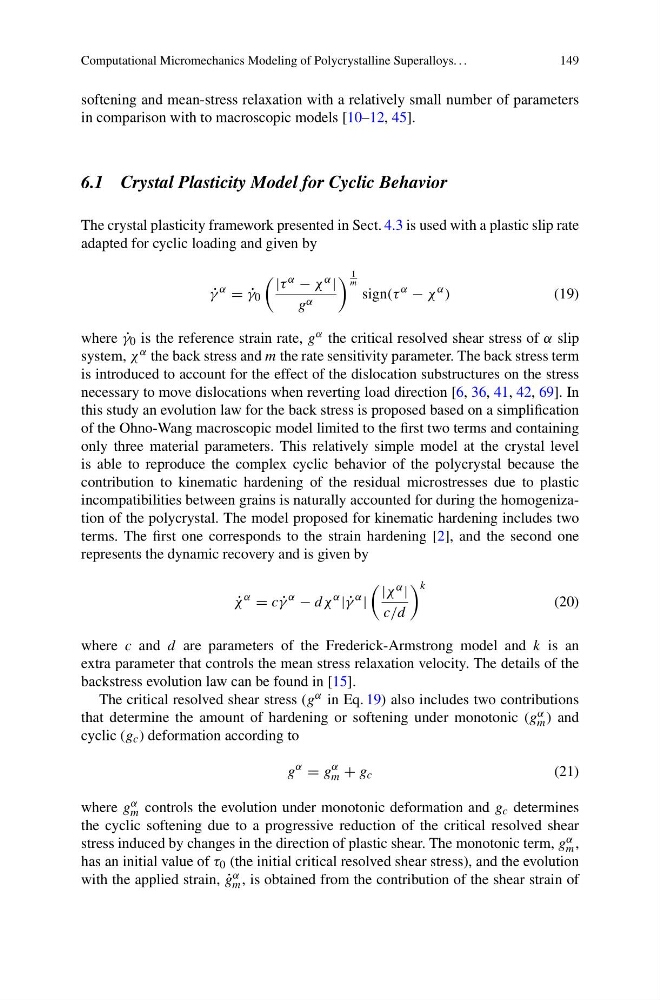
The crystal plasticity framework presented in Sect. 4.3 is used with a plastic slip rate
adapted for cyclic loading and given by
˙
γ
α
= ˙
γ 0
|τ α − χ α |
g α
1
m
sign(τ
α
− χ
α )
(19)
where ˙
γ 0 is the reference strain rate, g α the critical resolved shear stress of α slip
system, χ α the back stress and m the rate sensitivity parameter. The back stress term
is introduced to account for the effect of the dislocation substructures on the stress
necessary to move dislocations when reverting load direction [6, 36, 41, 42, 69]. In
this study an evolution law for the back stress is proposed based on a simplification
of the Ohno-Wang macroscopic model limited to the first two terms and containing
only three material parameters. This relatively simple model at the crystal level
is able to reproduce the complex cyclic behavior of the polycrystal because the
contribution to kinematic hardening of the residual microstresses due to plastic
incompatibilities between grains is naturally accounted for during the homogenization of the polycrystal. The model proposed for kinematic hardening includes two
terms. The first one corresponds to the strain hardening [2], and the second one
represents the dynamic recovery and is given by
˙
χ
α
= c ˙
γ
α
− dχ
α
| ˙
γ
α
|
|χ α |
c/d
k
(20)
where c and d are parameters of the Frederick-Armstrong model and k is an
extra parameter that controls the mean stress relaxation velocity. The details of the
backstress evolution law can be found in [15].
The critical resolved shear stress (g α in Eq. 19) also includes two contributions
that determine the amount of hardening or softening under monotonic (g α
m ) and
cyclic (g c ) deformation according to
g
α
= g
α
m + g c
(21)
where g α
m controls the evolution under monotonic deformation and g c determines
the cyclic softening due to a progressive reduction of the critical resolved shear
stress induced by changes in the direction of plastic shear. The monotonic term, g α
m ,
has an initial value of τ 0 (the initial critical resolved shear stress), and the evolution
with the applied strain, ˙
g α
m , is obtained from the contribution of the shear strain of
149
softening and mean-stress relaxation with a relatively small number of parameters
in comparison with to macroscopic models [10–12, 45].
6.1 Crystal Plasticity Model for Cyclic Behavior
The crystal plasticity framework presented in Sect. 4.3 is used with a plastic slip rate
adapted for cyclic loading and given by
˙
γ
α
= ˙
γ 0
|τ α − χ α |
g α
1
m
sign(τ
α
− χ
α )
(19)
where ˙
γ 0 is the reference strain rate, g α the critical resolved shear stress of α slip
system, χ α the back stress and m the rate sensitivity parameter. The back stress term
is introduced to account for the effect of the dislocation substructures on the stress
necessary to move dislocations when reverting load direction [6, 36, 41, 42, 69]. In
this study an evolution law for the back stress is proposed based on a simplification
of the Ohno-Wang macroscopic model limited to the first two terms and containing
only three material parameters. This relatively simple model at the crystal level
is able to reproduce the complex cyclic behavior of the polycrystal because the
contribution to kinematic hardening of the residual microstresses due to plastic
incompatibilities between grains is naturally accounted for during the homogenization of the polycrystal. The model proposed for kinematic hardening includes two
terms. The first one corresponds to the strain hardening [2], and the second one
represents the dynamic recovery and is given by
˙
χ
α
= c ˙
γ
α
− dχ
α
| ˙
γ
α
|
|χ α |
c/d
k
(20)
where c and d are parameters of the Frederick-Armstrong model and k is an
extra parameter that controls the mean stress relaxation velocity. The details of the
backstress evolution law can be found in [15].
The critical resolved shear stress (g α in Eq. 19) also includes two contributions
that determine the amount of hardening or softening under monotonic (g α
m ) and
cyclic (g c ) deformation according to
g
α
= g
α
m + g c
(21)
where g α
m controls the evolution under monotonic deformation and g c determines
the cyclic softening due to a progressive reduction of the critical resolved shear
stress induced by changes in the direction of plastic shear. The monotonic term, g α
m ,
has an initial value of τ 0 (the initial critical resolved shear stress), and the evolution
with the applied strain, ˙
g α
m , is obtained from the contribution of the shear strain of